Welcome back! In our previous lesson, we delved into the world of syncopation, learning how to shift rhythmic emphasis to create groove and forward momentum. The core concept was the "Principle of Constant Motion"—the idea that your strumming hand maintains a steady down-up flow, and rhythm is created by deciding which of these motions make contact with the strings.
Today, we will expand this rhythmic system by adding two powerful new tools: rests and muted strums. This lesson will teach you how to incorporate muted strums and rests into strumming patterns for rhythmic effect. If syncopation was about playing on the "wrong" beat, today is about introducing deliberate silence and percussive texture. From a system design perspective, you can think of your steady eighth-note hand motion as a constant data stream. Until now, you've used a binary operator: either strum (1) or don't (0). Today, we add a third state—the percussive mute—and formalize the concept of the "0" state as an intentional rhythmic choice called a rest.
The Power of Silence: Incorporating Rests
You've already been using rests without necessarily calling them that. Every time you performed a "stranded upstroke" or skipped a strum in a pattern, you created a moment of silence. In music, this intentional silence is called a rest. A rest has a specific rhythmic duration, just like a note.
The key to executing rests effectively on the guitar lies in the principle we've already mastered: keeping your strumming hand in constant motion. The rest isn't a pause where everything stops; it's simply a moment where your pick intentionally misses the strings while your arm continues its steady down-up trajectory.
Let's watch a video that brilliantly illustrates this concept. Instructor Justin Sandercoe explains how virtually all strumming patterns can be understood as selections from eight possible eighth-note strums within a bar. The un-selected strums are your rests.
Learn ANY Strumming Patterns with this Guitar Exercise
This video from JustinGuitar provides a powerful conceptual framework for understanding rests. It treats the constant eighth-note motion as a foundation from which any rhythm can be built by adding or subtracting strums.
First, watch the introduction from the beginning, where Justin establishes the eighth-note grid (one & two & three & four &) and emphasizes keeping your hand moving even when not strumming. Then, watch the next segment, from creating a pattern, where he demonstrates how to create a rhythm by omitting a strum (creating a rest) on beat three.
As you saw, the pattern was created by keeping the hand moving but simply avoiding contact on the downstroke of beat 3. This creates a quarter-note rest at that point in the music.
Let's formalize this.
Introducing Guitar Strumming Patterns and the Basics of Rhythm
This article provides clear, concise definitions for rests and explains how they are integrated into patterns.
First, read the section on Rests to understand their formal definition. Then, skip down to "Guitar strumming pattern 3" and read how a crotchet rest (a one-beat silence) makes a pattern effective. Finally, in "Guitar strumming pattern 4," notice the important distinction made: muting for a rest is about creating silence, which is different from other muting techniques we'll discuss.
Adding Percussion: The Muted Strum
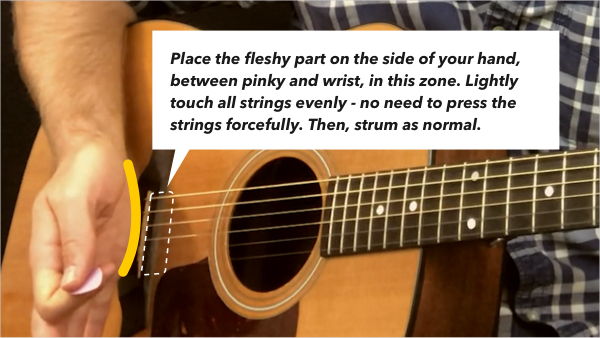
Now we'll add a new sound to our palette. A muted strum (often called a "slap," "chop," or "click") is not silence, but a percussive, non-pitched sound created by striking the strings while they are muted. This turns your guitar into a rhythm machine, allowing you to mimic the sound of a snare drum.
This is different from the muting for a rest that the previous article mentioned. There, the goal is silence. Here, the goal is a percussive sound. The technique involves a coordinated motion of your strumming hand where you "slap" the strings with your palm and strum with the pick in one fluid movement.
How To Get a Percussive Strum on Guitar
This video from Relax and Learn Guitar gives a fantastic, step-by-step breakdown of how to perform this "slap strum" technique.
Please watch the entire video carefully. The key stages are: Step 1: Mastering the deadened sound by muting with your palm. Step 2: Practicing the "slap" motion to get the click of strings against frets. Step 3: Combining the mute, slap, and pick strum into one motion. Integration: Incorporating the slap into basic strumming patterns on the backbeat (beats 2 and 4).
Reading Rhythmic Notation
As you learn more patterns, you'll see them written down in diagrams. It's useful to know the common symbols. Rests are typically shown as a slash (/) or just a blank space. Muted strums are almost always shown with an x.
56 Guitar Strumming Patterns for Beginners | Deviant Noise Blog
This article has a large library of patterns. For now, we just need to understand its notation legend.
Read the section How to Read the Diagrams. Pay close attention to the symbols for a Mute (x) and a Rest (/).
Practice Routine (~25 minutes)
Set your metronome to a slow tempo, around 60-70 BPM. Use a single chord like E minor or G major to begin.
-
Rest Isolation (5 minutes)
- Let's practice the pattern from the JustinGuitar video:
D U D U D U D Ubut with a rest on beat 3. - Pattern: Down, Up, Down, Up, (miss), Up, Down, Up
- Count: 1 & 2 & 3 & 4 &
- Strum:
D U D U / U D U - Your hand must move down on beat 3, but the pick should not touch the strings. This creates the rest. Focus on making the rhythm feel smooth and intentional, not accidental.
- Let's practice the pattern from the JustinGuitar video:
-
Muted Strum Isolation (10 minutes)
- Follow the practice advice from the "Relax and Learn Guitar" video.
- First, just practice the slap-strum motion itself, without a chord, until it feels somewhat natural.
(slap) (slap) (slap) (slap) - Next, apply it to the backbeat with quarter notes. Fret a G chord.
- Pattern: Down, Slap, Down, Slap
- Count: 1 2 3 4
- Finally, apply it to an eighth-note pattern.
- Pattern: Down, and, Slap, and, Down, and, Slap, and
- Strum:
D U Slap U D U Slap U - The slap happens on the downstroke of beats 2 and 4.
-
Pattern Integration: Rests and Mutes (10 minutes)
- Now let's combine these ideas into a more complex, funky pattern.
- We'll use a variation of the "Thinking Out Loud Pattern" from the Deviant Noise article.
- Pattern:
D / X U / / D / - Let's break that down by the eighth-note count:
| Count: | 1 | & | 2 | & | 3 | & | 4 | & |
| :--- | :-: | :-: | :-: | :-: | :-: | :-: | :-: |
| Strum: | D | | X | U | | | D | |
| Motion: | D | U | D | U | D | U | D | U | - Notice what's happening:
- Beat 1: Downstroke.
- Beat 2: A muted downstroke (Slap/
X). - Beat 3: A downstroke and an upstroke are both skipped (two rests).
- Beat 4: A downstroke, followed by a skipped upstroke.
- Try this very slowly. The challenge is keeping your hand moving
D U D U D U D Uwhile only making contact for theD,X,U, andDat the right times.
Conclusion
You have now significantly upgraded your rhythmic capabilities. You've moved beyond a binary system of strum/no-strum and have learned to treat silence (rests) and percussion (muted strums) as deliberate, expressive tools.
Key Takeaways:
- Rests are intentional silences, created by continuing your constant strumming motion while intentionally missing the strings.
- Muted Strums (or "slap" strums) are percussive, non-pitched sounds used to create a drum-like effect. This is a distinct technique that involves striking and muting the strings simultaneously with your strumming hand.
- By combining strums, rests, and mutes, you can construct an enormous variety of rhythmic patterns.
In our next lesson, we'll explore another essential muting technique: palm muting. While the slap strum is a sharp, percussive attack, palm muting is used to create a dampened, controlled sound, often sustained throughout a passage. You'll learn how the hand placement differs to achieve this distinct effect.