Hello! In our last session, we added percussive "slap" strums and intentional silence (rests) to our rhythmic toolkit. This gave us a way to create sharp, drum-like accents. Today, we'll explore a different, more subtle, but equally powerful muting technique.
This lesson focuses on how to apply palm muting to create a percussive, dampened sound. Unlike the abrupt "slap" which creates a sound and immediately stops, palm muting is about controlling the sustain of the notes as you play them. From a signal processing perspective, if the slap was about creating a sharp transient, palm muting is about shaping the decay envelope of your sound. It allows you to transform ringing chords into tight, focused rhythmic pulses, adding a layer of dynamic control that is fundamental to countless styles of music.
1. What is Palm Muting and Why Use It?
First, let's distinguish palm muting from the techniques you already know.
- Rests: Intentional silence where the pick doesn't strike the strings.
- Slap Mute: A sharp, percussive attack created by striking and muting the strings simultaneously. The sound is short and non-pitched.
- Palm Mute: A continuous dampening technique where the side of your picking hand rests on the strings near the bridge. The goal is to shorten the note's sustain while still allowing its pitch to be clearly heard. The result is a "chunkier," more controlled sound.
Palm muting is effective because it gives you precise control over rhythm and tone. It's the key to making a simple chord progression feel more driving and intricate.
How to Palm Mute on Guitar for Perfect Rock and Metal Tone - TrueFire
This article from TrueFire, while geared toward electric guitar, provides an excellent explanation of the core purpose of palm muting. The principles of rhythmic precision and tonal control are universal.
Read the introduction, from the start down to the quote. Focus on the three key benefits listed: Rhythmic Precision, Tonal Control, and Added Aggression (which on an acoustic guitar translates to a more percussive "thump").
2. The Mechanics: Finding the Sweet Spot
The entire technique hinges on precise hand placement. This is a game of millimeters. Too far forward, and you'll choke the note into a dead "thud." Too far back, and the note will ring out as if unmuted. Your goal is to find the "sweet spot."
The part of your hand that does the work is the fleshy "karate-chop" area on the side of your palm, below the pinky. You'll rest this part of your hand gently across the strings, right on or just in front of the bridge saddle (the white strip where the strings rest).
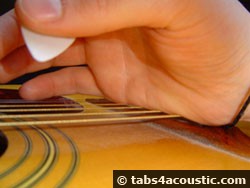
Watching this in action is the best way to understand the process of finding this sweet spot. The following video gives a fantastic demonstration.
THE SECRET to Palm Muting + 4 COOL STRUMMING PATTERNS
In this video, instructor Lauren Bateman provides a clear, step-by-step method for finding the palm muting sweet spot on an acoustic guitar by sliding the hand.
Watch from the beginning of her demonstration. Notice how she starts with her hand too far forward (creating a dead sound) and slowly slides it back toward the bridge. Listen for the moment the sound "opens up" and you can hear both the note's pitch and the percussive attack. Pay attention to the close-up view to see the exact position.
To solidify this, let's get another perspective. This next video also walks through the process and emphasizes the importance of even pressure across the strings.
TMT #11: How to Palm Mute on the Guitar
This video from the channel for3v3rfaithful offers another excellent walkthrough, reinforcing the concepts of hand placement and pressure.
Watch from the beginning to the main demonstration. The instructor clearly explains which part of the hand to use and how to experiment by moving your hand to find the spot where the strings sound "dampened but not completely dead."
Once you find the spot, the next variable to control is pressure. Palm muting isn't just on or off; it's a spectrum.
How to Palm Mute on Guitar for Perfect Rock and Metal Tone - TrueFire
This article provides a fantastic analytical breakdown of hand placement and pressure control.
First, read the section Mastering Your Hand Placement. This reinforces what you saw in the videos and includes an excellent troubleshooting table to help you debug common issues. Then, read the next section, Controlling Pressure, to understand the difference between a light mute and a heavy mute.
3. Practice Routine (~30 minutes)
As with any new physical skill, building muscle memory through deliberate practice is key. Use a metronome set to a slow tempo (around 60-70 BPM).
1. Finding Your Sweet Spot (5 minutes)
- Don't even worry about chords yet. Just use the open low E string (the thickest one).
- Follow the process from the videos:
- Place your palm too far forward, over the soundhole. Strum downstrokes and hear the dead "thud."
- Slowly slide your hand back toward the bridge, strumming continuously.
- Listen for the point where the pitch becomes clear but the sustain is short and punchy.
- Keep sliding back until the note rings out fully.
- Now, move your hand back and forth within that small zone to internalize where the sweet spot is on your guitar.
2. Basic Muted Strumming (10 minutes)
- Stay on your sweet spot and keep the metronome on. Fret an E minor chord, which is easy to hold.
- Downstrokes only: Play one palm-muted downstroke on every click for one minute. Focus on consistency. Every strum should have the same tone and volume.
- Adding Upstrokes: Now, play steady eighth notes (
Down-Up, Down-Up). Strum down on the click and up on the "&".- Count: 1 & 2 & 3 & 4 &
- Strum:
D U D U D U D U - The challenge is to keep the muting consistent on both the downstroke and the upstroke. Your hand must remain in contact with the strings throughout the motion.
3. Dynamic Control (10 minutes)
- This exercise, based on the TrueFire article, helps you master pressure control. Stay on the E minor chord.
- The Pressure Scale:
- For 4 beats, play the chord with open, ringing strums (no palm mute).
- For the next 4 beats, apply a light mute (just barely touching the strings).
- For the next 4 beats, apply a medium mute.
- For the next 4 beats, apply a heavy mute (firm pressure for a very tight, percussive sound).
- Work your way back down: heavy -> medium -> light -> open.
- Repeat this cycle for several minutes. This builds a direct connection between the pressure you feel and the sound you produce.
4. Alternating Muted and Open (5 minutes)
- Let's practice switching between muted and open sounds, a very common application.
- We'll mute on beats 2 and 4, like a snare drum.
- Count: 1 & 2 & 3 & 4 &
- Strum:
D U D U D U D U - Technique: Play beats 1 and 3 open, then press your palm onto the bridge for beats 2 and 4. This requires a small, quick "rocking" motion of your hand.
4. Common Mistakes to Avoid
As you practice, you might run into a few common issues. Knowing what they are makes them easier to solve. Think of this as a debugging guide for your technique.
How to Palm Mute on Guitar for Perfect Rock and Metal Tone - TrueFire
This resource is excellent for self-correction.
Read the section Common Mistakes. Pay close attention to the descriptions of: The "Over-Mute" or Note Choke: The most common problem, caused by your hand being too far from the bridge. Inconsistent Pressure and Tone: Happens when your hand angle isn't right for crossing strings. Locking Down Your Picking Hand: A bad habit that kills speed and mobility. Your hand should be relaxed.
Conclusion
Today you've learned a technique that adds a new dimension of control to your playing. Palm muting is a fundamental skill for shaping the rhythmic character and texture of your guitar parts.
Key Takeaways:
- Palm muting is a technique for dampening sustain, not eliminating the note entirely.
- The sound is controlled by two main parameters: hand position (finding the sweet spot near the bridge) and downward pressure (from light to heavy).
- Mastery comes from practicing with a metronome to build consistency and control in transitioning between muted and open sounds.
This lesson concludes our module on expanding your rhythmic vocabulary. You now have a powerful set of tools—eighth notes, syncopation, rests, slap mutes, and palm mutes—to create dynamic and engaging strumming patterns.
In our next module, we will shift our focus from rhythm to the melodic and harmonic "source code" of music. We'll begin by exploring musical intervals, the fundamental building blocks of both melodies and chords. This will be our first major step into the deep music theory you're eager to learn.