Welcome to your fifth lesson. In our previous session, we explored the strategic principles of defense-in-depth and least privilege, which govern how we design secure systems. You learned that granting minimal necessary permissions is key to limiting the damage of a potential breach. Today, we will examine the technical framework that brings these principles to life.
This lesson focuses on distinguishing between Authentication, Authorization, and Accounting, commonly known as the AAA framework. For an aspiring SOC Analyst, understanding AAA is non-negotiable. These three functions are the foundation of access control, and the logs they generate—especially from authentication and accounting—will be the primary data you analyze to detect and investigate security incidents.
From Security Goals to Access Management
Before diving into the "three A's," let's connect them to the core security goals we discussed in our first lesson. The CIA triad (Confidentiality, Integrity, Availability) defines what we aim to protect. The AAA framework provides the mechanism for how we enforce that protection.

As the diagram shows, AAA is about enforcement:
- Authentication enforces security by verifying user identities.
- Authorization enforces it by controlling permissions.
- Accounting enforces it by logging activity for auditing and analysis.
Let's begin with a clear, high-level overview of this entire process from Professor Messer.
Authentication, Authorization, and Accounting - CompTIA Security+ SY0-701 - 1.2
This video, "Authentication, Authorization, and Accounting," provides a concise introduction to the AAA framework.
Watch the first part of the video, which defines the AAA process. Pay close attention to how he separates identification, authentication, authorization, and accounting into distinct steps.
Now, let's break down each component in detail.
1. Authentication: "Who are you?"
Authentication is the process of verifying a claimed identity. When a user presents credentials, the system checks them against a database to prove they are who they say they are. This is the first gate in any secure access process.
For a comprehensive definition and examples of different authentication methods, please read the following sections from an article by CrowdSec.
This article breaks down each component of the AAA framework with modern examples.
Start by reading the section titled "Authentication". Note the different types of methods described, such as passwords, biometrics, and Multi-Factor Authentication (MFA).
As you read, it's important to realize that authentication isn't just for human users. Devices, services, and applications also need to be authenticated to ensure that only legitimate components are communicating on your network.
2. Authorization: "What are you allowed to do?"
Once a user's identity is authenticated, the system must determine their permissions. Authorization is the process of granting or denying specific permissions to an authenticated user based on their role or identity. This is where the Principle of Least Privilege is directly implemented.
An authenticated user does not automatically get access to everything. Authorization ensures they only have access to the resources required for their job.
The following text from the Cisco Community provides an excellent, practical example of authorization.
What is AAA Authentication, Authorization, and Accounting?
This blog post from the Cisco Community offers clear, networking-focused definitions of the AAA components.
Read the short section on "Authorization". The example of the junior network engineer with restricted command access is a perfect illustration of authorization in a technical environment.
At a small scale, you could assign permissions to users individually. However, this quickly becomes unmanageable. In any real-world environment, authorization is handled through groups and roles, a concept known as Role-Based Access Control (RBAC).
Professor Messer provides a powerful visual explanation of why this group-based approach is essential for scalability.
Authentication, Authorization, and Accounting - CompTIA Security+ SY0-701 - 1.2
Let's return to Professor Messer's video to see how authorization is managed in a large organization.
Watch the section from "to be able to scale". He demonstrates how assigning users to a "Shipping and Receiving" group is far more efficient than managing permissions for each individual user and resource. This is a crucial concept for implementing least privilege effectively.
3. Accounting: "What did you do?"
Accounting is the process of logging and tracking user actions. It answers the "what, when, and where" of a user's session. This function creates an audit trail that is indispensable for security analysis, troubleshooting, and compliance.
For a SOC Analyst, accounting logs are the lifeblood of an investigation. They provide the evidence needed to reconstruct an attacker's steps, identify a policy violation, or simply understand normal system behavior.
Let's go back to the CrowdSec article for a clear definition of accounting.
Please read the section on "Accounting". Notice the types of information collected, such as session times, actions performed, and resources used.
The "Learn with Cisco" video provides another excellent way to think about this third 'A'—as auditing.
Authentication, Authorization, and Accounting (AAA) with Cisco Modeling Labs
This video from the "Learn with Cisco" channel features a principal engineer giving a conversational but precise explanation of the AAA services.
Watch the segment where the host explains the "third A". Framing accounting as the creation of an audit log reinforces its importance for security monitoring.
The AAA Process in Action
Now let's see how these three distinct services work together in a typical network interaction. The following diagram shows a user trying to access a Cisco router that uses a central AAA server for access control.
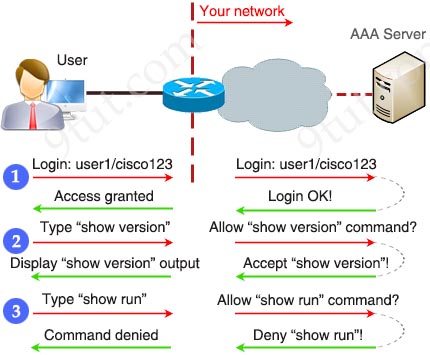
Let's trace the steps:
- Authentication: The user provides credentials (
user1/cisco123) to the router. The router forwards this to the AAA server, which verifies the credentials and sends back a "Login OK!" message. The user is now authenticated. - Authorization: The user types a command (
show version). The router asks the AAA server, "Allow 'show version' command?". The server, knowing the user's role, approves the request. The user is authorized to run this command. - Authorization (Denial): The user then types a more sensitive command (
show run). The router again asks the AAA server for permission. This time, the server denies the request based on the user's privileges. The command is denied. - Accounting (Implied): Throughout this entire session, every action—the successful login, the allowed command, the denied command—is sent to the AAA server to be logged. This creates the audit trail.
This simple flow perfectly illustrates the separation of concerns: proving who you are (Authentication), checking what you can do (Authorization), and recording what you did (Accounting).
Conclusion
In this lesson, you have dissected the AAA framework and seen how its three components work in concert to enforce access control policies. Understanding this distinction is fundamental to nearly all aspects of operational security.
Here are the key takeaways:
- Authentication is the process of verifying a user's identity. It asks, "Who are you?".
- Authorization is the process of granting or denying permissions based on that verified identity. It asks, "What are you allowed to do?".
- Accounting is the process of logging user activity for auditing and security analysis. It records, "What did you do?".
- The AAA framework is the practical implementation of access control principles like the Principle of Least Privilege, often using Role-Based Access Control (RBAC) for scalable management.
What's Next?
We've now established a solid foundation for understanding security goals (CIA), security strategies (DiD, POLP), and the access control framework that enforces them (AAA). We understand the "good guys" and the rules they follow. In the next lesson, we will shift our focus to the adversaries. We will explore the world of threat actors, classifying them by their motivations, capabilities, and the common tactics they employ to bypass the very controls we've been discussing.