Welcome to your fourth lesson. In our last session, we categorized security controls by their function—preventive, detective, corrective, and compensating. This gave us a vocabulary for the individual tools in our security arsenal. Now, we will explore the strategic principles that govern how we deploy these tools.
This lesson focuses on two of the most fundamental principles in cybersecurity architecture: defense-in-depth and the principle of least privilege. As an aspiring SOC Analyst, you will see these principles in action every day. Defense-in-depth is the reason an attacker might trigger multiple alarms from different systems, and the principle of least privilege often determines whether a compromised user account leads to a minor incident or a catastrophic breach.
Principle 1: Defense-in-Depth (DiD)
The core idea of defense-in-depth is simple but powerful: no single security control is perfect. Therefore, we should never rely on just one. Instead, we build a layered defense, where multiple, overlapping security controls work together to protect our assets. If one layer fails or is bypassed by an attacker, another layer is there to stop them.
This concept has existed for centuries. A medieval castle is a classic example of physical defense-in-depth: it has a moat, a drawbridge, high walls, lookout towers, and guards. Each layer presents a new obstacle.
To see how this historical concept translates directly to modern IT, we'll start with a video from IBM Technology that illustrates the principle brilliantly.
Cybersecurity Architecture: Five Principles to Follow (and One to Avoid)
This video, "Cybersecurity Architecture," begins by explaining defense-in-depth using the castle analogy and then maps it to a typical IT environment.
Please watch the first section of the video, focusing on the explanation of "defense in depth". Pay close attention to how different controls like multifactor authentication (MFA), firewalls, and encryption are applied at different points to create a system with no single point of failure.
The Layers of a Modern Defense
As you saw in the video, a modern IT environment has many layers that need protection. We can visualize these layers to better understand where different types of controls fit.
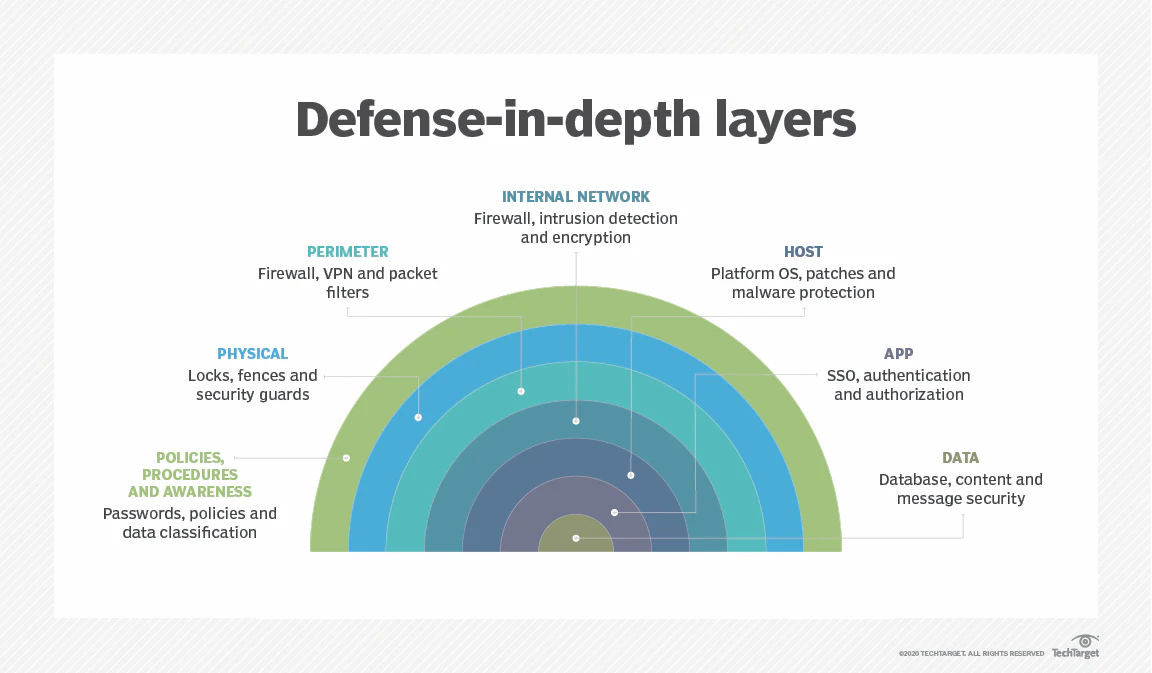
Let's break down these layers and think about the controls we might place at each one, using the classifications you learned in the previous lesson:
- Physical: (Preventive) Locks, fences, security guards.
- Perimeter: (Preventive/Detective) Firewalls and VPNs to control traffic entering and leaving the network.
- Internal Network: (Preventive/Detective) Intrusion Detection/Prevention Systems (IDS/IPS) to monitor for malicious activity inside the network, and segmentation (like VLANs) to prevent an attacker from moving freely.
- Host: (Preventive/Detective/Corrective) Anti-malware software, endpoint detection and response (EDR) agents, and patch management to secure individual servers and workstations.
- Application: (Preventive) Secure coding practices, authentication, and authorization to control who can use an application and what they can do.
- Data: (Preventive/Detective) Encryption to make data unreadable if stolen, and data loss prevention (DLP) systems to monitor for unauthorized exfiltration.
- Policies, Procedures, and Awareness: (Administrative) This layer surrounds all others. It includes security policies, incident response plans, and user training.
To explore more examples of layered controls, let's watch a video from Professor Messer.
Defense in Depth - N10-008 CompTIA Network+ : 4.1
This video, titled "Defense in Depth," provides a wealth of examples of different controls and how they work together.
Watch the first part of the video, from the beginning to the end of the initial overview. Notice how he explicitly mentions physical, technical, and administrative controls and emphasizes that you wouldn't replace one with another, but rather use them all together.
To solidify your understanding of the strategy and its relevance in today's world of cloud computing and remote work, please read the following guide from CrowdStrike.
Defense in Depth [Beginner's Guide]
This article provides a comprehensive overview of the defense-in-depth strategy, explaining why it's necessary and how it's implemented.
Read the article from the beginning to the end. Pay special attention to the sections "Why defense in depth Is necessary", which discusses modern challenges, and "Focal areas of the defense in depth strategy", which connects the strategy back to prevention, detection, and response.
Principle 2: Principle of Least Privilege (POLP)
The second foundational principle, the Principle of Least Privilege (POLP), dictates that a user, program, or system should only be given the bare minimum permissions necessary to perform its function. We operate on a "need-to-know" basis, not a "nice-to-have" one.
The goal of POLP is to limit the "blast radius" of a security incident. If an attacker compromises a user account, we want that account to have as few permissions as possible, restricting the attacker's ability to access sensitive data or move to other systems.
Here is a simple, real-world example of POLP in action:

Implementing Least Privilege
Applying POLP involves more than just setting initial permissions. It's an ongoing process of management and review. Let's return to the IBM video, which does an excellent job explaining the key aspects of implementing this principle.
Cybersecurity Architecture: Five Principles to Follow (and One to Avoid)
The video now moves on to the principle of least privilege.
Please watch the section covering the principle of least privilege. Focus on three key concepts he discusses: Granting access: Only what is needed, and only for as long as it's needed. System hardening: Reducing the attack surface by removing unnecessary services and default configurations. Privilege creep: The dangerous accumulation of permissions over time.
The Danger of Privilege Creep
The video introduced a critical real-world problem: privilege creep. This happens when employees change roles within an organization. They gain new permissions for their new job, but their old permissions are often never revoked. Over time, some user accounts accumulate a dangerous level of access that far exceeds what they actually need. A SOC analyst might investigate an alert and discover that an account from the marketing department inexplicably has administrative access to a financial server—this is often the result of unmanaged privilege creep.
The key to combating this is regular auditing and recertification, where managers must review and re-approve the permissions held by their team members.
The following article from CrowdStrike provides a deeper dive into implementing POLP and avoiding its pitfalls.
What is Principle of Least Privilege (POLP)?
This guide offers a detailed look at POLP, including practical implementation steps and its benefits.
Please read the article, focusing on these sections: The definition of POLP. The descriptions of Superuser, Least-privileged user (LPU), and Guest accounts. The section on "What Is Privilege Creep?" for a clear definition of this risk. The list of implementation methods under "How to Implement Least Privilege".
Conclusion
In this lesson, we've moved from individual controls to the overarching strategies that guide their use. You've learned how defense-in-depth and the principle of least privilege form the bedrock of a strong security posture.
Here are the key takeaways:
- Defense-in-Depth (DiD): A strategy of layering multiple, diverse security controls to ensure there is no single point of failure. If one control is bypassed, another is in place to stop an attack.
- Principle of Least Privilege (POLP): The practice of granting only the minimum necessary permissions to users and systems. This limits the potential damage from a compromised account or application.
- Privilege Creep: The gradual accumulation of excessive permissions over time, which undermines POLP and must be managed through regular audits.
These two principles are not separate; they are intertwined. A defense-in-depth strategy is made exponentially stronger when the principle of least privilege is applied at every single layer.
What's Next?
We've established the importance of controlling what users and systems can do. In our next lesson, we will delve into the technical framework that manages this: Authentication, Authorization, and Accounting (AAA). We will explore how systems verify who you are (Authentication), determine what you're allowed to do (Authorization), and log what you did (Accounting), which are the core functions that enable the principle of least privilege.