안녕하세요! Welcome to your very first Korean lesson. I'm excited to guide you on your journey to learning the Korean language.
This course is designed to take you from the very beginning to a level where you can have conversations and enjoy Korean media. We'll start with the absolute foundation: the Korean alphabet, known as Hangul (한글).
Today's lesson focuses on the first part of the alphabet. Your goal is to identify and pronounce the 10 basic Korean vowels and 11 complex vowels (diphthongs). Think of these as the fundamental building blocks. Just as you need to understand nucleotides to read a DNA sequence, you need to know these vowels to read Korean.
A Quick Note on Hangul
Before we dive in, it's worth noting that Hangul is widely praised for its scientific and systematic design. The shapes of the letters were designed to mimic the shape of the mouth when making the sound. This logical structure often appeals to learners with a background in technical or scientific fields.
A crucial rule to learn from the start is that Korean is written in syllable blocks. You can't write a vowel by itself; it must be paired with a consonant. When a syllable starts with a vowel sound, we use a special silent consonant, ㅇ, as a placeholder. For example, the vowel 'a' is written as 아. The 'ㅇ' here has no sound.
Let's begin with the 10 basic vowels.
Part 1: The 10 Basic Vowels
The basic vowels are all formed from simple horizontal and vertical lines. We'll learn their shapes and sounds.
To start, let's get a feel for the sounds and how to write them. This first video provides a great overview.
Learn Hangeul 한글 (Korean Alphabet) in 30 minutes
Watch this segment from 'Learn Hangeul (Korean Alphabet) in 30 minutes' by Korean with Miss Vicky. It introduces all 10 basic vowels, their sounds, and the correct stroke order.
Watch from the timestamp 06:37 to 11:12. Pay close attention to the distinction between vowels placed next to a consonant (like ㅏ) and those placed under a consonant (like ㅗ).
Now that you've heard the vowels, let's solidify your memory with some useful learning aids. The following text uses mnemonics to help you associate the vowel shapes with their sounds.
Korean Alphabet - Learn the Hangul Letters and Character Sounds
This article from 90 Day Korean, 'Korean Alphabet - Learn the Hangul Letters and Character Sounds', offers clever ways to remember the basic vowels.
Read the section titled 'Korean Vowels'. Focus on the subsections 'The 4 Core vowels', 'How to Remember the Korean Vowel Sounds' (which explains the 'Old Father, New Son' mnemonic), 'Adding a Y sound', and 'The Final Two Vowels'. This will give you a system for remembering them.
To summarize, here are the 10 basic vowels. Practice saying them out loud.
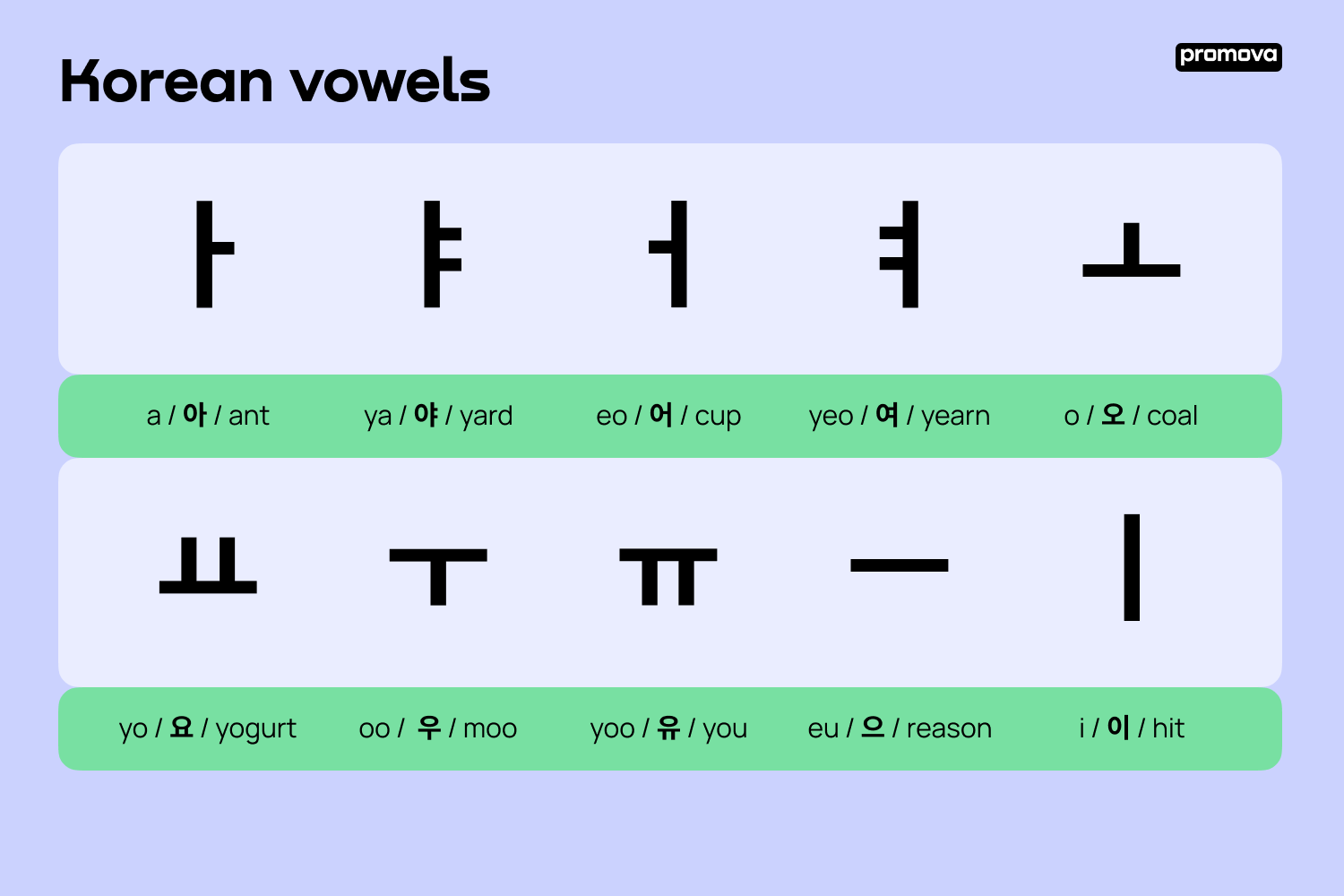
| Hangul (with ㅇ) | Romanization | Approximate Sound (like the vowel in...) |
|---|---|---|
| 아 | a | father |
| 야 | ya | yacht |
| 어 | eo | son, thought |
| 여 | yeo | yummy |
| 오 | o | old, go |
| 요 | yo | yogurt |
| 우 | u | new, goose |
| 유 | yu | you |
| 으 | eu | brook (a sound made with lips unrounded) |
| 이 | i | tree |
Key Observations:
- Adding a second short stroke to ㅏ, ㅓ, ㅗ, and ㅜ adds a 'y' sound. (e.g., ㅏ [a] -> ㅑ [ya]).
- Vowels like 아, 야, 어, 여, 이 are "tall" and are written to the right of the initial consonant.
- Vowels like 오, 요, 우, 유, 으 are "short" and are written below the initial consonant.
Part 2: The 11 Diphthongs (Complex Vowels)
The remaining 11 vowels are called diphthongs or complex vowels. The good news is that you don't need to memorize 11 completely new sounds. Each one is a combination of the basic vowels you've just learned.
This next video explains this concept very clearly. It shows you how to think of diphthongs as logical constructions.
How to Memorize 21 Korean Hangul Vowels EASILY?! (Hangul Lessons #2)
In 'How to Memorize 21 Korean Hangul Vowels EASILY?!', Hailey explains how complex vowels are built from simple ones. This is a very efficient way to learn them.
Watch from 01:37 to 04:50. Notice how she combines basic vowels like '아' and '이' to create the complex vowel '애'. This will help you understand the system, rather than just memorizing shapes.
Now that you understand the logic, let's get more practice with the pronunciation of each diphthong.
Learn Hangeul 한글 (Korean Alphabet) in 30 minutes
Let's return to Miss Vicky's video to hear the 11 diphthongs pronounced clearly and see how they are written.
Watch the segment from 17:00 to 22:04. Pay attention to her note that some of these vowels have identical or very similar sounds in modern Korean.
As mentioned in the video, some of these sounds have merged in modern spoken Korean. This is a key point to remember!
- 애 (ae) and 에 (e) are pronounced identically by most speakers today. The sound is like the 'e' in "neck".
- 왜 (wae), 외 (oe), and 웨 (we) are also pronounced identically by most people, like the word "way".
Here is a summary table of the diphthongs. Notice how they are formed from the basic vowels.
| Hangul | Combination | Romanization | Approximate Sound (like the vowel in...) |
|---|---|---|---|
| 애 | ㅏ + ㅣ | ae | egg, neck |
| 얘 | ㅑ + ㅣ | yae | yes |
| 에 | ㅓ + ㅣ | e | egg, neck (sounds like 애) |
| 예 | ㅕ + ㅣ | ye | yes (sounds like 얘 in most cases) |
| 와 | ㅗ + ㅏ | wa | waffle |
| 왜 | ㅗ + ㅐ | wae | wedding, way |
| 외 | ㅗ + ㅣ | oe | wedding, way (sounds like 왜) |
| 워 | ㅜ + ㅓ | wo | won |
| 웨 | ㅜ + ㅔ | we | wedding, way (sounds like 왜) |
| 위 | ㅜ + ㅣ | wi | week |
| 의 | ㅡ + ㅣ | ui | A tricky gliding sound from 으 to 이 |
Practice Time
Let's test your recognition. Try to name the sound for each vowel before revealing the answer.
- 아 -> (a)
- 위 -> (wi)
- 요 -> (yo)
- 에 -> (e)
- 어 -> (eo)
- 왜 -> (wae)
- 유 -> (yu)
Practice writing each of the 21 vowels. Remember the stroke order rule: top to bottom, left to right. A good way to practice is to write them while saying the sound out loud. Try to do this for 10-15 minutes to build muscle memory.
For a complete overview of all the letters we'll be covering, you can refer to this chart. Today, we focused on the "Vowels" and "Diphthongs" sections.

Conclusion
Congratulations on completing your first lesson! You've taken a crucial step towards reading and writing Korean.
Here are the key takeaways:
- There are 10 basic vowels in Hangul, built from simple vertical and horizontal lines.
- There are 11 complex vowels (diphthongs), which are combinations of the basic vowels.
- A silent consonant, ㅇ, is used as a placeholder when a syllable begins with a vowel sound.
- In modern Korean, some diphthongs like 애/에 and 왜/외/웨 have the same pronunciation.
In our next lesson, we will learn the 14 basic consonants and 5 double consonants. Once you've mastered those, you will have all the tools you need to combine them with the vowels you learned today to read and write your first Korean syllable blocks. Keep practicing