안녕하세요! Welcome to our third lesson.
In our first two lessons, you successfully learned all the individual building blocks of the Korean alphabet: the vowels and the consonants. You now have the complete set of Hangul letters. This is a fantastic achievement!
Today, we move from knowing the letters to actually using them. Our goal is to combine consonants and vowels to form and read basic syllable blocks. Unlike English, where letters are simply written in a line, Korean characters are assembled into neat, square-like blocks. This lesson will teach you the rules for that assembly process, which is the key to reading Korean.
1. The Concept of Syllable Blocks
The first thing to understand is that Hangul is a syllabic alphabet. This means that instead of writing letters one after another in a long string, they are grouped into blocks, where each block represents one syllable.
To get a clear idea of this fundamental principle, let's start with a reading and a short video.
Learn Hangul: A Guide to the Korean Alphabet (With Audio!)
The following article, 'Learn Hangul: A Guide to the Korean Alphabet' from the Migaku blog, explains how Korean's block system works. It contrasts it with how we write in English.
Please read the section titled '2. How Hangul work, or how 24 symbols make 11,172 unique sounds'. Focus on the example of how 'Hangul' is written in English vs. Korean to understand the concept of 'blocks'.
Now, let's see this concept visualized.
[Hangeul Lesson] Anyone can learn to read and write in Korean!
This video from 'Talk To Me In Korean' will help you visualize what these 'square blocks' look like and introduces the basic idea of how they are formed.
Watch from 03:34 to 05:30. The speaker explains how different letters are arranged to fit into a boxy shape. You don't need to read the letters yet, just observe the structure.
The key idea is that every syllable block is a self-contained unit. This structure might feel new, but it's highly systematic.
2. The Rules of Assembly
So, how do you combine the letters you've learned into these blocks? There are two simple but essential rules that depend on the shape of the vowel.
Let's read about these rules first.
Korean Writing - Learn to form words through syllable blocks
This article, 'Korean Writing - Learn to form words through syllable blocks' from 90daykorean.com, clearly explains the rules for block formation. It's a great reference for the core mechanics of writing Hangul.
Please read the sections 'Start With a Consonant' and 'Consider the Vowel Placement'. Pay close attention to the distinction between 'Vertical Vowels' and 'Horizontal Vowels' and how this changes the block structure.
To summarize the rules you just read:
-
Rule for Vertical Vowels (ㅏ, ㅑ, ㅓ, ㅕ, ㅣ, etc.)
- The consonant is placed on the left.
- The vowel is placed on the right.
- Example: ㄴ + ㅏ = 나 (na)
-
Rule for Horizontal Vowels (ㅗ, ㅛ, ㅜ, ㅠ, ㅡ, etc.)
- The consonant is placed on top.
- The vowel is placed on the bottom.
- Example: ㄴ + ㅗ = 노 (no)
And remember the crucial rule from our first lesson: a syllable block can't start with a vowel sound on its own. It must begin with a consonant. If the sound starts with a vowel, we use the silent placeholder consonant ㅇ (ieung).
- Example: ㅇ + ㅏ = 아 (a)
- Example: ㅇ + ㅗ = 오 (o)
Here is a helpful visual summary of these construction rules.

Now, let's watch someone build these blocks. Seeing it done dynamically can help solidify the rules.
How to make WORD with Consonant and Vowel (Hangul class #3)
In this video, Hailey_Your Korean Friend demonstrates how to combine consonants and vowels to make words.
Please watch two segments: From 00:52 to 01:32, where she shows basic combinations. From 02:43 to 04:36, which provides more detailed examples. Try to read the syllables along with her. Notice how she places the vowels either to the right of or below the consonants.
3. Reading and Writing Practice
You now know the rules. The best way to master them is through practice. Let's apply what you've learned to read some basic syllables.
We'll use the practice chart from the 90daykorean.com article you looked at earlier. This chart is a classic tool used to teach Korean children how to read. It combines each consonant with the 10 basic vowels.
Korean Writing - Learn to form words through syllable blocks
Let's return to the 'Korean Writing' article. This time, we'll focus on the practice charts.
Find the section 'Korean Writing Practice with Syllable Blocks'. Look at the large table that starts with 'Initial Consonant' and 'Syllables'. Try reading the first four rows out loud: the ones for ㄱ, ㄴ, ㄷ, and ㄹ. For example, the first row is read 'ga, gya, geo, gyeo, go, gyo, gu, gyu, geu, gi'.
This exercise is incredibly effective for building reading speed and accuracy.
Now, let's try reading a few simple, real one-syllable words. These words are formed with just one consonant and one vowel.
| Hangeul | Breakdown | Romanization | English |
|---|---|---|---|
| 가 | ㄱ (g) + ㅏ (a) | ga | go |
| 비 | ㅂ (b) + ㅣ (i) | bi | rain |
| 오 | ㅇ (silent) + ㅗ (o) | o | five |
| 개 | ㄱ (g) + ㅐ (ae) | gae | dog |
| 너 | ㄴ (n) + ㅓ (eo) | neo | you |
Take a moment to sound these out, applying the rules you've learned. Notice how the structure of 가 (left-right) differs from 오 (top-bottom).
4. A Glimpse of More Complex Blocks
The blocks we've focused on today have two letters: one consonant and one vowel (CV). However, syllable blocks can also have a third (and sometimes even a fourth) letter. This final consonant is called 받침 (batchim), which literally means "support" because it sits at the bottom of the block.
You don't need to master this today, but it's important to know that these structures exist.
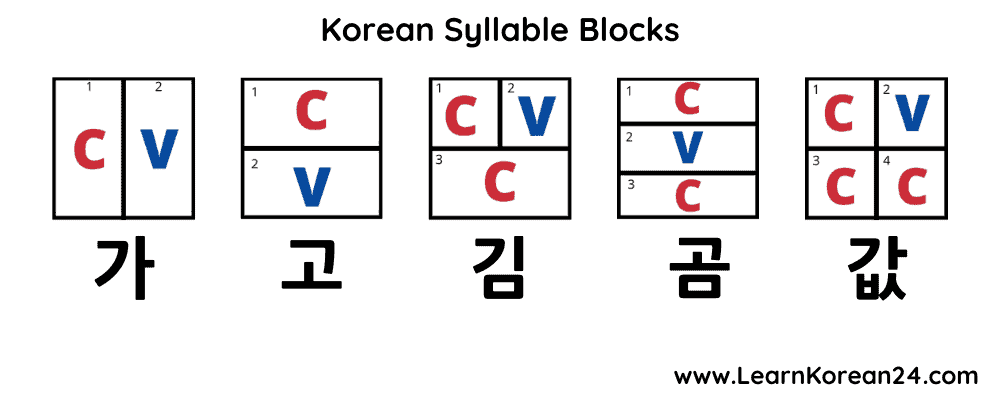
For example, the word for "eye" or "snow" is 눈 (nun).
- It's built from ㄴ (n) + ㅜ (u) + ㄴ (n).
- The first ㄴ and the vowel ㅜ form a top-bottom block, and the final ㄴ is placed at the very bottom as the batchim.
This is what we will be covering in detail in our very next lesson.
Conclusion
Excellent work today! You've made the critical transition from knowing individual letters to understanding how they are combined to form readable units. This is a huge step towards being able to read Korean.
Here are the key takeaways from this lesson:
- Korean letters are assembled into syllable blocks, with each block representing one syllable.
- Every block must contain at least one consonant and one vowel. The silent consonant ㅇ is used as a placeholder when a syllable begins with a vowel sound.
- The block's structure depends on the vowel's shape:
- Vertical vowels are placed to the right of the initial consonant.
- Horizontal vowels are placed below the initial consonant.
In our next lesson, we will build upon this foundation by learning how to read and write syllables with a final consonant (받침). You'll soon be able to read even more complex words like 눈 (nun) and 한국 (hanguk).