Ciao! Welcome back to your Italian course.
Introduction
In our last lesson, we established a crucial foundation: every Italian noun has a gender (masculine or feminine) and a number (singular or plural). You learned to identify these features by looking at a noun's ending, like in il libro (masculine) or la casa (feminine).
Today, we'll learn what to do with those little words, il and la. These are definite articles, the Italian equivalents of the English word "the". While English has one definite article, Italian has seven: il, lo, la, l', i, gli, le.
This might seem complicated, but there's a clear logic to it. The choice of article depends on the noun's gender, its number, and what sound it starts with. The whole system is designed to make the language flow more smoothly from one word to the next. Your background in computer science might help you appreciate this rule-based system for assembling grammatically correct phrases.
By the end of this lesson, you will be able to correctly use all singular and plural definite articles, a skill that is essential for building even the simplest sentences.
Part 1: The Standard Articles and Their Plurals
Let's begin with the most common articles you'll encounter. Most masculine nouns that start with a consonant use il, and most feminine nouns that start with a consonant use la.
The video below gives a great introduction to this concept, showing how these "standard" articles and their plurals work.
How to say "THE" in Italian (Definite Articles) - Beginner Italian Course: Lesson 17
Let's watch this segment from Manu at Italy Made Easy. He provides a very clear, logical introduction to the standard definite articles and their plurals, which form the core of the system.
Watch from 02:22 to 05:28. Pay close attention to the explanations for: il (singular masculine) and its plural, i. la (singular feminine) and its plural, le.
As you just saw, the basic system is:
- Masculine: il libro (the book) → i libri (the books)
- Feminine: la casa (the house) → le case (the houses)
This covers a large number of nouns, but what about nouns that start with a vowel or certain other consonant sounds? Let's move on to the complete rule set.
Part 2: The Complete Rules for Definite Articles
Now that you have the basic framework, we can fill in the details. Italian uses different articles not just for gender and number, but also to make pronunciation easier. This is why we have special articles for nouns that start with vowels or with tricky consonant combinations.
The following resource provides a clear, systematic breakdown of all seven definite articles.
This guide from Woodward Italian is an excellent text reference. It lays out all the rules in a very organized way, which will help you understand the special cases.
Read the following four sections on the page: 'Articles with Singular Masculine Nouns in Italian' 'Articles with Singular Feminine Nouns in Italian' 'Articles with Plural Masculine Nouns in Italian' 'Articles with Plural Feminine Nouns in Italian' Focus on the reasons for using the 'special' articles: l' (for vowels), lo (for s+consonant, z, etc.), and gli (the plural of l' and lo).
Part 3: A Visual Summary
That's a lot of rules to absorb. A summary chart can be a great tool for consolidating this knowledge and for quick reference later.
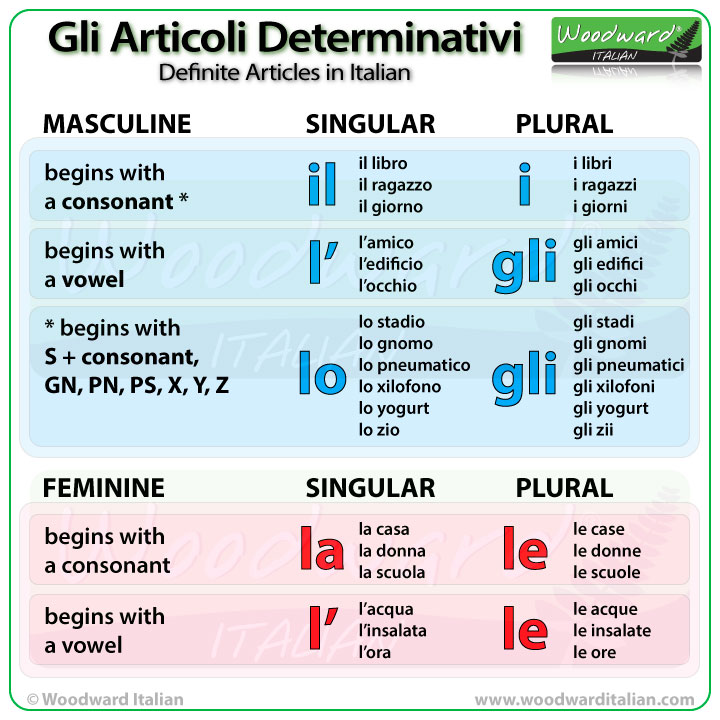
As you can see from the chart, the logic is consistent:
- Feminine is simpler:
lafor consonants,l'for vowels.- All plurals use
le.
- Masculine has more variety to handle sounds:
ilfor most consonants.l'for vowels.lofor "special" sounds (s+consonant,z,gn,ps).- In the plural,
ilbecomesi, whilel'andloboth becomegli.
Test your understanding!
Let's apply these rules. Choose the correct definite article for each noun. I've included the gender and number to help you focus on the article rule.
- ___ ragazzo (boy, masc. sing.)
- ___ studente (student, masc. sing.)
- ___ amica (friend, fem. sing.)
- ___ libri (books, masc. plur.)
- ___ zaini (backpacks, masc. plur.)
- ___ amiche (friends, fem. plur.)
- ___ gatto (cat, masc. sing.)
Show answer
- il ragazzo (starts with a regular consonant)
- lo studente (starts with
s+ consonant) - l' amica (starts with a vowel)
- i libri (plural of
il libro) - gli zaini (plural of
lo zaino) - le amiche (plural of
l'amica) - il gatto (starts with a regular consonant)
Conclusion
Benissimo! You've just tackled one of the most essential parts of Italian grammar. You now understand the system behind choosing the correct form of "the".
Key Takeaways:
- The choice of definite article depends on the noun's gender, number, and starting sound.
- The seven articles are il, lo, la, l', i, gli, le.
- Masculine articles have more variety to accommodate pronunciation (
il,lo,l'). Feminine articles are simpler (la,l'). - The most effective way to master this is to follow the advice from our last lesson: always learn a new noun with its article. For example, memorize "lo studente" as a single unit, not just "studente". This will make the rule feel natural over time.
In our next lesson, we will explore indefinite articles—the words for "a" and "an" (un, uno, una, un'). You'll be pleased to know that they follow a very similar logic to the definite articles you've learned today, so you've already done most of the hard work!
A presto