Introduction
In our previous lesson, you designed an image processing pipeline using the Hexagonal Architecture. We focused on the practical application of ports and adapters to isolate your core application logic from external dependencies like cameras and databases. This gave you a hands-on feel for how one of these modern structural patterns works.
Today, we'll zoom out to gain a broader perspective. Our goal is to compare the trade-offs of the classic Layered Architecture with its more evolved counterparts, Hexagonal Architecture and Clean Architecture. You'll learn why these newer patterns emerged and what problems they solve. This isn't about finding a single "best" architecture, but about understanding the principles and compromises each one entails. This comparative understanding will equip you to make deliberate, justified architectural choices, which is exactly what we'll be doing in the next lesson.
The Problem with Traditional Layered Architecture
For decades, the most common way to structure an application has been the "N-tier" or Layered Architecture. You've likely encountered or built systems like this, where dependencies flow in one direction, typically from presentation down to a database.
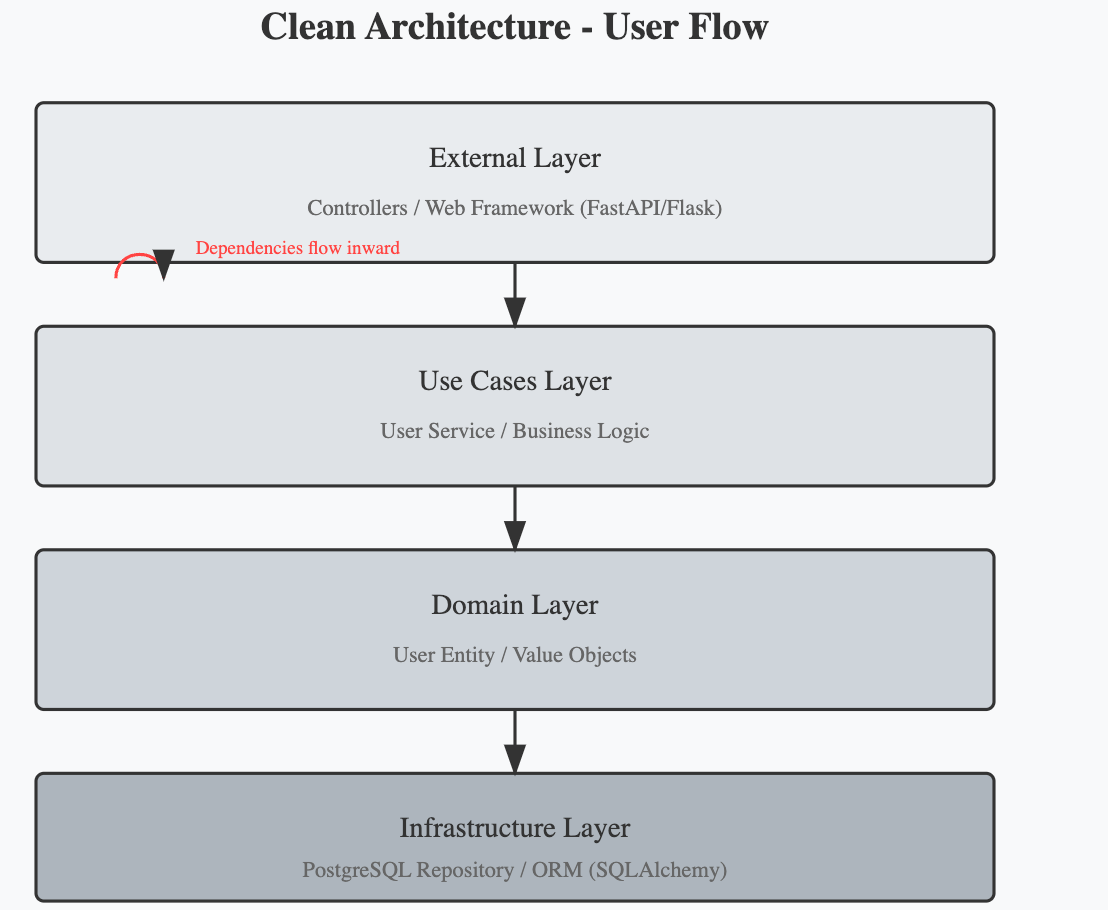
While simple and intuitive, this model has a significant drawback that becomes more apparent as applications grow. To understand this weakness, it's helpful to see it contrasted with the patterns we'll discuss.
Hexagonal Architecture – What Is It? Why Use It? - HappyCoders.eu
This article from Happy Coders provides a sharp analysis of the traditional layered model's shortcomings and directly contrasts it with the hexagonal approach.
Please read two sections from this article: Start with the section Disadvantages of the Layered Architecture. The key takeaway here is how the business logic becomes directly, and transitively, dependent on infrastructure details like the database. Then, jump down to the section Hexagonal Architecture vs. Layered Architecture. This part is crucial. Pay close attention to the diagrams showing how dependencies evolve. In the layered model, adding a REST API or an external service creates a "dependency chaos," coupling everything together. In contrast, the hexagonal model maintains clear, inward-pointing dependencies.
As the article highlights, the fundamental issue with the classic layered approach is that the business logic depends on infrastructure. Your core rules become tied to the database, the file system, or a specific messaging queue. This makes the system rigid. Swapping out a database or even upgrading an ORM can cause ripple effects throughout the entire application. More importantly, it makes it incredibly difficult to test your business logic in isolation.
The Solution: Inverting Dependencies
Hexagonal and Clean Architectures solve this problem by applying the Dependency Inversion Principle (the 'D' in SOLID) at an architectural scale. The core idea is simple but profound: dependencies must only point inwards, toward the core business logic.
This means the business logic should have no knowledge of the database, the web framework, or any other infrastructure. Instead, the core defines interfaces (or ports) that it needs, and the outer layers (the adapters) implement them.
A Tale of Two Architectures
You're already familiar with Hexagonal Architecture. Clean Architecture, popularized by Robert C. Martin ("Uncle Bob"), is a more formalized expression of the same underlying principles. They are so similar that they are often discussed interchangeably.

This diagram clearly shows the parallels:
- The Application hexagon corresponds to the Business Rules section of Clean Architecture, which is split into Use Cases (application-specific logic) and Entities (core domain logic).
- The Adapters hexagon corresponds to the Interface Adapters ring.
- The External Agencies map to the Frameworks & Drivers ring.
The central tenet for both is the Dependency Rule: source code dependencies can only point inwards. The core is independent, and the outer layers depend on it.
To get a more dynamic explanation of these concepts, the following video provides an excellent walkthrough.
🚀 The Clean Architecture (Ian Cooper)
In this talk from DevTernity Conference, Ian Cooper explains the foundational ideas of layering before diving into Clean Architecture itself.
Please watch two segments from this presentation: First, watch the section on traditional layering. This provides a great summary of the benefits and thought process behind the layered model we just critiqued. Then, jump to the detailed explanation of the Clean Architecture diagram. He breaks down each circle and, crucially, explains how control flows across the boundaries using dependency inversion. This directly addresses the question of how an inner layer can trigger an action (like saving to a database) in an outer layer.
The Core Idea: Stability and Coupling
At this point, you might be thinking about Hexagonal, Clean, and a related pattern called Onion Architecture. It's easy to get lost in the specific terminology of each. However, it's more productive to recognize that they are all mental models for achieving the same goal.
Hexagonal vs Clean vs Onion Architecture... It Doesn’t Matter
This short video from the CodeOpinion channel cuts through the noise and focuses on the "why" behind these patterns.
Watch the first few minutes of this video (the core idea). The speaker makes a crucial point: these architectures are about managing coupling to create a stable core and isolate it from volatile external concerns.
Your core business logic should be the most stable part of your system. A web framework, a database technology, or a cloud SDK are all volatile details that are likely to change. By making these external details depend on your core (and not the other way around), you protect your most valuable code from the churn of technology.
A Comparative Look at the Trade-offs
Now that we understand the principles, let's systematically compare the trade-offs. No architecture is a silver bullet; the choice depends on the specific context of your project.
| Feature | Classic Layered Architecture | Hexagonal / Clean Architecture |
|---|---|---|
| Simplicity | High. Very intuitive to start. Often the default for many frameworks. | Low to Medium. Requires more upfront design: defining interfaces (ports), data transfer objects (DTOs), and setting up dependency injection. |
| Testability | Low. Business logic is hard to test in isolation from the database and other infrastructure. | High. The core is completely independent and can be tested with simple mock implementations of its ports. |
| Flexibility | Low. Changing infrastructure (e.g., swapping a database) can require significant refactoring in the business and even presentation layers. | High. Infrastructure is interchangeable. You can swap adapters with minimal to no impact on the core business logic. |
| Coupling | Business logic is tightly coupled to infrastructure details. | Business logic is decoupled from all infrastructure. All dependencies point inward. |
| Best For | Simple CRUD applications, prototypes, projects where long-term maintainability is not the primary concern. | Complex applications with significant business logic, long-lived systems, projects where technology choices might evolve. |
The Trade-off of Abstraction
A key challenge when implementing these patterns is deciding when to create an abstraction (a port and adapter). Is it necessary for every single external interaction? Creating abstractions for everything can lead to excessive boilerplate code. The pragmatic answer is no. The decision should be based on two factors: volatility and blast radius.
The CodeOpinion video you watched earlier provides a perfect example.
Hexagonal vs Clean vs Onion Architecture... It Doesn’t Matter
Let's revisit the CodeOpinion video to see a concrete example of this trade-off.
Watch the segment where the presenter discusses sending a confirmation email. He questions the value of creating an IEmailSender interface if the AWS SDK is only used in one place and is not considered volatile. This introduces the idea of "blast radius": how much of your code would be affected if this dependency changed?
This is a critical insight for an experienced developer. Don't apply the pattern dogmatically. If a dependency is stable and used in only one or two places (small blast radius), directly using the SDK might be a reasonable trade-off. If, however, a dependency is volatile or used all over the codebase (large blast radius), creating a port and adapter is a wise investment.
Conclusion
In this lesson, we placed Hexagonal Architecture in a broader context by comparing it with the traditional Layered Architecture and the very similar Clean Architecture. We've seen that the primary driver for these modern patterns is to fix the core flaw of the layered model: the dependency of business logic on infrastructure.
Key Takeaways:
- Layered Architecture is simple but creates tight coupling between your core logic and infrastructure, hindering testability and flexibility.
- Hexagonal and Clean Architectures solve this by enforcing the Dependency Rule, where all dependencies point inward to a stable, isolated core. They are conceptually almost identical.
- The main trade-off is upfront complexity versus long-term maintainability. The additional effort of defining ports and adapters is an investment that pays off in complex, long-lived systems.
- The decision to create an abstraction should not be dogmatic. It should be a pragmatic choice based on the volatility and blast radius of a given dependency.
You now have a framework for not just implementing a pattern, but for reasoning about why and when to use it. In our next lesson, we will put this knowledge to work. You'll be presented with project scenarios and tasked with selecting and justifying an appropriate structural pattern, formalizing the critical skill of architectural decision-making.