Welcome to the first lesson of your course on Data Structures and Algorithms in Java. Your goal is to build a deep and reliable understanding of DSA to excel in SDE interviews at companies like Google. This journey begins not with code, but with the fundamental language used to describe and analyze it: asymptotic analysis.
In this lesson, you will learn to explain Big-O, Big-Omega, and Big-Theta notations. These are the mathematical tools that allow software engineers to have precise conversations about algorithm performance. Mastering this topic is the essential first step, providing the theoretical foundation for every data structure and algorithm you will study. We will focus on the "why" behind these concepts, ensuring you have a rigorous understanding from the start.
Why Do We Need to Analyze Algorithms?
Imagine you and a colleague have both written code to solve the same problem. How do you determine which solution is "better"? You could time them, but this approach has flaws. The result would depend on the computer's hardware, its current load, and the specific programming language or compiler used. It's not a standardized or scalable way to compare algorithms.
Instead, we need a way to analyze performance that is independent of the machine and environment. We do this by counting the number of fundamental operations an algorithm performs relative to the size of its input, which we'll call . This gives us a function, let's call it , that describes the algorithm's runtime.
However, the exact function can be complex (e.g., ). For large inputs, the dominant term (here, ) is what truly dictates the performance. Asymptotic notations are the formal way to capture this dominant behavior and describe the "order of growth" of the function as approaches infinity.
To begin building an intuition for this, let's watch a short segment from the "Asymptotic Notations 101" video by Back To Back SWE.
Asymptotic Notations 101: Big O, Big Omega, & Theta (Asymptotic Analysis Bootcamp)
This video provides an excellent, mathematically grounded yet intuitive explanation of asymptotic bounds.
Watch the first part of the video, from the beginning up to the introduction to T(n). The speaker explains what "asymptotic" means and why we're interested in an algorithm's behavior on very large inputs.
Big-O Notation: The Upper Bound
Big-O notation is the most common of the three and is used to describe an upper bound on an algorithm's growth rate. It essentially answers the question: "As the input size gets very large, what is the worst-case rate of growth for my algorithm's runtime?"
Formally, we say that a function is in (read as "Big-O of g of n") if there exist positive constants and such that for all input sizes , the following inequality holds:
This definition might seem abstract, so let's break it down. It means that for a sufficiently large input size (), our actual runtime function will always be less than or equal to our bounding function multiplied by some constant . The function provides a ceiling on the growth of .
The following video segment visualizes this definition perfectly, showing how we can find a constant c to make the bound hold.
Asymptotic Notations 101: Big O, Big Omega, & Theta (Asymptotic Analysis Bootcamp)
The presenter does a fantastic job of demystifying the formal definition with clear graphs.
Please watch from the definition breakdown to see the formal definition explained. Then, continue with the graphical example from finding constants, where he demonstrates how to find a constant c and introduces the important idea of "tight" versus "loose" bounds.
As you saw, a function can have many upper bounds. For example, an algorithm that runs in linear time, whose runtime function is, say, , is . It is also technically and . However, these are loose bounds. In practice, we always seek the tightest possible upper bound that accurately describes the function's growth.
Let's solidify this with a concrete mathematical example.
1.8.1 Asymptotic Notations Big Oh - Omega - Theta #1
In this video, Abdul Bari walks through a clear, step-by-step proof for a simple function.
Watch the segment from this Big O example. He demonstrates how to find constants c and n0 to show that the function f(n) = 2n + 3 is O(n), and also explains why it's technically O(n^2) but that O(n) is the preferred, tighter bound.
A key takeaway here is that we drop constants and lower-order terms. When we say an algorithm is , we don't care if its exact runtime is or . The constant in the definition absorbs these factors, and as becomes massive, the term dominates everything else. The notation is about the behavior and order of growth.
Big-Omega (Ω) and Big-Theta (Θ): Lower and Tight Bounds
While Big-O gives an upper bound, the other two notations provide different perspectives.
-
Big-Omega (Ω) Notation describes a lower bound. It answers: "What is the best-case rate of growth for the runtime?" A function is if its growth is at least as fast as . Formally, for constants and , the inequality is for all .
-
Big-Theta (Θ) Notation describes a tight bound. A function is if its growth rate is bounded both from above and below by . This is the most precise description. Formally, is if and only if is both and . It means is "sandwiched" between and .
The image below provides a great side-by-side summary of these three notations.
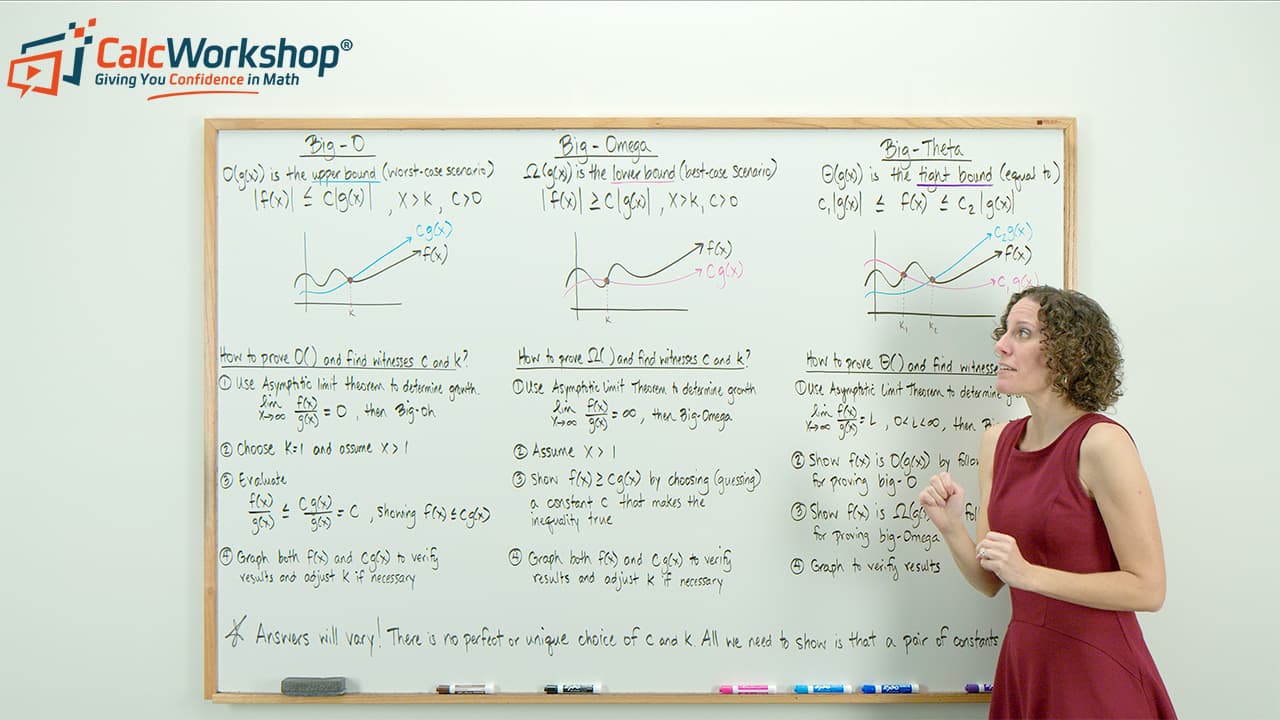
To see how these definitions are applied, let's return to Abdul Bari's video and his example of .
1.8.1 Asymptotic Notations Big Oh - Omega - Theta #1
This part of the video completes the picture by applying the definitions of Omega and Theta to the same function.
Watch his explanation for Big-Omega and then for Big-Theta. Notice how for Theta, the bounding function g(n) must be the same for both the upper and lower bound, which is why it represents an exact or "tight" bound.
A Crucial Clarification: Notations vs. Case Analysis
A very common point of confusion is equating these notations directly with best, average, and worst-case analysis of an algorithm. You will often see sources incorrectly state:
- Big-O = Worst Case
- Big-Omega = Best Case
- Big-Theta = Average Case
This is wrong. These are two separate concepts:
- Asymptotic Notations (O, Ω, Θ): These are mathematical tools for describing the growth rate of functions.
- Case Analysis (Best, Average, Worst): This is about analyzing an algorithm's performance on different types of inputs (e.g., a sorting algorithm on an already-sorted array vs. a reverse-sorted array).
You can use any notation to describe any case. For instance, for the Bubble Sort algorithm, the worst-case performance (on a reverse-sorted array) takes a number of operations that can be described as . This is a tight bound. It is also, by definition, (upper-bounded) and (lower-bounded).
The distinction is subtle but critical for precise communication, which is paramount in a technical interview setting. To emphasize this point, let's hear the final, important clarification from Abdul Bari.
1.8.1 Asymptotic Notations Big Oh - Omega - Theta #1
This short clip corrects a widespread misconception and is vital for developing a truly reliable understanding.
Please watch this final, crucial segment from don't mix this one.
Conclusion
In this lesson, we have established the theoretical bedrock for the entire course. You now have the language to discuss algorithm efficiency with precision.
Here are the key takeaways:
- Asymptotic notations provide a standardized way to measure how an algorithm's resource usage scales with input size, independent of the hardware.
- Big-O () describes an upper bound (grows at most as fast as).
- Big-Omega () describes a lower bound (grows at least as fast as).
- Big-Theta () describes a tight bound (grows at the same rate as).
- In interviews and professional practice, we aim to provide the tightest possible bound, which is often expressed using Big-O as shorthand for a tight upper bound ().
- Critically, these notations are mathematical tools for describing functions and are distinct from the best, average, and worst-case analysis of an algorithm's behavior.
In our next lesson, we will put this theory into practice. You will learn to determine the time and space complexity of iterative algorithms, analyzing loops and nested loops in Java code. This will be your first step in applying these fundamental concepts to the practical work of a software engineer.