Hello! In our previous lesson, we explored how to evaluate regression models using metrics like RMSE and R-squared. We saw that these metrics give us a number, but a crucial question remains: how much can we trust that number? A model's performance on a single, randomly chosen test set can be misleadingly high or low. This is often called the "lucky split" problem.
Today, we will tackle this challenge head-on by diving into cross-validation (CV). As a data scientist, you've certainly used cross_val_score, but our goal here is to formalize the why and when for each strategy. This lesson will differentiate the use-cases for the most important CV methods: k-fold, stratified k-fold, and time-series cross-validation. Mastering this topic is not just about writing robust code; it's about building reliable models and being able to defend your evaluation methodology in a technical interview.
The Problem with a Single Split
Before we explore the solutions, let's solidify our understanding of the problem. A single train-test split gives you one performance score, a point estimate. But what if, by sheer luck, your test set contained all the "easy" examples? Or all the "hard" ones? Your performance metric would be unreliable.
Cross-validation solves this by creating a more robust estimate of your model's generalization performance. Instead of a single score, you get a distribution of scores (e.g., a mean and standard deviation), which is far more informative.
This video provides an excellent introduction to why we need to move beyond a simple train-test split and embrace a more rigorous validation framework.
Complete Guide to Cross Validation
This video from Rob Mulla sets the stage perfectly by demonstrating how evaluating a model on the training data gives an overly optimistic score, and how a single train-validation split, while better, is still not the complete solution.
Please watch from the beginning to the start of the cross-validation discussion. Pay close attention to these parts: The initial model training: Notice the huge gap between the training score (99% accuracy) and the holdout score (93% accuracy, worse than a simple baseline). This is a classic case of overfitting. The simple train-validation split: The presenter introduces this as a "bare minimum" step. This sets up the need for the more powerful cross-validation techniques we're about to cover.
A Visual Guide to Cross-Validation Strategies
At its core, cross-validation is about systematically partitioning your data into training and validation sets multiple times. The way this partitioning is done defines the strategy. This image provides a fantastic visual comparison of the different splitting patterns we will discuss.
Let's now break down each of these primary strategies.
1. K-Fold Cross-Validation: The General-Purpose Standard
K-Fold is the most common and straightforward cross-validation technique. It's the workhorse for many machine learning tasks, especially regression.
The process is as follows:
- The dataset is shuffled randomly.
- It is then split into 'k' equal-sized folds.
- For each fold from 1 to k:
- The model is trained on k-1 folds.
- The model is validated on the held-out fold.
- The final performance is the average of the performance across all k folds.
This blog post provides a very clear explanation of the mechanics and the problem it solves.
Cross-Validation vs Train-Test Split: Trust Your Model | Let's Data ...
This article from Let's Data Science frames the problem perfectly as the "lucky split" and then walks through the K-Fold solution.
Please read the first two main sections: Start with The Lucky Split Problem. This section vividly illustrates how unstable a single train-test split can be. Continue to K-Fold Cross-Validation Mechanics. Focus on the algorithm's steps and the example showing how K-Fold produces a much more stable score (86.5% +/- 4.4%) compared to the wild swings of random splits.
The choice of k involves a trade-off. A common practice is to use k=5 or k=10.
- Low k (e.g., 2 or 3): Less computationally expensive, but the performance estimate has higher bias because the training sets are much smaller than the full dataset.
- High k (e.g., N, also known as Leave-One-Out CV or LOOCV): The training sets are almost the size of the full dataset, so the estimate has low bias. However, the training sets overlap significantly, leading to highly correlated fold scores. This increases the variance of the performance estimate, making it less reliable for model comparison.
For most i.i.d. (independent and identically distributed) datasets, 5-fold or 10-fold CV provides a good balance.
Use-Case: K-Fold is the default, go-to strategy for regression problems or any scenario where your data is i.i.d. and you don't have significant class imbalance.
2. Stratified K-Fold: For Classification and Imbalanced Data
What happens if you use standard K-Fold on a classification dataset where one class is rare, like in fraud detection? A random split might create a fold with no examples of the minority class. Training on the other folds and then trying to validate on this fold would be meaningless; metrics like precision and recall would be undefined.
Stratified K-Fold solves this. It's a variation of K-Fold that ensures each fold has the same percentage of samples for each class as the complete dataset.
Cross-Validation vs Train-Test Split: Trust Your Model | Let's Data ...
The same article we've been using has a great section on this.
Please read the section titled Stratified K-Fold. The key is the example output comparing the class distributions per fold for KFold versus StratifiedKFold. It clearly shows StratifiedKFold maintaining the original class ratio in each split.
Use-Case: Stratified K-Fold is the essential, default choice for classification problems. Even if your classes aren't severely imbalanced, it costs nothing and provides a more robust and representative validation set for each fold. In scikit-learn, functions like cross_val_score automatically use StratifiedKFold for classifiers.
3. Time-Series Cross-Validation: Respecting the Arrow of Time
Both K-Fold and Stratified K-Fold rely on a crucial assumption: that the data points are independent. This assumption is fundamentally broken in time-series data, where observations are correlated with their neighbors in time (autocorrelation).
If you use random shuffling on time-series data, you will commit a critical error: lookahead bias. You would be training your model on future data to predict the past, leading to wildly optimistic and completely invalid performance scores.
Time-Series cross-validation respects the temporal order of the data. The most common approach is an expanding window:
- The first fold uses a small initial segment of data for training (
[1...t]) and the immediately following segment for validation ([t+1...t+k]). - The second fold expands the training set to include the previous validation set (
[1...t+k]) and validates on the next segment ([t+k+1...t+2k]). - This continues until all the data has been used.
3.1. Cross-validation: evaluating estimator performance
The official scikit-learn documentation provides the authoritative take on this.
Please navigate to the subsection Time Series Split. Focus on the core idea: "successive training sets are supersets of those that come before them." Look at the example code output to see the expanding window in action.
This ensures that the model is always trained on past data and tested on "future" data, mimicking how it would be deployed in a real-world scenario.
Use-Case: This is the only correct approach for datasets with a temporal dependency, such as stock prices, weather forecasting, or sensor log data.
A Decision Framework for Choosing Your Strategy
So, how do you choose? It boils down to asking a few simple questions about your data's structure and your modeling goal. This flowchart provides a clear path.
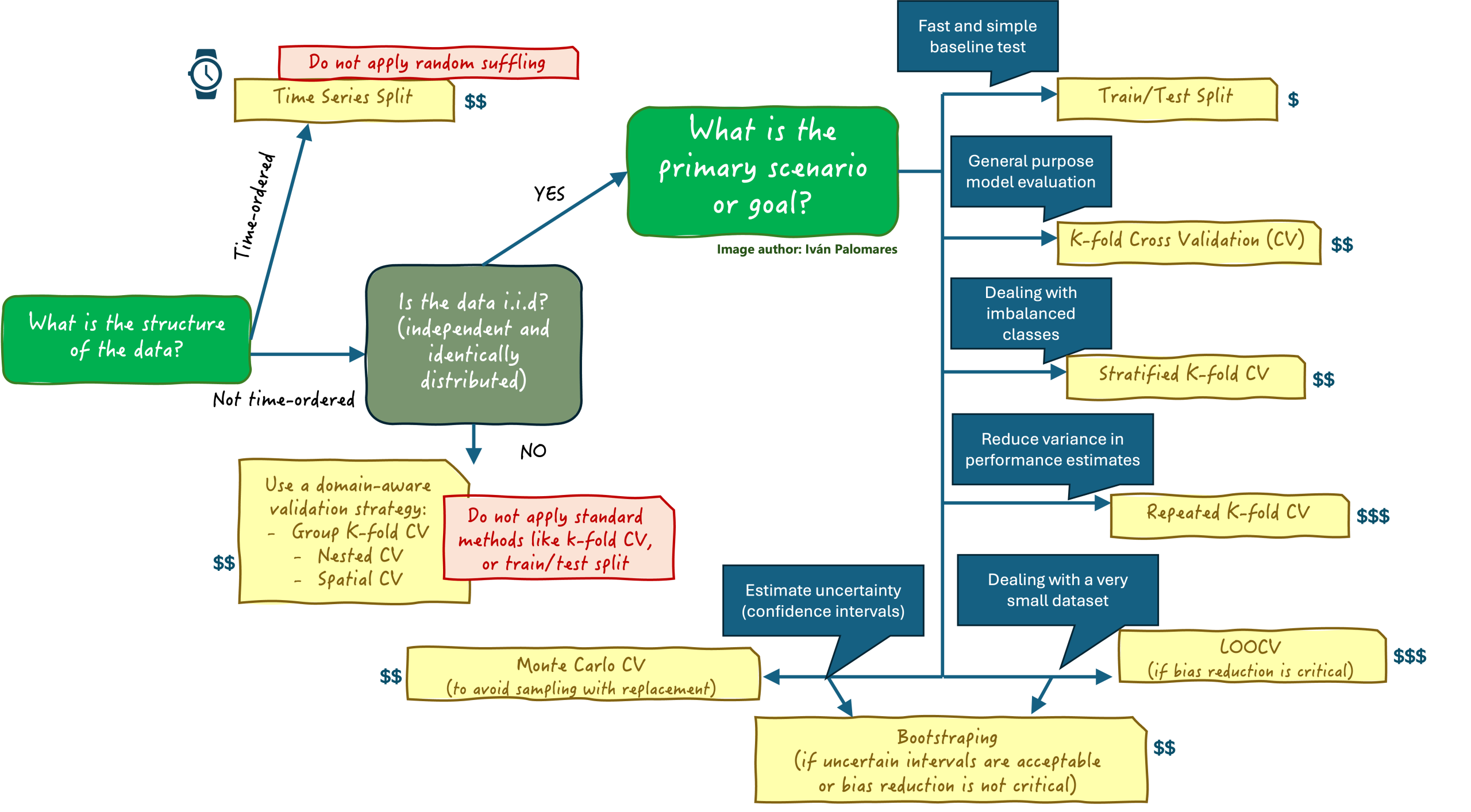
Here's a summary table to reinforce the decision process:
| Scenario | Recommended Strategy | Why? |
|---|---|---|
| My data is time-ordered (e.g., stock prices, sensor data). | Time-Series CV | Prevents lookahead bias by always testing on "future" data. |
| My data has groups (e.g., multiple samples per patient/user). | Group K-Fold | Prevents data leakage by keeping all data from a single group in either the train or test set, never both. This tests generalization to new, unseen groups. |
| I am doing classification. | Stratified K-Fold | Preserves class proportions in each fold, crucial for imbalanced datasets and robust metric calculation. |
| I am doing regression with i.i.d. data. | K-Fold | The standard, general-purpose approach for independent data. |
You'll notice Group K-Fold in the table, which we haven't discussed in detail. It's a vital strategy for data that isn't time-ordered but is still not i.i.d., for example, having multiple medical readings from the same patient. Using standard K-Fold here would be a mistake, as the model could learn patient-specific patterns rather than generalizable medical insights. GroupKFold ensures all data from one patient is in either the training or validation set for a given fold, but never both. It's a key tool for avoiding a subtle but common form of data leakage.
Conclusion
You now have a structured framework for choosing the right cross-validation strategy. Moving beyond a simple train-test split is the first step towards building models you can actually trust. By deliberately selecting a CV strategy that matches your data's structure, you ensure your performance metrics are both robust and realistic.
Key Takeaways:
- A single train-test split provides an unstable performance estimate; use cross-validation for a more reliable mean and standard deviation.
- K-Fold is the default for i.i.d. data, common in regression.
- Stratified K-Fold is the default for classification, as it preserves class ratios in each fold, which is critical for imbalanced data.
- Time-Series CV is mandatory for temporal data to avoid lookahead bias by always training on the past and testing on the future.
In our next lesson, we will build on this foundation and explore a closely related, critical topic: data leakage. We'll see how even with the right CV strategy, you can inadvertently leak information from your validation set into your training process, and more importantly, how to prevent it.