Hello! In our previous lesson, we classified the six types of synovial joints based on their structure. Now, we'll shift our focus from structure to function by learning the precise language used to describe the movements these joints allow.
This lesson directly addresses the learning outcome of defining and identifying the primary angular and rotational movements at synovial joints. Mastering this vocabulary is not just crucial for your A&P exam; it's the fundamental language you will use in clinical settings to assess and document a patient's range of motion, a skill highly relevant to your work and future nursing career. We will cover flexion, extension, abduction, adduction, rotation, and circumduction.
The Foundation of Movement: The Anatomical Position
Before we can describe any movement, we need a standard frame of reference. In anatomy, this is the anatomical position: standing upright, feet shoulder-width apart, arms at the sides, with palms facing forward. Every movement we discuss is described as a deviation from or return to this position.
To start, let's watch a brief introduction that explains the importance of this concept.
The video "Joint Movements" by Dr. Matt & Dr. Mike begins by establishing the anatomical position as the essential starting point for describing all body movements.
Watch the first minute of the video, from the start to the end of the introduction. Pay close attention to the description and demonstration of the anatomical position.
Angular Movements: Changing the Angle
Angular movements are defined by an increase or decrease in the angle between two bones. These movements typically occur in pairs with opposite actions.
Flexion, Extension, and Hyperextension
These are perhaps the most common terms you'll encounter.
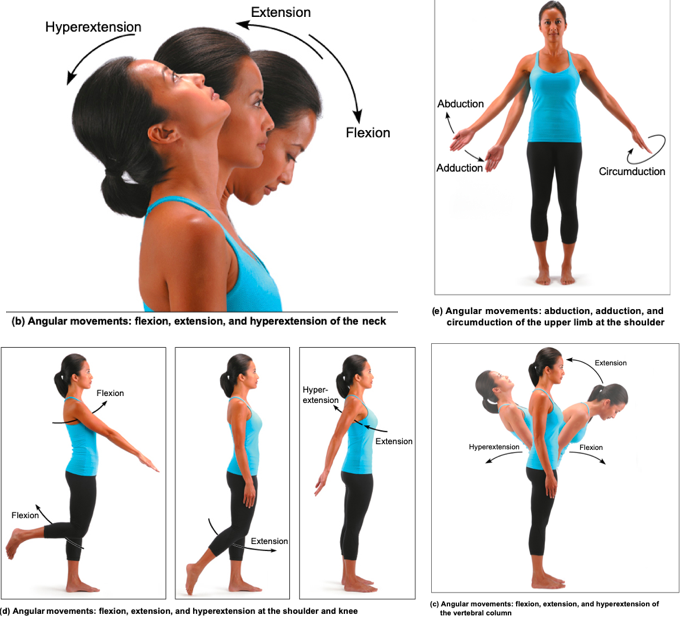
- Flexion: A movement that decreases the angle of a joint, bringing two bones closer together. Think of flexing your bicep—you decrease the angle at your elbow.
- Extension: The opposite of flexion. It increases the angle of a joint, returning it toward the anatomical position. Straightening your arm from a flexed position is extension.
- Hyperextension: Extending a joint beyond its normal range or past the anatomical position. Bending your head backward is an example of hyperextension of the neck.
Abduction and Adduction
These terms describe movements of a limb relative to the body's midline.
- Abduction: Movement of a limb away from the midline of the body. A simple way to remember this is that to abduct something is to take it away. Raising your arm out to the side is abduction.
- Adduction: The opposite of abduction. It is the movement of a limb toward the midline of the body. You are "adding" the limb back to the body. Lowering your arm back to your side is adduction.
The following video provides excellent demonstrations of these key angular movements at several different joints.
Dr. Mike demonstrates these fundamental movements clearly and provides helpful memory aids.
Please watch these two segments: First, watch the section on abduction and adduction. Then, watch the section covering flexion and extension/hyperextension. Notice how he performs each movement starting from the anatomical position.
Rotational and Circular Movements
While angular movements involve changing the angle between bones, rotational movements involve turning a bone around its own axis.
Rotation
Rotation is the turning of a bone around its own longitudinal axis. This can occur toward or away from the body's midline.
- Medial (Internal) Rotation: The anterior surface of the limb turns toward the midline.
- Lateral (External) Rotation: The anterior surface of the limb turns away from the midline.
A common example is keeping your elbow bent at 90 degrees and rotating your forearm so your hand moves toward and away from your body. The rotation is happening at the shoulder joint.
Circumduction
Circumduction is a circular, cone-like movement of a limb extending from a joint. It is not simple rotation, but rather a combination of flexion, abduction, extension, and adduction performed in sequence. This is possible at ball-and-socket joints like the shoulder and hip. Drawing a large circle in the air with your arm is an example of circumduction.
This final video clip explains the difference between these two important types of movement.
This segment from "Joint Movements" clearly distinguishes between circumduction and rotation, which are often confused.
Watch the portion of the video from circumduction and rotation. The analogy of drawing a circle versus a dot is a very effective way to understand the difference.
To bring all these concepts together, study the following image, which illustrates these primary movements.
Finally, to reinforce the definitions for your exam preparation, please review the following summary resource.
Introduction to Anatomy: Anatomical Movements
This PDF provides concise, illustrated definitions of the movements we've just covered. It also includes helpful memorization hints.
Please review the following sections in the document: Navigate to the "Flexion & Extension" section. Read the definitions and look at the examples provided on the pages titled Flexion and Extension. Next, review the "Abduction & Adduction" section, paying attention to the definitions and hints. Finally, look at the "Rotational Movements" section to see the definition and diagram for Rotation.
Conclusion
In this lesson, we have established a precise vocabulary for describing the primary movements at synovial joints. By starting from the anatomical position, we can accurately define pairs of opposing actions and more complex motions.
Key Takeaways:
- All movements are described in relation to the anatomical position.
- Flexion decreases a joint angle, while extension increases it. Hyperextension goes beyond the normal range of extension.
- Abduction moves a limb away from the midline, while adduction moves it toward the midline.
- Rotation is the turning of a bone around its own long axis (medially or laterally).
- Circumduction is a circular motion that combines flexion, abduction, extension, and adduction.
In our next lesson, we will explore "special movements" that are unique to specific joints, such as pronation and supination of the forearm and inversion and eversion of the foot.