Welcome back. In our previous lesson, we completed our study of the lower leg by identifying the landmarks of the tibia and fibula. We concluded by seeing how the distal ends of these bones—the medial and lateral malleoli—form a mortise, or socket, ready to connect with the foot.
Today, we will take that next step and explore the complex anatomy of the ankle and foot. Our goal is to identify the bones of the ankle and foot (tarsals, metatarsals, and phalanges). By the end of this lesson, you will be able to name the 26 bones that comprise each foot, understand their organization into three distinct groups, and use mnemonics to recall the challenging ankle bones. This completes our journey through the appendicular skeleton.
Overview of the Foot Bones
The human foot is an engineering marvel, containing 26 bones that work together to support body weight, absorb shock, and provide propulsion for walking and running. These bones are organized into three groups:
- Tarsals: The seven bones that form the ankle and posterior half of the foot.
- Metatarsals: The five bones that form the main body of the foot, or the instep.
- Phalanges: The fourteen small bones that form the toes.
This diagram provides a great overview of how these groups are arranged from both a superior (dorsal) and a medial perspective.
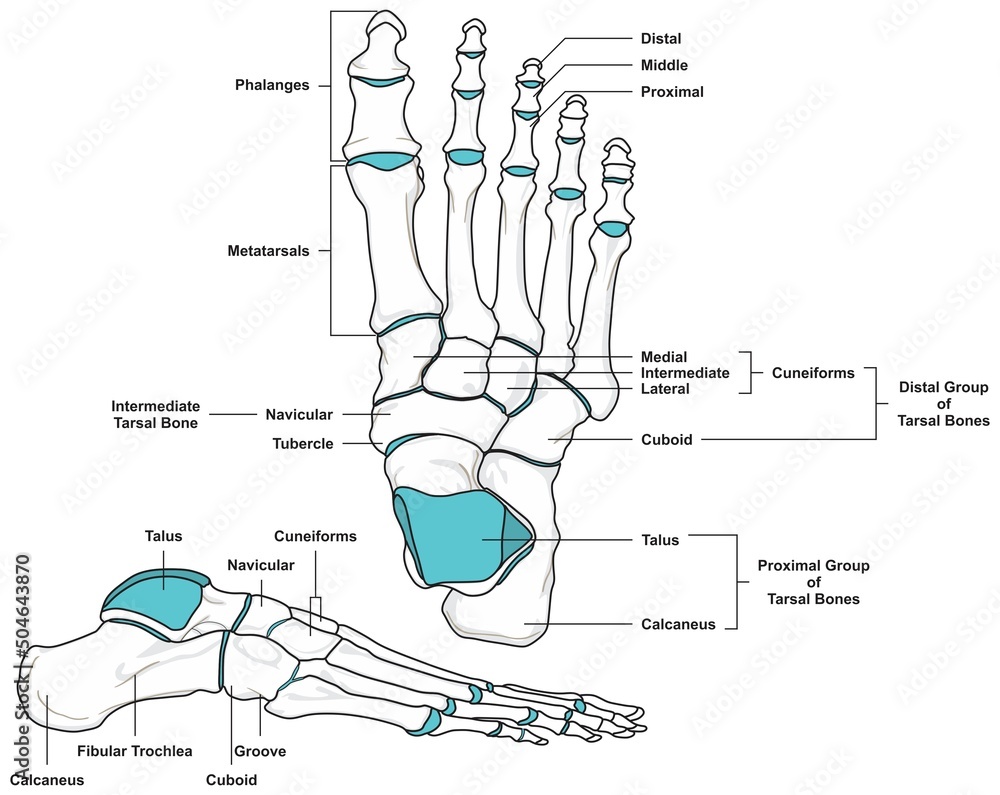
Let's examine each of these groups, starting with the most complex: the tarsals.
The Tarsals (Ankle Bones)
The seven tarsal bones are short, irregular bones that are much larger and stronger than their carpal counterparts in the wrist, reflecting their critical role in weight-bearing. Memorizing them can be challenging, so we'll use a video that introduces a helpful mnemonic and a clever way to group them.
Anatomy of the Ankle Joint | Bones, Ligaments, and Muscles
The video "Anatomy of the Ankle Joint" by Siebert Science provides an excellent walkthrough of all the foot bones, with a particularly useful mnemonic for the tarsals.
Please watch the segment from the tarsal bones section. The presenter introduces the mnemonic "Tiger Cubs Need MILC" and organizes the tarsals into two functional groups, which is a great way to learn them. Focus on identifying each of the seven tarsal bones as they are introduced.
As the video explained, the seven tarsals can be organized into groups and recalled with a mnemonic. Let's solidify that knowledge.
Proximal Tarsal Bones:
- Talus: This is the primary ankle bone. It sits directly in the mortise formed by the tibia and fibula, transferring the entire weight of the body from the leg to the foot.
- Calcaneus: The largest of the tarsal bones, commonly known as the heel bone. It lies inferior to the talus.
Intermediate Tarsal Bone:
- Navicular: A boat-shaped bone located anterior to the talus and medial to the cuboid.
Distal Tarsal Bones:
- Medial, Intermediate, and Lateral Cuneiforms: Three wedge-shaped bones lined up in a row, anterior to the navicular.
- Cuboid: A cube-shaped bone on the lateral side of the foot, anterior to the calcaneus.
This color-coded image can help you visualize the relative positions of these seven bones.
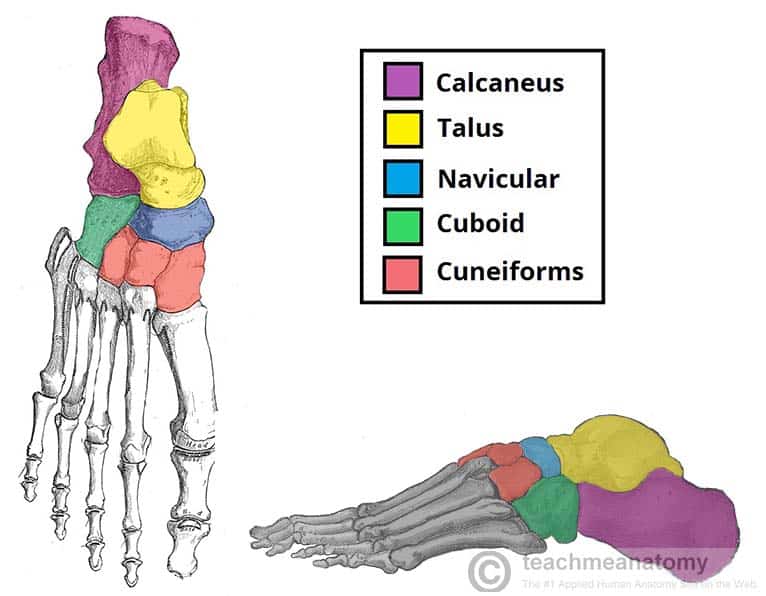
The mnemonic Tiger Cubs Need MILC is an effective way to remember these bones in order:
- Tiger: Talus
- Cubs: Calcaneus
- Need: Navicular
- MILC: Medial cuneiform, Intermediate cuneiform, Lateral cuneiform, Cuboid.
You might also see a variation of this mnemonic: "Tall Camels Never Consume Cubes," where "Consume" stands for the three Cuneiforms. Both work equally well.
To quickly review this grouping, please read the following short text.
Ankle and foot anatomy: Bones, joints, muscles
This article from Kenhub concisely lists the bones of the foot and reinforces the tarsal mnemonic.
Read the section beginning with this description of the tarsals. Pay attention to the classification of the tarsals into proximal, intermediate, and distal groups.
The Metatarsals and Phalanges
Distal to the tarsals are the metatarsals and phalanges, which have a simpler and more regular organization, much like the metacarpals and phalanges of the hand.
Let's watch a short video that provides a clear and concise identification of these remaining bones.
The video "Bones of the Foot" from The Noted Anatomist offers a very clear and quick explanation of the metatarsals and phalanges.
Watch the section covering the metatarsals and phalanges. Note the numbering of the metatarsals and the number of phalanges in the great toe versus the lesser toes.
Let's summarize what you just watched:
The Metatarsals (Metatarsus):
- There are five metatarsal bones, which form the arch and instep of the foot.
- They are numbered 1 to 5, starting from the medial side (the side of the big toe).
- Metatarsal 1 is the shortest and thickest, supporting the big toe.
- Metatarsals articulate proximally with the cuneiform bones and the cuboid bone, and distally with the phalanges.
The Phalanges (Toes):
- There are fourteen phalanges in each foot.
- The great toe, or hallux (digit 1), has only two phalanges: a proximal and a distal phalanx.
- The other four toes (digits 2-5) each have three phalanges: a proximal, a middle, and a distal phalanx.
This structure is directly analogous to the bones of the hand, where the thumb (pollex) has two phalanges and the other fingers have three.
Conclusion
In this lesson, we have successfully identified the 26 bones that make up the ankle and foot. We've seen how they are organized into the tarsals, metatarsals, and phalanges, each group playing a distinct role in the foot's function of support and movement. By completing this lesson, you have now identified all the major bones of the appendicular skeleton.
Key Takeaways:
- The foot consists of three bone groups: 7 tarsals (ankle), 5 metatarsals (instep), and 14 phalanges (toes).
- The seven tarsal bones can be remembered with the mnemonic "Tiger Cubs Need MILC": Talus, Calcaneus, Navicular, Medial cuneiform, Intermediate cuneiform, Lateral cuneiform, and Cuboid.
- The talus articulates with the tibia and fibula, while the calcaneus forms the heel.
- The metatarsals are numbered 1-5 from medial to lateral.
- The hallux (great toe) has two phalanges, while the other four toes have three each.
In our next module, we will shift our focus from identifying bones to understanding how they connect and move. We will begin by classifying the different types of joints found in the body and exploring their structure and function. This will allow us to appreciate how the foot bones you've just learned articulate to allow for complex movements like walking, running, and maintaining balance.