Welcome to the fourth lesson in our foundational module. In our previous session, we established the language of set theory, which is essential for defining the domains and ranges of the functions we'll encounter. Today, we turn our attention to two of the most important families of functions in mathematics and machine learning: exponentials and logarithms.
Your goal of conducting machine learning research requires a deep, intuitive, and formal understanding of these functions. They are not just tools for calculation; they are fundamental to concepts like the logistic function in classification, information theory (entropy, KL divergence), and maximum likelihood estimation, where log-transformations are ubiquitous.
This lesson will guide you through the process of applying the properties of logarithms and exponentials to simplify complex expressions. We will start with a quick review of exponent rules, then formally define logarithms as their inverse, derive their properties from first principles (including proofs, as you prefer), and finally, practice manipulating expressions with them.
From Exponents to Logarithms
The properties of logarithms are not arbitrary; they are a direct consequence of the rules for exponents. Let's begin by ensuring those rules are fresh in your mind.
An expression like involves a base raised to an exponent . The fundamental rules govern how we handle multiplication, division, and nested powers.
To refresh these concepts, watch the following video from The Organic Chemistry Tutor. It provides a clear explanation of the three main exponent rules and the intuition behind them.
Please watch the first two minutes, from the beginning to the end of the explanation of the power rule.
To summarize, for any valid base and real exponents and :
- Product Rule:
- Quotient Rule:
- Power Rule:
These three rules are the seeds from which all the properties of logarithms grow.
Now, what is a logarithm? It is simply the inverse of an exponential function. It answers the question: "To what exponent must we raise a base to obtain a certain value?"
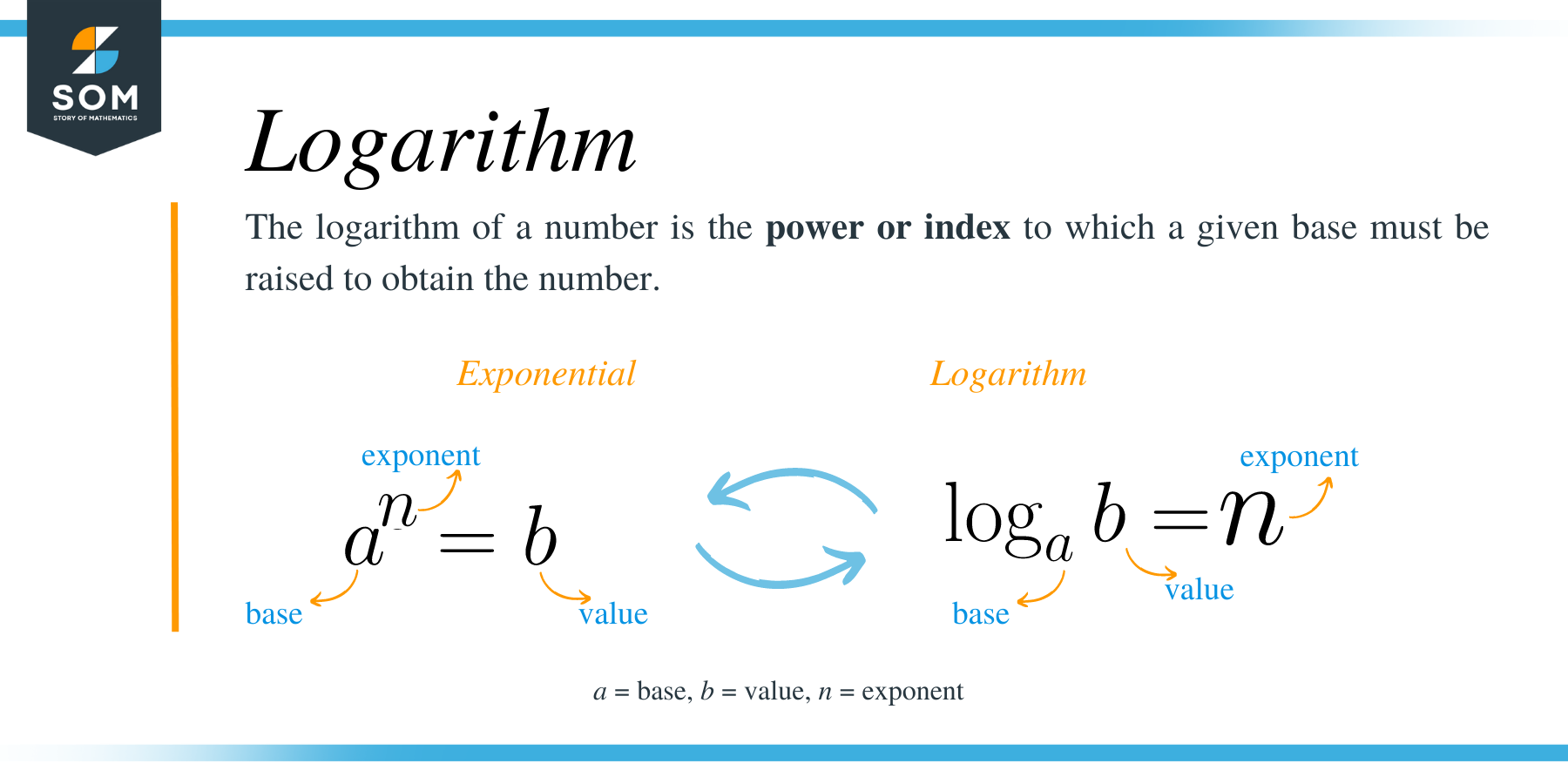
This inverse relationship, , holds under specific conditions that we can define using set theory from our last lesson:
- The base must be a positive real number not equal to 1, i.e., .
- The argument must be a positive real number, i.e., . The set of positive real numbers is the domain of the logarithm function.
- The result can be any real number, so the range is .
Two bases are particularly important:
- Common Logarithm: Base 10, written as .
- Natural Logarithm: Base , written as . The number is a fundamental mathematical constant, like , that arises naturally in calculus and growth processes. We will explore it more in later modules.
Deriving the Properties of Logarithms
Because you are interested in a rigorous foundation, it is not enough to just state the properties. Understanding where they come from is key. Each property of logarithms is a direct translation of an exponent rule, seen through the lens of the inverse relationship.
The following video provides excellent, step-by-step proofs for the three core laws of logarithms. As you watch, notice how each proof follows a similar pattern:
- Define the logarithmic terms as variables.
- Convert the logarithmic equations to their exponential equivalents.
- Apply the corresponding exponent rule (product, quotient, or power).
- Convert the result back into a logarithmic equation.
06 - Proving the Logarithm (Log) Rules - Understand Logarithm Rules & Laws of Logs
Watch these segments from the "Math and Science" channel to see the formal proofs for the product, power, and quotient rules.
First, watch the proof of the Product Rule. Next, watch the proof of the Power Rule. Finally, watch the proof of the Quotient Rule. The logic here is very similar to the product rule proof, but with a clever use of negative exponents.
These proofs beautifully illustrate the connection we've been discussing. The properties aren't new rules to memorize, but rather the exponent rules you already know, just expressed in a different language.
The image below provides a complete summary of these properties, including a few others that derive from the definition. It's a useful reference sheet.
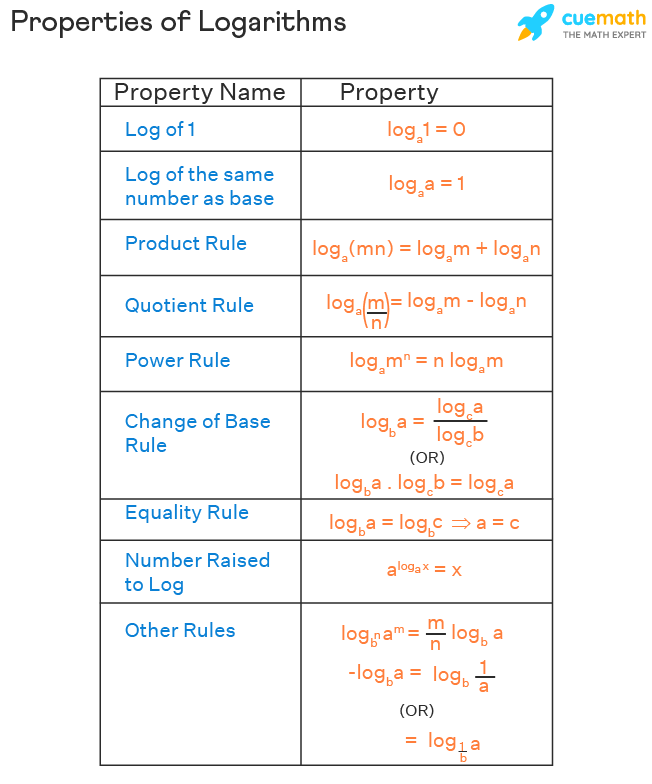
The Change of Base Formula
What if you need to calculate a logarithm with a base that isn't on your calculator, like ? The change of base formula allows you to convert any logarithm into a ratio of logarithms with a different, more convenient base (like 10 or ).
The formula is:
For a clear derivation of this essential formula, please consult the following resource.
Why Do Logarithms Work That Way? – The Math Doctors
This article from The Math Doctors provides straightforward proofs for the logarithmic properties. We'll focus on its derivation of the change of base formula.
Please read the section titled Deriving the change of base formula. Pay close attention to how taking the log of both sides of an exponential equation and applying the power rule naturally leads to this identity. The example with 4^x = 5 is particularly illustrative.
This formula shows that all logarithmic functions are simply scaled versions of one another. The graph of has the same shape as ; it's just stretched or compressed vertically by a factor of .
Applying the Properties: Expanding and Condensing
Now that we understand the properties and their origins, let's put them to use. Simplification of logarithmic expressions generally takes two forms:
- Expanding: Taking a single, complex logarithm and breaking it down into a sum or difference of simpler logarithms.
- Condensing: Taking a series of simple logarithms and combining them into a single, more compact logarithmic expression.
These skills are crucial for solving logarithmic equations and for manipulating expressions in calculus and beyond.
5.4 Properties of Logarithms – Functions, Trigonometry, and Systems of Equations (First Edition)
This textbook chapter offers a series of well-explained examples for both expanding and condensing logarithms. Working through them will solidify your understanding.
First, focus on expanding. Start at Example 5.4.1 and work through all five sub-examples. Notice the general strategy: apply the properties in the "reverse" order of operations. Next, focus on condensing. Go to the next section, Example 5.4.2, and study the four sub-examples. Here, the strategy follows the standard order of operations: handle coefficients (powers) first, then sums/differences (products/quotients).
A Critical Subtlety: Mind the Domain
As you become proficient, it's vital to be aware of a subtlety that can trip up even experienced students. Applying the rules of logarithms can sometimes alter the domain of the expression. This is a point of rigor that is often overlooked but is critical for formal mathematics.
For instance, consider the functions and .
- The domain of is all real numbers except 0, since is positive for any non-zero .
- The domain of is only positive real numbers ().
Because their domains are different, and are not identical functions. The identity is only strictly true for . The fully correct identity for all is .
Why Do Logarithms Work That Way? – The Math Doctors
Let's return to the article from The Math Doctors, which has an excellent section on this very issue.
Read the section titled It’s not quite so simple. This will give you concrete examples of how applying log properties can inadvertently change the set of valid inputs, a crucial consideration when solving equations.
Conclusion
In this lesson, we have revisited exponents and used their properties as a foundation to build a robust understanding of logarithms. You've learned not only what the properties of logarithms are but also why they are true, by examining their formal proofs. We then practiced applying these properties to expand and condense expressions, a key algebraic skill.
Key Takeaways:
- Logarithms are the inverse of exponential functions.
- The properties of logarithms (Product, Quotient, and Power Rules) are direct consequences of the corresponding exponent rules.
- Logarithmic expressions can be expanded into simpler terms or condensed into a single term.
- The Change of Base formula allows any logarithm to be expressed in terms of any other base, showing that all logarithmic functions are related by a simple scaling factor.
- Applying logarithmic properties can change the domain of an expression, which requires careful attention for mathematically precise work.
In our next lesson, we will introduce summation and product notation ( and ). These are powerful tools for representing and manipulating the long sums and products that frequently appear in machine learning algorithms, such as in the definition of a neuron's activation or a model's cost function.