Welcome to your fifth lesson. In our last session, we mastered the manipulation of expressions using logarithms and exponentials. Today, we'll learn the notation for handling not just single terms, but long sequences of them. We will be exploring summation and product notation, represented by the Greek letters Sigma () and Pi ().
This is a fundamental step in our journey. Your goal of conducting machine learning research will require you to read and write mathematical formulas that describe complex algorithms. This notation is the language used to express core concepts like the cost function of a model (a sum of errors over a dataset), the activation of a neuron (a weighted sum of inputs), or the probability of a sequence of events (a product of individual probabilities).
Our objective is to learn how to use this notation to both express and manipulate mathematical series, moving from long, written-out calculations to compact and powerful expressions.
The Language of Sums: Sigma Notation
Often in mathematics, we need to add up a long list of numbers that follow a specific pattern. For instance, imagine summing the first 100 square numbers: . Writing this out is cumbersome. Summation notation provides a concise and precise way to represent such sums.
The notation uses the capital Greek letter Sigma, , to signify "sum." Let's break down its components.
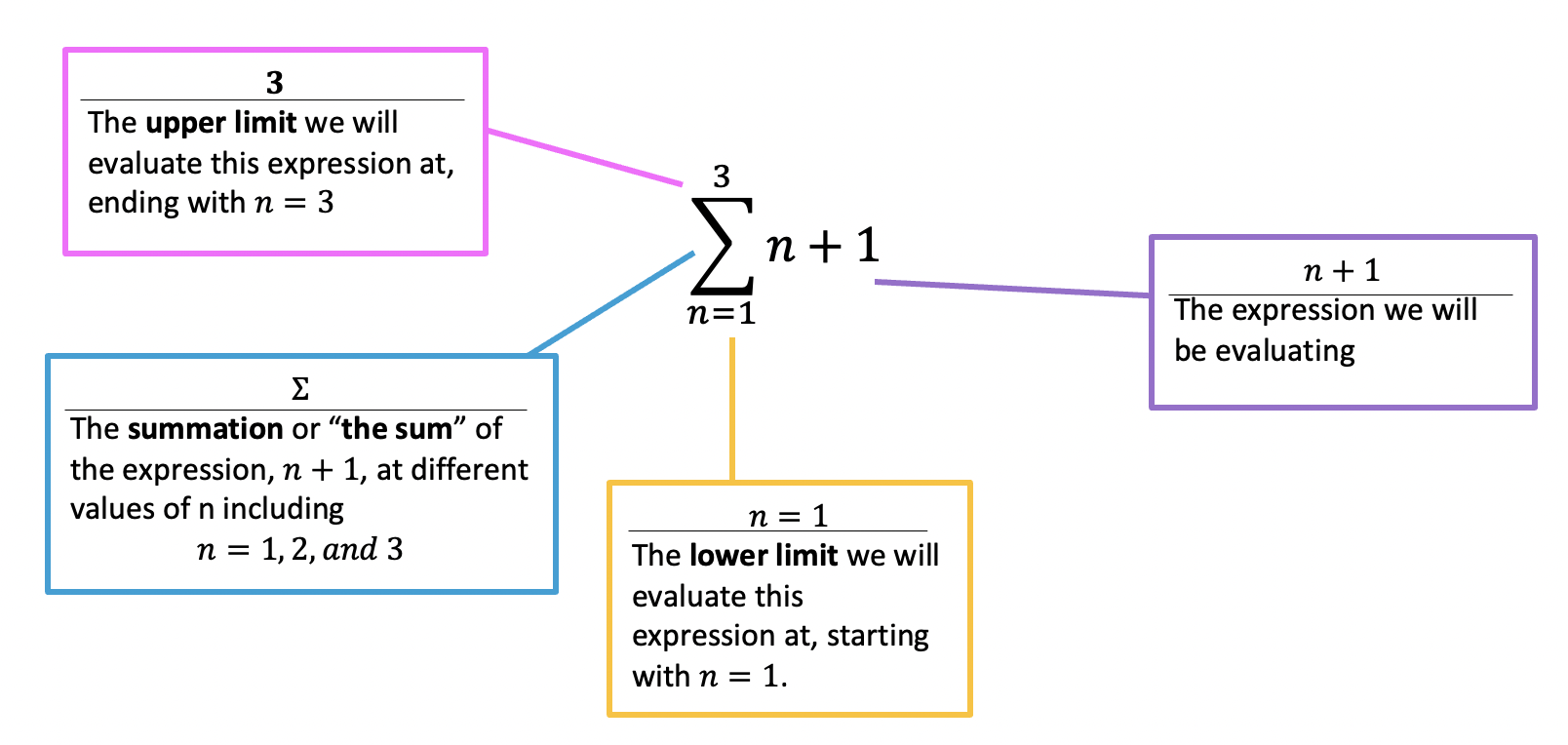
Here's a breakdown of the parts:
- The Index of Summation (e.g., or ): A variable that takes on integer values.
- The Lower Limit: The starting integer value for the index.
- The Upper Limit: The final integer value for the index.
- The Expression (Summand): The formula that is evaluated for each value of the index.
The notation instructs us to:
- Start with the index .
- Evaluate the expression , which gives .
- Increment the index to and evaluate , giving .
- Continue this process until the index reaches the upper limit, .
- Sum all the results: .
The following video provides a friendly introduction to the concept of a series and how sigma notation is used to represent it.
Introduction to Series and Summation Notation (Precalculus - College Algebra 68)
This video by Professor Leonard introduces the concept of a series as the sum of a sequence's terms and explains the components of summation notation.
Watch the first part of the video, from the beginning to the basic mechanism, where the instructor explains what a series is and how to expand a sum written in sigma notation. Pay close attention to how the index, limits, and sequence formula work together.
Properties of Summations
To "manipulate" series, we need to understand the algebraic rules they follow. These properties are direct consequences of the familiar laws of addition and multiplication (like associativity and distributivity). They allow us to break down complex sums into simpler, more manageable parts.
The main properties are:
- Factoring out a constant: A constant multiplier inside a sum can be factored out.
- Splitting sums and differences: A sum of two expressions can be split into two separate sums.
- Summing a constant: The sum of a constant repeated times is simply .
Since you appreciate formal rigor, it's worth noting that these properties can be formally proven using mathematical induction. The resource below provides such a proof for the third property.
This document from Millersville University outlines the properties of sums and provides a formal proof by induction for one of them.
Please read the section titled "Properties of sums", which lists the key properties and then walks through an inductive proof for the sum of a constant.
A Toolbox of Standard Formulas
While the properties help us simplify the structure of a sum, they don't always help us compute the final value. For that, mathematicians have derived closed-form formulas for several common series. Knowing these is essential.
The following video introduces the most important formulas and, for the sum of the first integers, provides the elegant intuitive proof famously discovered by a young Carl Friedrich Gauss.
Discrete Math - 2.4.4 Summation Properties and Formulas
This video from the Kimberly Brehm channel clearly presents the properties of summation and the closed-form formulas for the most common series.
Please watch the following segments: First, watch the overview of summation properties. This will reinforce what we just discussed. Next, watch the derivation of the formula for the sum of integers. Then, see the formula for the sum of squares. Finally, learn the formula for a geometric progression. Note that this formula starts from k=0.
Here is a summary of the key formulas for sums starting at :
- Sum of the first integers:
- Sum of the first squares:
- Sum of the first cubes:
Manipulating Complex Series
The real power of this framework comes when we combine the properties and formulas to solve complex sums without calculating each term. The strategy is to:
- Use the properties to break the complex sum into simpler sums.
- Factor out any constants.
- Apply the standard formulas to each simple sum.
- Combine the results.
Professor Leonard's video provides an excellent, detailed walkthrough of this exact process. He tackles a difficult-looking series and systematically simplifies it.
Introduction to Series and Summation Notation (Precalculus - College Algebra 68)
This video demonstrates how to use the standard formulas and properties together to evaluate a complex finite series.
Please watch the segment from applying the formulas. The instructor first introduces the standard formulas and then applies them step-by-step to a polynomial series, \sum_{k=1}^{12} (k^3 - 4k^2 + 5k + 7). Follow his process of separating terms, factoring constants, and substituting the formulas.
Beyond the Basics: Changing Indices and Telescoping Series
Two other powerful manipulation techniques are worth knowing.
1. Changing the Index of Summation
Sometimes a sum doesn't start at 1, which prevents us from using our standard formulas directly. We can adjust the limits by making a substitution. For example, to evaluate , we can let .
- When , .
- When , .
So the sum becomes . This is now in a form we can work with. We can calculate and subtract the terms we don't want: .
2. Telescoping Series
This is a special type of series where most intermediate terms cancel each other out, leaving only the first few and last few terms.
This document provides a clear example of a telescoping sum.
Find the example of a telescoping sum in the text. Notice how the expression is first manipulated into the form a_n - a_{n+1}, which sets up the cancellation.
The Language of Products: Pi Notation
Just as sigma notation represents repeated addition, Pi notation () represents repeated multiplication. The structure is identical to sigma notation, with an index, limits, and an expression.

The most famous example of product notation is the factorial function:
A crucial distinction lies with empty operations. An empty sum, like , is defined as 0, the additive identity. An empty product, , is defined as 1, the multiplicative identity. This convention ensures that mathematical rules remain consistent even in these edge cases.
[PDF] Notes on summations and related topics
This resource introduces product notation and explains the important concept of an empty product.
Please read the brief section titled "Products". Focus on the comparison with summation and the rationale for defining an empty product as 1.
Conclusion
In this lesson, you've learned the essential notation for representing and working with series. These tools are not just for mathematical convenience; they are the building blocks for expressing complex operations in machine learning, statistics, and calculus.
Key Takeaways:
- Summation () and Product () notations provide a compact way to express repeated addition and multiplication.
- They consist of an index, lower and upper limits, and an expression to be evaluated.
- Summations have properties of linearity that allow you to split them up and factor out constants.
- A "toolbox" of closed-form formulas exists for common series (sums of integers, squares, cubes, geometric series).
- By combining properties and formulas, you can manipulate and evaluate complex series systematically.
- An empty sum is 0 (the additive identity), while an empty product is 1 (the multiplicative identity).
In our next lesson, we will explore function composition and inverses. We will see how functions can be combined or "undone," which are concepts that underpin the architecture of neural networks and the logic of feature transformations in data science.