¡Hola! Welcome back.
In our recent lessons, we've built a solid foundation for narrating past events. You've learned to use the imperfect for descriptions, the preterite for completed actions, and the present perfect for life experiences. Today, we'll put these skills to work in a very practical, high-impact scenario for the wedding: explaining how you know someone.
Your goal for this lesson is to explain how you know someone using past tenses (e.g., 'nos conocimos en...'). Mastering this will allow you to answer one of the most common questions in any social gathering: "So, how do you two know each other?"
We'll focus on the verb conocer, which has a fascinating and systematic change in meaning when used in different past tenses—a perfect example of the kind of grammar rule that allows for precise expression.
1. The Key Verb: Conocer and Its Meaning Shift
In the present tense, conocer means "to know" in the sense of being familiar with a person, place, or thing. For example, Conozco a la novia means "I know the bride."
However, its meaning changes significantly in the past tenses. This distinction is a cornerstone of expressing relationships in Spanish. The difference is rooted in the very nature of the preterite and imperfect tenses you've already studied: completed actions versus ongoing states.
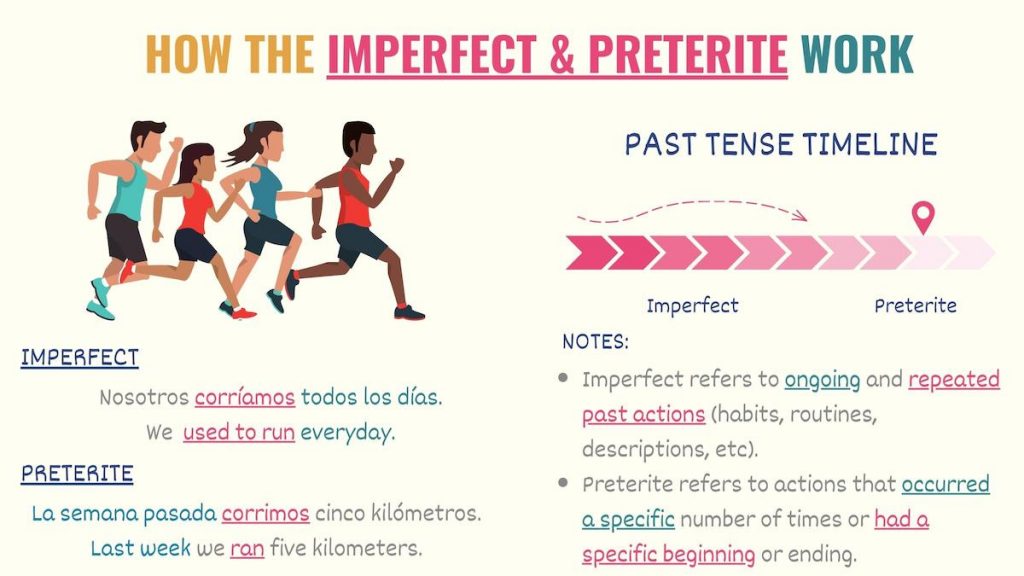
Applying this logic to conocer:
- Imperfect (
conocía): Describes the ongoing state of knowing someone in the past. It means "knew" or "used to know." - Preterite (
conocí): Refers to the single, completed action of coming to know someone. It means "met" for the first time.
The following resource explains this concept clearly.
Verbs That Change Meaning - Preterite vs. Imperfect
This article, 'Verbs That Change Meaning', gives a logical explanation for why 'conocer' shifts from 'to know' to 'to meet'. This systematic rule is key to using it correctly.
Read section 1, titled 'Conocer'. Focus on the logic provided: the act of meeting someone is a singular, completed event (preterite), while the state of knowing them is ongoing (imperfect).
To see this distinction in a real sentence, consider this powerful example.
Saber and Conocer in the Spanish Past Tenses
The article 'Saber and Conocer in the Spanish Past Tenses' provides a perfect sentence demonstrating both past tense uses of 'conocer' side-by-side.
Read the section 'Conocer in the preterite and imperfect past' and pay close attention to the example sentence: 'Se perdió de camino a mi casa, pero conoció a un chico, y a ese chico, yo lo conocía del trabajo.'
Let's break down that example:
...pero **conoció** a un chico...(...but she met a guy...) - Preterite: The single event of meeting him for the first time....yo lo **conocía** del trabajo.(...I knew him from work.) - Imperfect: The ongoing state of being familiar with him prior to that moment.
2. Building Your Sentences
Now let's construct the key phrases you'll use at the wedding.
"We met..." - The Reciprocal nos conocimos
The most common way to explain a shared connection is to say "we met...". In Spanish, this uses a reciprocal structure.
Formula: Nos conocimos + [time/place]
Here, nos means "each other." So, nos conocimos literally translates to "we met each other."
Nos conocimos en la universidad.- We met at university.Nos conocimos hace tres años.- We met three years ago.Nos conocimos en el trabajo.- We met at work.
"I met..." - The Personal 'a'
When you state that you met a specific person, you must use the personal 'a'. This is a non-negotiable rule when the direct object of a verb is a person.
Formula: Conocí a + [person] + [time/place]
Conocí a la novia en Bogotá.- I met the bride in Bogotá.Conocí al novio en una fiesta.- I met the groom at a party. (a+el=al)
The following video will help solidify these structures and introduces the different ways of talking about "meeting."
Learn Spanish - TO MEET - Quedar or Conocer or Encontrarse?
This video, 'Learn Spanish - TO MEET', demonstrates the conversational use of 'conocer' in the past tense. It's a great way to hear these phrases in action.
Watch from 00:35 to 06:01. The speaker covers how to say 'I met' (conocí), 'we met' (conocimos), and 'we met each other' (nos conocimos). Note the consistent use of the personal 'a'.
Test your understanding!
Translate the following sentences into Spanish.
- We met at a wedding.
- I met Maria last year.
- I knew her parents from my old neighborhood.
Show answer
Nos conocimos en una boda.(Using the reciprocal preterite for a single event).Conocí a María el año pasado.(Using the preterite for a single event and the personal 'a').Conocía a sus padres de mi antiguo barrio.(Using the imperfect to describe a past state of knowing).
3. A Deeper Dive: Other Ways "To Meet"
Your preference for systematic rules will be useful here. In English, "meet" is ambiguous. Does it mean you were introduced, you bumped into someone, or you had a planned meeting? Spanish is more precise, and using the right verb shows a sophisticated understanding.
Conocer is only for the first time you meet someone. For other situations:
Encontrarse con: To meet by chance; to bump into someone.Me encontré con Carlos en el supermercado.- I bumped into Carlos at the supermarket.
Quedar con: To meet up with someone (pre-arranged).Quedé con mis amigos para cenar.- I met up with my friends for dinner.
This quick video segment will clarify the distinctions.
Learn Spanish - TO MEET - Quedar or Conocer or Encontrarse?
Let's return to the 'Learn Spanish - TO MEET' video to see the breakdown of these other two verbs. This will help you avoid common mistakes.
Watch the segments covering 'encontrarse con' (06:11 - 08:34) and 'quedar' (08:34 - 12:59). The final recap from 12:59 to 14:42 provides an excellent summary of all three verbs.
Understanding this system—conocer (first time), encontrarse (by chance), quedar (arranged)—gives you a robust framework for talking about any kind of meeting.
Conclusion
Excellent work today. You've just learned one of the most useful conversational skills for any social event. By understanding the systematic way the verb conocer changes meaning, you can now precisely describe how you know someone, distinguishing between the moment you first met and the period you knew them.
Key Takeaways:
- The meaning of
conocerchanges with the tense:- Preterite (
conocí): met for the first time. - Imperfect (
conocía): knew over a period of time.
- Preterite (
- To say "we met," use the reciprocal form:
Nos conocimos en... - When you meet a specific person, you must use the personal 'a':
Conocí a [persona] en... - Spanish has a system for different types of "meeting":
conocer(first time),encontrarse con(by chance), andquedar con(arranged).
Preview of the Next Lesson:
Now that you're comfortable talking about the past, we'll shift our focus to the future. In our next lesson, you will learn to use the 'ir a + infinitive' structure to talk about near-future plans. This is essential for answering questions like, "What are you going to do after the wedding?" or "Are you going to travel more in Colombia?"