¡Hola! Welcome back to your Spanish lessons.
In our last session, we mastered how to tell stories about past travel and where you've lived, focusing on the systematic difference between the preterite and imperfect tenses. You learned to use the preterite for the sequence of actions and the imperfect for the background scenery.
Today, we're shifting our focus from the past to the future. This is a crucial skill for small talk, allowing you to answer questions like “¿Qué planes tienes para el fin de semana?” (What are your plans for the weekend?) or “¿Qué vas a hacer después de la boda?” (What are you going to do after the wedding?).
Our learning goal is to use the 'ir a + infinitive' structure to talk about near-future plans. You'll find this structure particularly straightforward, as it follows a very clear and predictable formula—a systematic approach that should feel familiar.
1. The "Going To" Formula: A Simple System for the Future
In English, to talk about the near future, we often say "I am going to do something." Spanish uses an almost identical structure that is one of the most common ways to express future plans.
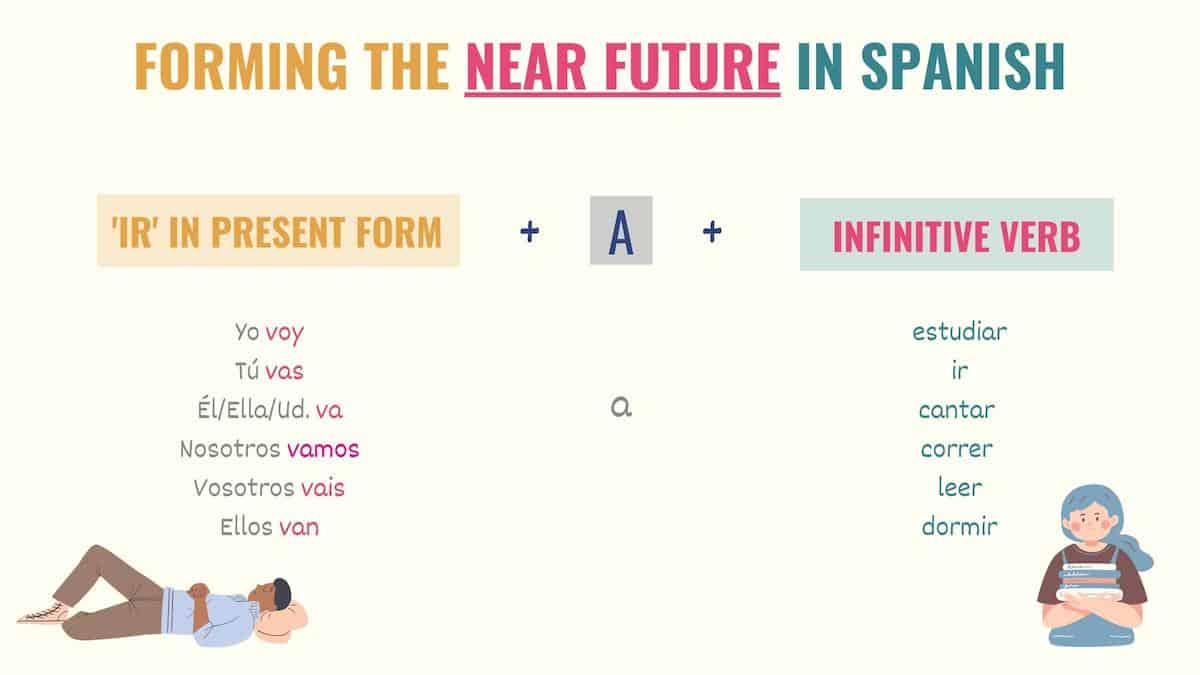
The structure is a simple, three-part formula:
Conjugated ir + a + Infinitive Verb
This is the grammatical equivalent of "to be going to + verb." Let's break it down:
- Conjugated
ir: The verbirmeans "to go." You conjugate it to match the person who is doing the action (e.g.,yo voy- I go,tú vas- you go). a: This small but essential word acts as a connector, similar to "to" in English. It always comes after the conjugatedir.- Infinitive Verb: This is the main action you are going to do (e.g.,
viajar- to travel,comer- to eat,dormir- to sleep). This verb is not conjugated; it stays in its original "-ar," "-er," or "-ir" form.
This diagram provides a clear visual breakdown of the formula.
To see this formula explained, please watch the first few minutes of the following video. The instructor compares it to a math formula, which is a great way to think about it.
Using ''Ir + a + Infinitive'' to Talk About the Near Future - Learn Spanish with Teacher Catalina
In 'Using ''Ir + a + Infinitive'' to Talk About the Near Future', Teacher Catalina introduces this structure as a clear formula and breaks down each component.
Please watch from 01:05 to 03:47. Pay attention to: The introduction of the ir + a + infinitive formula. The explanation of each part: the conjugated verb ir, the preposition a, and the unconjugated infinitive. The first example, Voy a comer (I am going to eat).
2. The Key Component: Conjugating ir
As you saw in the video, the only part of the formula that changes is the verb ir. Since ir is an irregular verb, its present tense conjugations don't follow the standard patterns and must be memorized. You've encountered this verb before, but let's do a quick, focused review.
Spanish Future Tense Conjugation (with Examples)
The article 'Spanish Future Tense Conjugation' from Busuu provides a clear and concise table of the present tense conjugations for 'ir'. This is the part of the formula you need to commit to memory.
Please read the section titled Ir + a + infinitive: Making future plans. Focus on the conjugation table for 'ir' in the present tense.
Here is that conjugation table for easy reference:
| Pronoun | ir Conjugation |
Meaning |
|---|---|---|
| yo | voy | I go / am going |
| tú | vas | you (informal) go / are going |
| él/ella/usted | va | he/she/you (formal) goes / is going |
| nosotros/nosotras | vamos | we go / are going |
| vosotros/vosotras | vais | you all (informal, Spain) go / are going |
| ellos/ellas/ustedes | van | they/you all go / are going |
As noted in the resource, since the wedding is in Colombia, you'll primarily hear and use ustedes and van for "you all" instead of vosotros and vais.
3. Assembling the Structure: Creating Sentences
Now, let's combine these components to form sentences. The process is a direct application of the formula.
Let's say you want to talk about your plans for after the wedding: "I am going to travel to Cartagena."
- Start with the subject's
irform: For "I," this isvoy. - Add the connector:
a. - Add the main verb (infinitive):
viajar. - Add the rest of the sentence:
a Cartagena.
Putting it together: Voy a viajar a Cartagena.
Let's try another one: "We are going to dance at the party."
irform for "We":vamos.- Connector:
a. - Infinitive:
bailar(to dance). - Rest of sentence:
en la fiesta.
Result: Vamos a bailar en la fiesta.
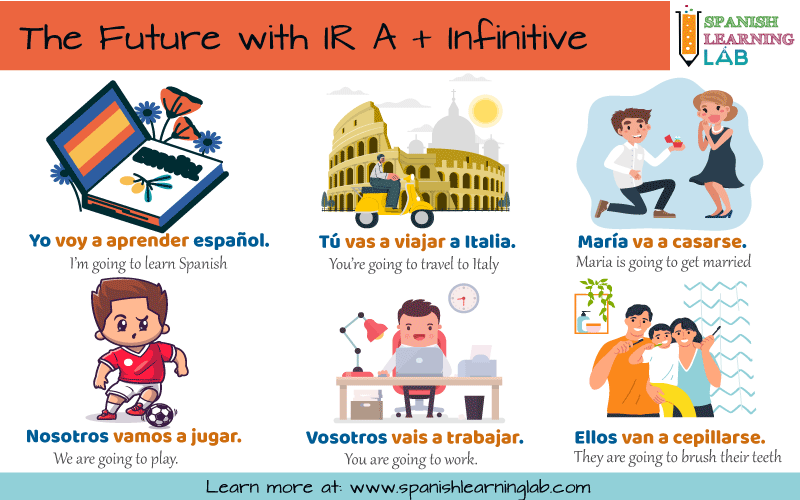
The following image provides more excellent examples with different subjects and verbs.
Test your understanding!
Using the formula, translate the following simple ideas into Spanish sentences.
- You (informal) are going to eat. (to eat =
comer) - She is going to work. (to work =
trabajar) - They are going to read. (to read =
leer)
Show answer
Tú vas a comer.(or simplyVas a comer.)Ella va a trabajar.Ellos van a leer.
4. Adding Detail with Time Expressions
To make your future plans clearer, you can add time expressions. This is exactly like saying "I'm going to travel tomorrow."
The resource 'Ir A + Infinitive' from StudySpanish.com offers a helpful list of common time expressions you can use with this structure.
Scroll down to the list of 'useful words and expressions'. Review these phrases, as they are essential for specifying when your plans will happen.
Here are some of the most useful time expressions:
hoy: todayesta noche: tonightmañana: tomorrowmañana por la mañana: tomorrow morningmás tarde: laterel fin de semana: on the weekendla semana que viene/la próxima semana: next week
You can usually place these at the beginning or end of the sentence.
Voy a llamar a mis padres **esta noche**.(I am going to call my parents tonight.)**Mañana** vamos a visitar un museo.(Tomorrow we are going to visit a museum.)Él va a descansar **el fin de semana**.(He is going to rest on the weekend.)
This combination of the ir a + infinitive formula with time expressions gives you a powerful and flexible tool for any conversation about plans.
Final Practice
Now, let's put it all together. Translate the following sentences, which are typical of small talk, into Spanish.
- I am going to travel to Colombia next month. (next month =
el mes que viene) - What are you (informal) going to do tomorrow? (
hacer= to do) - We are going to celebrate tonight. (
celebrar= to celebrate)
Show answer
Voy a viajar a Colombia el mes que viene.¿Qué vas a hacer mañana?(Remember to put the question wordQuéat the beginning.)Vamos a celebrar esta noche.
Conclusion
Excellent work! You've now learned the most common and practical way to discuss future plans in Spanish. By mastering this simple, systematic formula, you've unlocked a huge range of conversational possibilities for the wedding and beyond.
Key Takeaways:
- The Formula: The structure for near-future plans is
conjugated ir + a + infinitive. - The Moving Part: The only verb you need to conjugate is
ir(voy, vas, va, vamos, vais, van). The main action verb always stays in its infinitive form. - Practical Application: You can combine this structure with time expressions like
mañana,esta noche, orel fin de semanato make your plans specific.
Preview of the Next Lesson:
Now that you can share your plans, what happens if you don't understand what someone asks you about theirs? In our next lesson, we'll cover another crucial conversational tool: how to ask for clarification and repetition in conversation. This will help you keep the dialogue flowing smoothly, even when you miss a word or phrase.