Hello! Welcome back to your Spanish course.
In our last lesson, you learned how to use the preterite tense to talk about completed past actions—the specific events that happened. This lesson introduces its essential counterpart: the imperfect tense. This is the key to adding depth and context to your stories, moving from a simple sequence of events to a rich narrative.
Today's learning outcome is to conjugate regular and key irregular verbs (ser, ir, ver) in the imperfect tense to describe past settings, routines, and ongoing actions. You'll learn the rules for forming this tense and, crucially, when to use it to talk about what things were like, what you used to do, or what was happening when something else occurred.
1. The Scenery of the Past: What is the Imperfect Tense?
While the preterite focuses on the main action points of a story, the imperfect tense sets the scene. It describes the background details: ongoing activities, repeated habits, and descriptions of people, places, and feelings in the past.
A great way to conceptualize this comes from the "Cyber Profe" YouTube channel. While the preterite is like a fish leaping out of the water (a distinct, completed event), the imperfect is like the waves on a beach: continuous, repetitive, with no clear beginning or end.
To help remember when to use the imperfect, you can use the acronym WATERS:
- Weather: It was raining (
Llovía). - Age: I was ten years old (
Tenía diez años). - Time/Date: It was three o'clock (
Eran las tres). - Emotion/Feeling: I was happy (
Estaba feliz). - Repetition (Habitual Actions): We used to go every summer (
Íbamos cada verano). - Setting/Description: The house was big (
La casa era grande).
The following video provides a detailed overview of these uses. Pay special attention to the English equivalents he mentions, such as "was/were -ing" and "used to."
Mastering the Imperfect Tense in Spanish | The Language Tutor *Lesson 50*
In this video, 'Mastering the Imperfect Tense in Spanish' from The Language Tutor, the instructor clearly explains the conditions for using the imperfect tense.
Watch from the beginning until 08:45. Focus on understanding the concepts behind when to use the imperfect, such as for ongoing actions, habits, descriptions, and feelings.
Here's a visual summary of those key uses:
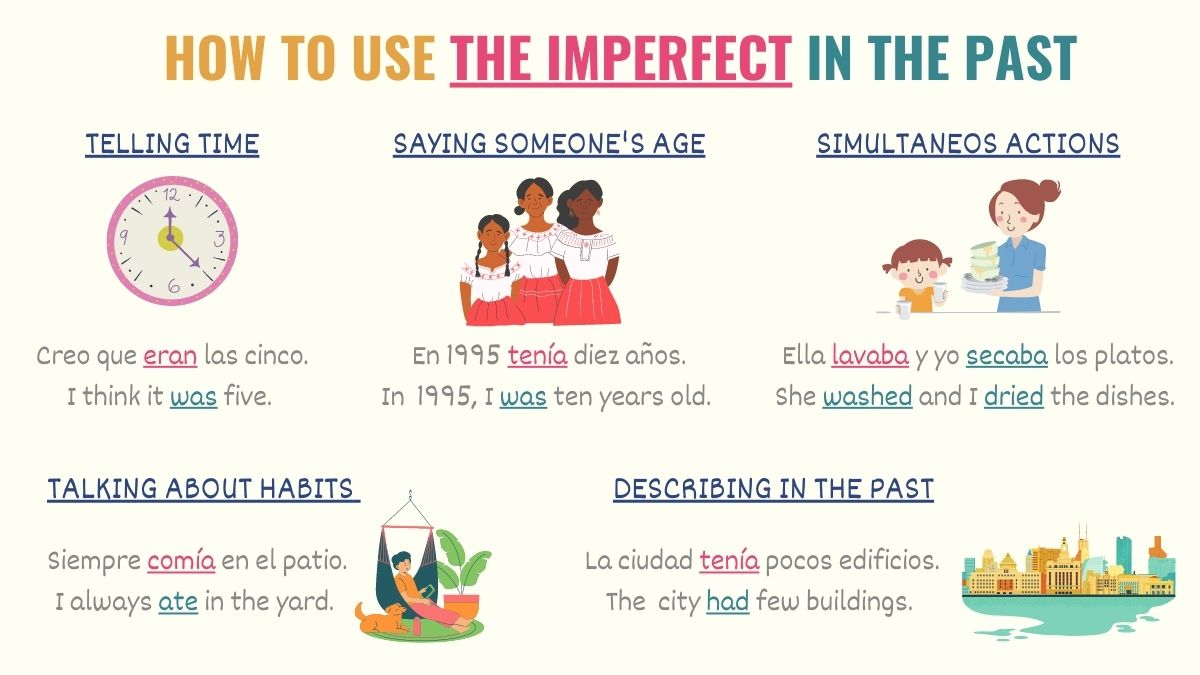
2. Conjugating Regular Verbs in the Imperfect
You'll be glad to hear that conjugating verbs in the imperfect is more straightforward than the preterite. There are no stem changes for regular verbs, and there are only two sets of endings to learn.
The process is systematic, just as with other tenses:
- Take the verb's infinitive form (e.g.,
hablar,comer). - Remove the
-ar,-er, or-irending to find the stem. - Add the appropriate imperfect ending.
This image neatly visualizes the two-step process.

Regular -ar Verb Endings
| Subject | Ending | Example: caminar (to walk) |
|---|---|---|
| yo | -aba | caminaba (I was walking / I used to walk) |
| tú | -abas | caminabas |
| él/ella/usted | -aba | caminaba |
| nosotros | -ábamos | caminábamos |
| vosotros | -abais | caminabais |
| ellos/ellas/ustedes | -aban | caminaban |
Notice that the yo and él/ella/usted forms are identical. Context will make the subject clear. The accent on nosotros (-ábamos) is important for pronunciation.
Regular -er and -ir Verb Endings
Again, we have an efficiency gain: -er and -ir verbs share the same set of endings.
| Subject | Ending | Example: comer (to eat) |
Example: vivir (to live) |
|---|---|---|---|
| yo | -ía | comía (I was eating / I used to eat) | vivía (I was living / I used to live) |
| tú | -ías | comías | vivías |
| él/ella/usted | -ía | comía | vivía |
| nosotros | -íamos | comíamos | vivíamos |
| vosotros | -íais | comíais | vivíais |
| ellos/ellas/ustedes | -ían | comían | vivían |
Note that every ending in this set begins with an accented í.
To hear these endings pronounced and see them in action, let's return to the video.
Mastering the Imperfect Tense in Spanish | The Language Tutor *Lesson 50*
The next segment of 'Mastering the Imperfect Tense in Spanish' covers the conjugation patterns for regular verbs.
Watch from 09:09 to 15:10. The video will walk you through the endings for -ar verbs, and then the shared endings for -er and -ir verbs.
Test your understanding!
Conjugate the following verbs in the imperfect tense to describe a past scene.
- When I was a child, I (hablar) Spanish with my grandmother. (
Cuando era niño, yo _______ español con mi abuela.) - The guests (comer) appetizers and (beber) wine. (
Los invitados _______ aperitivos y _______ vino.) - We (vivir) in a small apartment at that time. (
Nosotros _______ en un apartamento pequeño en esa época.)
Show answer
Cuando era niño, yo **hablaba** español con mi abuela.Los invitados **comían** aperitivos y **bebían** vino.Nosotros **vivíamos** en un apartamento pequeño en esa época.
3. The "Only Three" Irregulars: ser, ir, ver
This is another area where the imperfect is simpler than the preterite. There are only three irregular verbs in the entire imperfect tense. Mastering them is essential, as they are extremely common.
The following resource provides a very clear reference table for these three verbs.
The article 'Spanish Imperfect Tense' on SpanishDict.com has a concise section on the irregular verbs. It's a perfect reference to study and bookmark.
Please read the section titled 'Irregular Imperfect Forms'. Focus on memorizing the conjugation table for ir, ser, and ver.
Here is a summary of those conjugations:
| Subject | ser (to be) |
ir (to go) |
ver (to see) |
|---|---|---|---|
| yo | era | iba | veía |
| tú | eras | ibas | veías |
| él/ella/usted | era | iba | veía |
| nosotros | éramos | íbamos | veíamos |
| vosotros | erais | ibais | veíais |
| ellos/ellas/ustedes | eran | iban | veían |
Key Observations:
serandirare completely irregular.veris mostly regular; it keeps itsvand adds the standard-er/-irendings (-ía,-ías, etc.). You can think of its stem asve-.
Let's watch the final part of the video lesson to reinforce these three verbs.
Mastering the Imperfect Tense in Spanish | The Language Tutor *Lesson 50*
The video now concludes by covering each of the three irregular verbs one by one.
Watch from 15:10 to 18:22. This will clearly present the conjugations for ser, ir, and ver.
Test your understanding!
Imagine you're describing a past wedding you attended. Fill in the blanks.
- The bride (ser) very elegant. (
La novia _______ muy elegante.) - We often (ir) to the dance floor. (
Nosotros _______ a la pista de baile a menudo.) - From our table, we (ver) the whole family celebrating. (
Desde nuestra mesa, nosotros _______ a toda la familia celebrar.)
Show answer
La novia **era** muy elegante.Nosotros **íbamos** a la pista de baile a menudo.Desde nuestra mesa, nosotros **veíamos** a toda la familia celebrar.
Conclusion
Great job today! You have now learned the second of the two main Spanish past tenses. By mastering the imperfect, you can now "paint a picture" with your words, describing settings, feelings, and past habits, which adds a completely new dimension to your storytelling abilities.
Key Takeaways:
- The imperfect tense is used for descriptions, repeated actions (habits), and ongoing actions in the past ("was/were -ing" or "used to do").
- The WATERS acronym is a helpful tool to remember when to use it.
- Regular
-arverbs use -aba endings, and regular-er/-irverbs use -ía endings. - There are only three irregular verbs in the imperfect: ser (era, eras...), ir (iba, ibas...), and ver (veía, veías...).
Preview of the Next Lesson:
You now know the preterite (what happened) and the imperfect (what was happening). The next logical—and crucial—step is learning how to choose between them in the same sentence or story. Our next lesson will focus on differentiating between the preterite and imperfect tenses to narrate past events and describe situations. This will allow you to combine both tenses to tell engaging and clear stories about your experiences.