Hello! Welcome back.
In our previous lessons, we've built a solid foundation for conversations in the present tense, covering everything from introducing yourself to describing how often you do your hobbies. Now, we're going to take a major step that will dramatically increase your conversational range: talking about the past. This is essential for sharing stories and experiences, which is at the heart of getting to know someone at the wedding.
This lesson addresses the learning outcome: Conjugate regular and key irregular verbs (ser, ir, dar, ver) in the preterite tense to describe completed past actions. You will learn the systematic rules for forming the simple past tense for most verbs, and then master the conjugations for four of the most common and important irregular verbs.
1. What is the Preterite Tense?
In Spanish, there are two main past tenses. Today, we focus on the first one: the preterite tense (el pretérito).
The preterite is used to talk about actions that were completed at a specific point in the past. Think of them as single, finished events.
- I ate an apple. (
Comí una manzana.) - She arrived yesterday. (
Ella llegó ayer.) - We went to the cinema. (
Fuimos al cine.)
This is different from describing ongoing actions or settings in the past (like "I was eating" or "It was a sunny day"), which we'll cover in the next lesson with the imperfect tense.
For a quick and clear introduction, the following video explains the concept of the preterite.
Preterite/pretérito in Spanish: how to form it & learn it! Easy animated explanation for beginners.
The video 'Preterite/pretérito in Spanish' from the Lingo Learner channel provides a great animated explanation of what the preterite tense is and how it compares to English.
Watch the first part of the video, from 00:00 to 01:17. This will introduce you to the concept of the preterite as the 'simple' past tense.
2. Conjugating Regular Verbs in the Preterite
Given your preference for systematic rules, you'll appreciate how regular verbs are conjugated in the preterite. The process is identical to the present tense:
- Take the infinitive verb (e.g.,
hablar). - Remove the ending (
-ar,-er, or-ir). - Add the correct preterite ending based on the subject.
There are only two sets of endings for regular verbs.
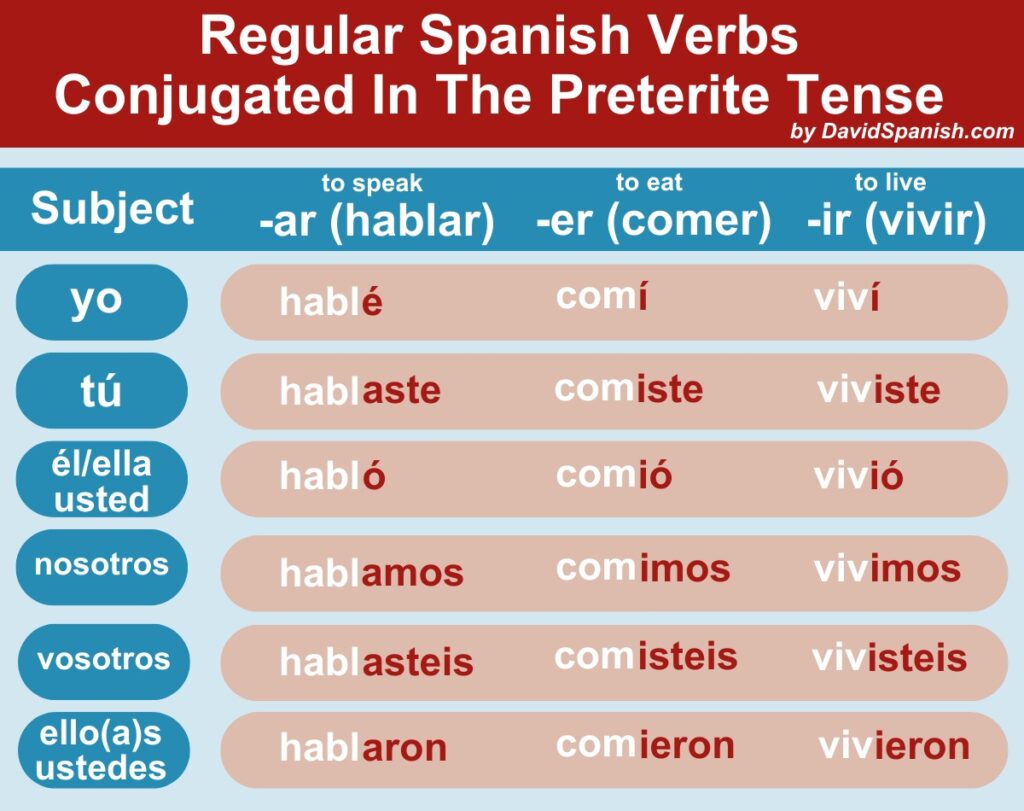
Regular -AR Verb Endings
| Subject | Ending | Example: hablar (to speak) |
|---|---|---|
| yo | -é | hablé (I spoke) |
| tú | -aste | hablaste (you spoke) |
| él/ella/usted | -ó | habló (he/she/you spoke) |
| nosotros | -amos | hablamos (we spoke) |
| vosotros | -asteis | hablasteis (you all spoke) |
| ellos/ellas/ustedes | -aron | hablaron (they spoke) |
Crucial Note on Accents: The accent marks on the yo (-é) and él/ella/usted (-ó) forms are not optional. They change the meaning entirely. For example, hablo means "I speak" (present tense), while habló means "he/she spoke" (past tense).
Regular -ER and -IR Verb Endings
Here's an efficiency gain: -er and -ir verbs share the exact same endings in the preterite.
| Subject | Ending | Example: comer (to eat) |
Example: vivir (to live) |
|---|---|---|---|
| yo | -í | comí (I ate) | viví (I lived) |
| tú | -iste | comiste (you ate) | viviste (you lived) |
| él/ella/usted | -ió | comió (he/she ate) | vivió (he/she lived) |
| nosotros | -imos | comimos (we ate) | vivimos (we lived) |
| vosotros | -isteis | comisteis (you all ate) | vivisteis (you all lived) |
| ellos/ellas/ustedes | -ieron | comieron (they ate) | vivieron (they lived) |
To see these rules in action and hear the pronunciation, let's return to the Lingo Learner video.
Preterite/pretérito in Spanish: how to form it & learn it! Easy animated explanation for beginners.
This next segment of the video demonstrates the conjugation patterns for all three types of regular verbs.
Watch from 01:17 to 03:56. Pay close attention to how the endings are added to the verb stems for -ar, -er, and -ir verbs.
Test your understanding!
Let's apply these patterns. How would you conjugate the following verbs?
viajar(to travel) in theyoform.aprender(to learn) in theellaform.abrir(to open) in thenosotrosform.
Show answer
Yo viajé.(I traveled.)Ella aprendió.(She learned.)Nosotros abrimos.(We opened.)
3. Key Irregular Verbs: ser, ir, dar, ver
As in English, some of the most frequently used verbs in Spanish are irregular. Memorizing them is essential for fluency. Today, we'll focus on four critical ones.
The article from SpanishDictionary provides a very clear, tabular summary of these verbs, which is perfect for reference.
Spanish Preterite Tense | SpanishDictionary. ...
The article 'Spanish Preterite Tense' from SpanishDictionary.com has excellent, clear conjugation tables that are perfect for study and review.
Please read the section titled 'Irregular Spanish Preterite Forms'. Focus on the conjugation table that shows ser, ir, dar, and ver. You don't need to read about the 'Uses of the Preterite' for now.
Let's break them down.
ser (to be) and ir (to go)
This is one of the strangest but most useful quirks of Spanish: ser and ir have identical conjugations in the preterite. You can only tell them apart by context.

- Context for
ir(to go): Usually followed bya+ destination.Ayer **fui** al mercado.(Yesterday I went to the market.)Ellos **fueron** a la fiesta.(They went to the party.)
- Context for
ser(to be): Used for descriptions, professions, identity.La fiesta **fue** divertida.(The party was fun.)Él **fue** mi profesor.(He was my teacher.)
dar (to give) and ver (to see)
These two verbs are also irregular but simpler. They loosely follow the -er/-ir endings but without any accent marks.
| Subject | dar (to give) |
ver (to see) |
|---|---|---|
| yo | di | vi |
| tú | diste | viste |
| él/ella/usted | dio | vio |
| nosotros | dimos | vimos |
| vosotros | disteis | visteis |
| ellos/ellas/ustedes | dieron | vieron |
Example Sentences:
Yo te **di** el libro.(I gave you the book.)¿**Viste** la película anoche?(Did you see the movie last night?)
The Lingo Learner video also covers these four irregular verbs, which will help with pronunciation.
Preterite/pretérito in Spanish: how to form it & learn it! Easy animated explanation for beginners.
Let's watch the final relevant part of the Lingo Learner video, where it introduces these 'completely irregular' verbs.
Watch from 04:50 to 06:07 and from 07:35 to 08:43. This section specifically goes over the conjugations for ser, ir, dar, and ver and provides a short practice quiz.
Test your understanding!
Let's practice with some wedding-themed small talk. Fill in the blanks with the correct preterite form.
La ceremonia _______ (ser) muy bonita.(The ceremony was very beautiful.)Yo _______ (ver) a los novios en la entrada.(I saw the bride and groom at the entrance.)¿Cuándo _______ (ir) ustedes a Colombia?(When did you all go to Colombia?)Mi amigo me _______ (dar) su invitación la semana pasada.(My friend gave me his invitation last week.)
Show answer
La ceremonia **fue** muy bonita.Yo **vi** a los novios en la entrada.¿Cuándo **fueron** ustedes a Colombia?Mi amigo me **dio** su invitación la semana pasada.
Conclusion
Excellent work! You've just unlocked a huge part of the Spanish language. Being able to talk about completed past events is fundamental to sharing stories and having more meaningful conversations.
Key Takeaways:
- The preterite tense is used for single, completed actions in the past.
- Regular verbs follow a systematic pattern: remove the infinitive ending and add
-é, -aste, -ó, -amos, -asteis, -aronfor -ar verbs, or-í, -iste, -ió, -imos, -isteis, -ieronfor -er/-ir verbs. - Accents are crucial and change the meaning of the verb.
- The four key irregular verbs are
ser,ir,dar, andver. Remember thatserandirare identical in the preterite and context is key.
Preview of the Next Lesson:
Now that you can talk about what happened, the next step is to learn how to describe what was happening or what things were like in the past. In our next lesson, we will "Conjugate regular and key irregular verbs (ser, ir, ver) in the imperfect tense to describe past settings, routines, and ongoing actions." Mastering both past tenses will allow you to narrate events with rich detail and clarity.