Hello! Welcome to the first lesson in your journey to learn conversational Spanish.
Our goal for this course is to get you ready to make small talk at a wedding in Colombia in nine months. To get there efficiently, this first module is all about "learning how to learn."
Today, we'll focus on a powerful technique to ensure the new words you learn actually stick in your long-term memory. The learning outcome for this lesson is to apply spaced repetition principles to schedule your Spanish vocabulary review sessions.
This method is essentially an algorithm for efficient learning. It helps you schedule reviews at the perfect moment—just before you're about to forget something—thereby minimizing study time and maximizing retention.
The Problem: The Forgetting Curve
When you learn something new, your memory of it naturally decays over time. This was famously mapped by the psychologist Hermann Ebbinghaus, who created the "forgetting curve." Without any review, you might forget 50% of new vocabulary within a day and up to 90% within a week. Trying to "cram" information is inefficient because you're constantly fighting this rapid decay.
Spaced Repetition is the solution. By reviewing information at specific, increasing intervals, you "reset" the forgetting curve each time, making the memory stronger and more durable.
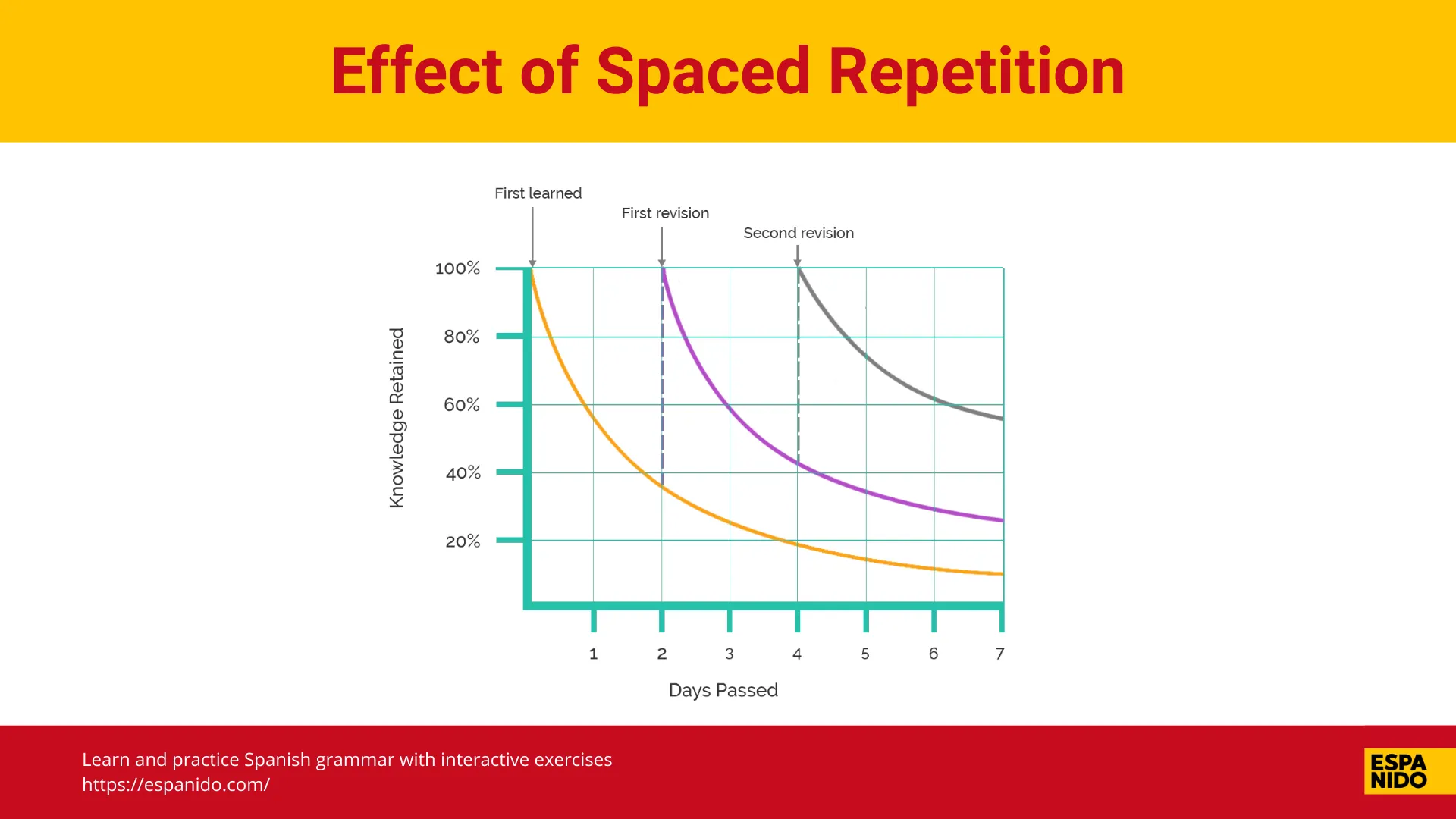
How Spaced Repetition Works
The core idea is simple: the better you know an item, the longer you can wait before reviewing it again. Let's watch a short video that introduces the concept and a simple, manual way to implement it.
The Secret Trick to Remember Every Spanish Word You Learn (Spaced Repetition)
The video 'The Secret Trick to Remember Every Spanish Word You Learn' from the Spring Spanish channel provides a great introduction to the Spaced Repetition System (SRS). We'll start by watching the first two sections.
Please watch from the timestamp 01:09 to 05:48. Focus on two key ideas: The basic concept of reviewing at increasing intervals. The practical 'five-box' system they describe for scheduling your reviews.
As the video explained, you can categorize your vocabulary based on how well you know it and review each category on a different schedule. Here's a typical schedule based on this principle:
- Category 1 (Very Difficult): Review daily.
- Category 2 (Difficult): Review every 3 days.
- Category 3 (Good): Review every 7 days.
- Category 4 (Easy): Review every 14 days.
- Category 5 (Mastered): Review every 30 days.
This manual system is a great way to understand the logic. However, you can imagine it becomes complex to manage hundreds of words. This is where specialized software comes in.
Using Software to Automate Your Schedule
Spaced Repetition System (SRS) software automates this entire process. You create digital flashcards, and the app's algorithm schedules them for you. After you review a card, you simply tell the app how difficult it was to remember, and it calculates the optimal time to show it to you again.
Given your background in machine learning, you can think of this as an optimization algorithm for your memory, where the "loss function" is forgetting, and the "hyperparameters" are the review intervals, which the software tunes for you.
Anki is widely considered the most powerful and customizable SRS tool for serious language learners. Let's see a quick tutorial on how it works.
How to use Anki for beginners! (Anki tutorial for language learning)
The video 'How to use Anki for beginners!' explains how the app uses spaced repetition. It will show you the basic review process.
Watch the sections from 00:51 to 01:34 and 05:40 to 06:40. Pay attention to how Anki uses your feedback ('Hard,' 'Good,' 'Easy') to automatically adjust the review schedule for each card.
While Anki is powerful, other user-friendly apps like Quizlet or the built-in review systems in platforms like Duolingo also use spaced repetition principles. The best tool is the one you'll use consistently.
Best Practices: Making Your Reviews Effective
The scheduling algorithm is only half of the equation. The quality of your flashcards is just as important for building usable, conversational skills. A poorly designed card, even on a perfect schedule, won't be very effective.
This article from Relearnify has excellent, practical advice on how to create powerful flashcards and master the timing of your reviews.
How to Use Spaced Repetition for Learning New Language
The article 'How to Use Spaced Repetition for Learning New Language' provides a detailed framework. We'll focus on the sections about creating effective cards and setting optimal review intervals.
Please read 'Step 2: Create powerful language cards' and 'Step 3: Master the optimal timing'. Focus on the difference between 'good' and 'bad' cards and the recommended starting intervals for different types of information (words vs. grammar).
Let's distill the most critical best practices from that reading:
- Learn in Context, Not Isolation: Instead of a card for the single word
sed(thirst), create a card for the phraseTengo sed(I am thirsty). This is more practical for conversation. - Prioritize Production over Recognition: Your goal is to speak, which requires producing the Spanish word. Design your cards to prompt this.
- Recognition (Less effective): Front:
la casa-> Back:the house - Production (More effective): Front:
the house-> Back:la casa
- Recognition (Less effective): Front:
- Use Multimedia: Include images and audio. A card for
el perro(the dog) is much more memorable with a picture of a dog and a recording of the pronunciation than with just the English text. - Keep Daily Sessions Short: Consistency is key. 15-20 minutes of focused review every day is far more effective than a two-hour session once a week. This builds the habit and prevents the review queue from becoming overwhelming.
Test your understanding!
Imagine you want to learn the Spanish word for "to eat," which is comer. Based on the best practices, which of these would be the most effective flashcard to create for use in an SRS app?
A) Front: comer | Back: to eat
B) Front: to eat | Back: comer
C) Front: Yo _______ una manzana. (I _______ an apple.) + Picture of someone eating an apple | Back: como (I eat) + Audio of "Yo como una manzana"
D) Front: A card explaining the conjugation rules for -er verbs like comer.
Show answer
Option C is the most effective. Here's why:
- It uses context (a full sentence).
- It forces production (you have to fill in the blank with the correct form of the verb).
- It uses multimedia (an image and implies audio would be included).
Option B is good because it focuses on production, but it lacks context. Option A focuses on recognition. Option D is about learning a grammar rule, which is important, but it's better learned through patterns and examples (like in C) rather than abstract explanation on a vocabulary card.
Conclusion
In this lesson, we've established a foundational technique for making your Spanish learning efficient and long-lasting.
Key Takeaways:
- Spaced Repetition Systems (SRS) combat the natural forgetting curve by scheduling reviews at increasing intervals.
- This process moves vocabulary from your short-term to your long-term memory, making it available for conversation.
- You can use a manual system to understand the principle, but apps like Anki automate the scheduling for you.
- For your flashcards to be effective, focus on context (phrases), production (English to Spanish), and multimedia (images/audio).
Your task before the next lesson is to put this into practice:
- Choose and download an SRS app (Anki is highly recommended, but Quizlet is also a great start).
- Create your first 5-10 flashcards using the best practices we discussed. You can start with basic greetings like
Hola(Hello),Gracias(Thank you),¿Cómo estás?(How are you?), and your name introductionMe llamo...(My name is...).
Preview of the Next Lesson:
Now that you know when to review vocabulary, our next lesson will focus on how to make new words memorable from the very first time you see them. We will explore mnemonic techniques to create strong, creative associations that make learning faster and more fun.