¡Hola! Welcome back.
In our last lesson, we built a crucial toolkit for managing conversations by learning how to ask for clarification and repetition. This ensures that even when you don't catch every word, you can stay engaged and turn confusion into a learning opportunity.
Today, we'll put those skills to use as we learn to discuss plans related to travel, work, and social events. This is the heart of small talk and will be incredibly useful for your conversations at the wedding in Colombia. We'll focus on the most common and practical way to talk about the future in Spanish, a structure you've already seen briefly: ir a + infinitive.
By the end of this lesson, you'll be able to ask people about their upcoming plans and share your own, moving from simple statements to more dynamic conversational exchanges.
1. The Blueprint for Future Plans: ir a + infinitive
To talk about what you or others are "going to do," Spanish uses a simple and logical formula. Think of it as a function where you input the person doing the action and the action itself. The structure is:
Conjugated ir + a + infinitive verb
This directly translates to "to be going to [do something]." Let's dive into a video that explains this "formula" very clearly.
Using ''Ir + a + Infinitive'' to Talk About the Near Future - Learn Spanish with Teacher Catalina
The video 'Using ''Ir + a + Infinitive'' to Talk About the Near Future' by Teacher Catalina provides an excellent breakdown of this structure. It's systematic and easy to follow.
Please watch from 01:42 to 06:36. As you watch, focus on: The three parts of the formula and which part gets conjugated. The full present-tense conjugation of the irregular verb ir (to go). How the meaning changes when you change the subject (e.g., voy a comer vs. vamos a comer).
As the video explained, the verb ir (to go) is irregular. Here is its present tense conjugation, which is the key to using this future structure:
| Pronoun | ir (to go) |
|---|---|
| yo | voy |
| tú | vas |
| él/ella/usted | va |
| nosotros/as | vamos |
| vosotros/as | vais |
| ellos/ellas/ustedes | van |
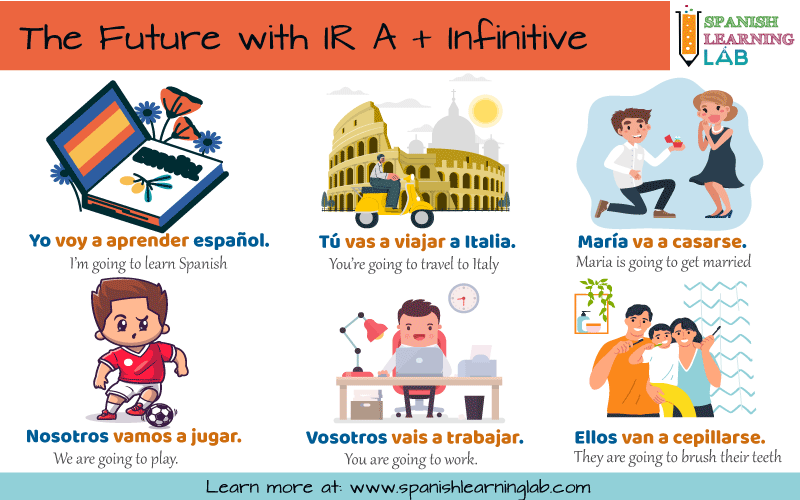
You simply select the correct form of ir, add a, and then finish with any infinitive verb (the base form ending in -ar, -er, or -ir).
Here is a great visual summary of this pattern in action.
Test your understanding!
Translate the following sentences into Spanish using the ir a + infinitive structure.
- She is going to work tomorrow.
- We are going to travel to Colombia.
- You (formal) are going to eat at a restaurant.
Show answer
- Ella va a trabajar mañana.
- Nosotros vamos a viajar a Colombia.
- Usted va a comer en un restaurante.
2. Building Your Vocabulary for Plans
Now that you have the grammatical structure, let's equip you with the specific vocabulary needed to discuss travel, work, and social events.
Travel Vocabulary
For discussing your travel plans in Colombia, you'll need words for transportation and describing the journey.
Talking about transport options in Spanish - BBC Bitesize
This BBC Bitesize article, 'Talking about transport options in Spanish', has excellent vocabulary lists that are perfect for this topic.
Please review the section titled 'Vocabulary- Describing travel and transport'. Focus on the three tables: 'Useful vocabulary for describing journeys' (e.g., rápido, barato). 'Useful verbs to describe travel' (e.g., viajar, llegar). The list of transport types below the image (e.g., el avión, el autobús).
Key Verbs for Common Plans
Here is a summary of high-frequency verbs, many of which you've seen in the video examples, categorized by topic:
| Travel Plans | Work Plans | Social Events |
|---|---|---|
viajar (to travel) |
trabajar (to work) |
comer (to eat) |
visitar (to visit) |
tener una reunión (to have a meeting) |
bailar (to dance) |
ir (to go) |
empezar (to start) |
ver una película (to watch a movie) |
llegar (to arrive) |
terminar (to finish) |
salir con amigos (to go out with friends) |
comprar un billete (to buy a ticket) |
hacer una presentación (to do a presentation) |
ir a una fiesta (to go to a party) |
Combine these verbs with the ir a + infinitive structure to form complete sentences about your plans.
- Después de la boda, voy a viajar a Cartagena. (After the wedding, I am going to travel to Cartagena.)
- El lunes, voy a tener una reunión importante. (On Monday, I am going to have an important meeting.)
- Este fin de semana, mis amigos y yo vamos a ir a una fiesta. (This weekend, my friends and I are going to go to a party.)
3. Asking and Answering: The Small Talk Engine
Knowing the structure and vocabulary is half the battle. The other half is using it in a conversational back-and-forth. This next video is a fantastic resource for learning the kinds of questions that spark discussions about plans.
How to Make GREAT Small Talk in Spanish? | ¿Cómo iniciar una conversación en español? | HOLA SPANISH
The video 'How to Make GREAT Small Talk in Spanish?' from Hola Spanish provides dozens of natural questions you can use. We'll focus on the ones related to our topics.
Please watch the sections on Work (02:57 - 05:09), General Life (05:09 - 08:03), and Travel (08:03 - 10:39). Don't worry about memorizing every question. Instead, listen for questions that start with: ¿Tienes planes para...? (Do you have plans for...?) ¿Qué vas a hacer...? (What are you going to do...?) ¿Estás planeando...? (Are you planning...?)
Practice Scenario: At the Wedding
Let's simulate a conversation. Imagine you are at the wedding reception, talking to a new acquaintance.
Their potential questions for you:
¿Qué planes tienes para el fin de semana?(What plans do you have for the weekend?)¿Vas a viajar por Colombia después de la boda?(Are you going to travel around Colombia after the wedding?)¿Cuándo vas a volver a tu país?(When are you going to return to your country?)
Your potential answers:
El fin de semana **voy a visitar** un museo en Bogotá.(On the weekend I am going to visit a museum in Bogotá.)Sí, **voy a viajar** a Medellín y Cartagena.(Yes, I'm going to travel to Medellín and Cartagena.)**Voy a volver** en dos semanas.(I'm going to return in two weeks.)
Your potential questions for them:
Now it's your turn to ask them questions to keep the conversation going.
¿Y tú? ¿Qué **vas a hacer** este fin de semana?(And you? What are you going to do this weekend?)¿Ustedes **van a viajar** para la luna de miel?(Are you all going to travel for the honeymoon? - asking the couple)¿**Vas a volver** al trabajo el lunes?(Are you going to go back to work on Monday?)
Remember your clarification tools! If they answer with a word you don't know, like, "Voy a rumbear," you can ask, ¿Qué significa "rumbear"? (It's Colombian slang for "to party").
4. A Quick Note: Another Way to Talk About the Future
The ir a + infinitive structure is perfect for plans and near-future events, and it's by far the most common way you'll hear people discuss these topics.
For completeness, you should know there is also a dedicated simple future tense (the futuro simple), like the English "will + verb". For example, viajaré (I will travel) instead of voy a viajar.
Spanish Future Tense Conjugation (with Examples)
This article from Busuu briefly explains the difference. It's good for context, but not something you need to master right now.
Read the section 'Expressing future actions in Spanish: Recap'. Just focus on the summary paragraph that distinguishes between the two future forms.
The key distinction is that ir a + infinitive is used for specific plans and intentions, while the futuro simple is often for more distant or general predictions. For your goal of making small talk about plans, ir a + infinitive is your primary tool.
Conclusion
Excellent work today! You have now combined a core grammatical structure with practical vocabulary to engage in one of the most common types of conversation.
Key Takeaways:
- The formula
conjugated ir+a+infinitiveis your go-to for discussing future plans. - Mastering the present tense of
iris essential (voy,vas,va,vamos,vais,van). - You can now form questions and answers about plans related to travel, work, and social events.
- This skill, combined with your ability to ask for clarification, makes your conversational ability much more robust and practical.
Preview of the Next Lesson:
To make your conversations even more personal and detailed, our next lesson will focus on using possessive adjectives (mi, tu, su, etc.). This will allow you to talk about your family, their friends, your job, and their travel plans, adding another layer of depth to your interactions. ¡Hasta la próxima