Hello! Welcome to your next Spanish lesson.
In our last session, we mastered three foundational irregular verbs: tener, hacer, and ir. You learned the crucial ir + a + infinitive structure (e.g., voy a viajar) for talking about future plans—a key skill for discussing your upcoming trip to Colombia.
Today, we'll shift our focus from the future to the immediate present. The goal of this lesson is to learn how to use the present progressive (estar + gerund) to describe ongoing actions. This is how you say what you are doing at the very moment of speaking, like "I am studying" or "We are talking." It's an essential tool for dynamic, real-time conversation.
The Anatomy of an Ongoing Action
In Spanish, to say something is happening right now, you combine two key components:
- The verb
estar(to be): You've already seenestarused for location and temporary states. Its temporary nature makes it the perfect choice for an action that is currently in progress. - A gerund (
gerundio): This is the Spanish equivalent of adding "-ing" to a verb in English (e.g., talking, eating).
The formula is: estar (conjugated) + main verb in gerund form
Let's start with a video that explains this concept and, importantly, contrasts it with the simple present tense you already know.
How to express what's happening right now in Spanish
The video 'How to express what's happening right now in Spanish' from the Butterfly Spanish channel provides a great introduction to this topic. The host, Ana, clearly explains when and why this tense is used.
Please watch from 00:20 to 05:18. Pay attention to: The distinction she makes between an action happening at this moment versus a habitual action (a routine). Her explanation for why estar is the correct auxiliary verb to use here.
As Ana explained, you use the simple present (yo cocino) for habits, but the present progressive (estoy cocinando) to describe the action as it unfolds.
Building the Gerund: A Systematic Approach
Creating the gerund is a systematic process, which should fit well with your preference for structured rules. The pattern depends on the verb's infinitive ending.
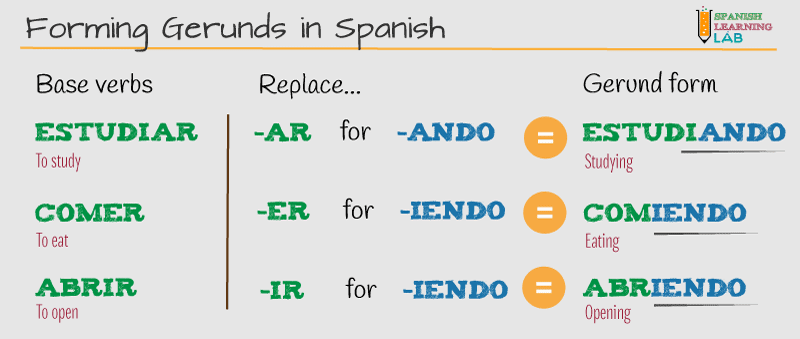
- For -ar verbs, drop the
-arand add-ando. - For -er and -ir verbs, drop the ending and add
-iendo.
This image provides a clear visual breakdown of this rule.
To see more examples and solidify this rule, let's turn to a well-structured article.
The Present Progressive Tense in Spanish: ESTAR + ...
The article 'The Present Progressive Tense in Spanish' from Spanish Learning Lab offers a concise, written summary of these rules.
Please read the section titled 'Regular gerunds and the present progressive in Spanish'. It reinforces the -ando and -iendo endings with clear examples.
Handling Irregular Gerunds (The "Edge Cases")
Just as in programming, language has its necessary exceptions. In the present progressive, these occur in the gerund form for a few specific verb groups.
1. Spelling Change: The "Y" Gerunds
When the stem of an -er or -ir verb ends in a vowel, the -iendo ending becomes -yendo. This is a phonetic rule to prevent an awkward combination of three vowels.
leer(to read) ->l**e**-iendo->leyendooír(to hear) ->**o**-iendo->oyendotraer(to bring) ->tr**ae**-iendo->trayendoir(to go) ->yendo(this one is highly irregular)
2. Stem-Changing Gerunds
Some -ir verbs that have a stem change in the present tense (which we'll cover in a future lesson) also have a simplified change in the gerund. The vowel in the stem changes to either i or u.
pedir(to ask for):e->i->p**i**diendodecir(to say/tell):e->i->d**i**ciendodormir(to sleep):o->u->d**u**rmiendomorir(to die):o->u->m**u**riendo
For a systematic list of these, you can refer to the tables in the Lingolia article "Progressive Tense in Spanish Grammar" under the sub-heading Exceptions. For now, focus on recognizing the pattern rather than memorizing every verb.
Test your understanding!
What is the correct gerund for the following verbs?
hablar(to speak)vivir(to live)leer(to read)dormir(to sleep)
Show answer
hablando(regular -ar verb)viviendo(regular -ir verb)leyendo(spelling change "y" gerund)durmiendo(stem-changing gerund)
The Most Important Rule: Use It ONLY for "Right Now"
This is the most critical takeaway for an English speaker. In English, we use the present progressive for the future all the time ("I'm flying to Bogotá tomorrow"). In Spanish, this is incorrect. The present progressive is reserved exclusively for actions happening at the moment of speaking or developing around the present moment.
Let's watch a segment that explains this common pitfall and what to do instead.
How to express what's happening right now in Spanish
Let's return to the Butterfly Spanish video. Ana gives a perfect, memorable example of an English speaker making this exact mistake.
Watch from 17:08 to 19:42. Note the mistake her friend Rubén makes and the correct alternatives she provides (simple present or ir + a + infinitive).
To summarize this crucial point:
- To talk about right now:
Estoy trabajando.(I am working.) - To talk about the future:
Trabajo mañana.(I work tomorrow.) orVoy a trabajar mañana.(I am going to work tomorrow.)
Seeing It in Action
Now, let's put everything together. Imagine someone calls you on the phone and asks, ¿Qué estás haciendo? (What are you doing?). Here’s how you might respond:
Estoy preparando la cena.(I am preparing dinner.)Estoy leyendo un libro.(I am reading a book.)Estamos viendo una película.(We are watching a movie.)
Read this short sample conversation to see how the present progressive flows naturally in a dialogue.
The Present Progressive Tense in Spanish: ESTAR + ...
The Spanish Learning Lab article we viewed earlier contains a great example conversation.
Read the dialogue under the heading 'Sample conversation using the present progressive in Spanish'. Notice how Carlos uses it to describe exactly what he's doing at that moment.
Conclusion
Excellent work today. You've learned a grammatical structure that makes your Spanish sound much more natural and dynamic. By distinguishing it from the simple present and future forms, you're building a robust mental model of the Spanish verb system.
Key Takeaways:
- The present progressive is formed with
estar+ gerund (e.g.,estoy hablando). - It is used strictly for actions in progress at the moment of speaking.
- Regular gerunds are formed with
-andofor-arverbs and-iendofor-er/-irverbs. - Key irregular patterns include
-yendofor vowel-stem verbs (leyendo) and stem changes for some-irverbs (durmiendo). - Crucially, do not use the present progressive for future plans. Use the simple present or
ir + a + infinitiveinstead.
Preview of the Next Lesson:
So far in this module, we've assembled some powerful grammatical tools. In our next lesson, we will start putting them to practical use for the wedding. Our goal will be to introduce yourself and others, stating your name, origin, and profession. You'll be ready to start your first real conversations