Introduction
Welcome to the next lesson in our exploration of shared-memory parallelism with OpenMP. In the previous lesson, we focused on implementing aggregation operations efficiently. You learned that while constructs like #pragma omp atomic and #pragma omp critical could correctly compute a parallel sum, they created performance bottlenecks. The reduction clause proved to be the superior, highly optimized solution for that specific pattern.
However, race conditions appear in many forms that can't be resolved with a simple reduction. You might need to:
- Protect updates to a complex data structure like a
std::vectoror a custom class. - Ensure that multiple threads have all completed a "producer" stage before any thread begins a "consumer" stage.
- Safely perform I/O operations like printing to the console from multiple threads.
This lesson focuses on the general-purpose tools OpenMP provides for these situations. Our learning outcome is to use OpenMP synchronization constructs (critical, atomic, and barrier) to prevent race conditions. We will explore what each construct does, when to use it, and the performance trade-offs involved.
1. critical: Guarding Complex Operations
A critical section is a block of code that only one thread can execute at a time. This principle is called mutual exclusion, and it's a fundamental concept in concurrent programming. If one thread enters a critical section, any other thread that tries to enter must wait until the first thread exits.
This is essential for operations that are not "atomic" (i.e., not indivisible) and involve multiple steps, such as modifying a data structure or writing to a file.
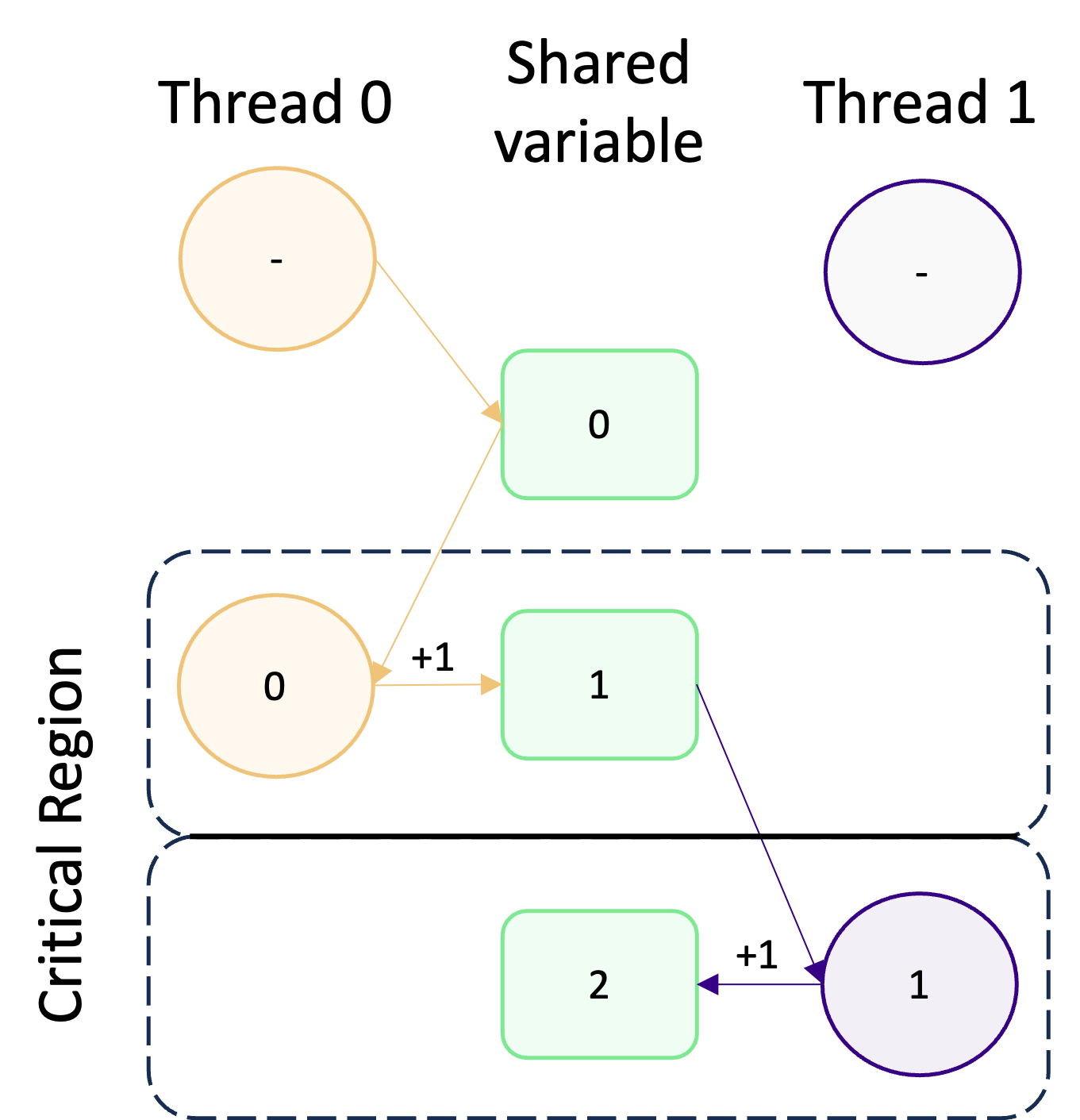
The syntax in OpenMP is straightforward:
#pragma omp critical
{
    // Code that only one thread can execute at a time.
}
Let's watch a short video that demonstrates how to use a critical section to correctly find the maximum value in an array—a task similar to the reductions we've seen, but here solved with a more general tool.
This video from HPC Education shows a practical example of using a critical section to protect a 'read-modify-write' operation when finding a maximum value.
Watch from the beginning until 01:30. Pay attention to how #pragma omp critical is placed around the if statement to ensure that the comparison and potential update of the max variable happen without interference from other threads.
A classic example of where critical is needed is for console output. The printf or std::cout operations are not inherently thread-safe. Without protection, output from different threads can get scrambled.
32 OpenMP Traps For C++ Developers
This article from PVS-Studio, '32 OpenMP Traps For C++ Developers', provides excellent real-world examples. Let's look at what happens with unprotected I/O.
Read section 13, 'Concurrent usage of a shared resource'. It shows the garbled output from an unprotected printf and how #pragma omp critical resolves it.
Performance Consideration:
Critical sections are powerful, but they serialize that portion of your code, forcing threads to wait. To minimize the performance impact, you should make your critical sections as small and as fast as possible.
2. atomic: Lightweight Protection for Simple Updates
Often, the operation you need to protect is a single, simple update to a scalar variable, like counter++ or sum += value. While #pragma omp critical would work, it's overkill and carries unnecessary overhead.
For these specific cases, OpenMP provides #pragma omp atomic. This directive is a highly optimized, more restrictive version of critical. It applies only to the single statement immediately following it and is typically limited to simple arithmetic and bitwise operations.
#pragma omp atomic
total_updates++;
The key advantage is performance. Because the operation is so simple, atomic can often be translated by the compiler into a single, specialized machine instruction (like LOCK XADD on x86 processors) that is much faster than the locking mechanism required for a full critical section.
32 OpenMP Traps For C++ Developers
The PVS-Studio article also contrasts these two approaches and gives clear guidance on when to prefer atomic.
First, read section 14, 'Shared memory access unprotected', which demonstrates a race condition on a++ and presents #pragma omp atomic as the correct, performant solution. Then, read the first paragraph of section 2 under 'Performance errors', titled 'Using critical sections or locks instead of the atomic directive', which explicitly ranks these constructs by performance.
So, the rule of thumb is:
- Use
#pragma omp atomicfor a single, simple update to a shared scalar variable. - Use
#pragma omp criticalfor everything else: compound statements, function calls, I/O, or updates to complex data structures.
3. barrier: Synchronizing the Team of Threads
Sometimes the problem isn't about protecting access to a shared variable, but about coordinating the timing of threads. A barrier is a synchronization point that forces all threads in a team to stop and wait until every thread has reached that point.

The explicit syntax is:
#pragma omp barrier
Barriers are crucial in algorithms with distinct phases. For example, imagine a process where all threads first produce data into an array, and then one or more threads consume that data. You must ensure the production phase is fully complete before the consumption phase begins.
It's also important to know that some OpenMP constructs have implicit barriers. For example, at the end of a #pragma omp for or #pragma omp parallel region, there is an implicit barrier that prevents any thread from moving on until all threads have finished. However, some constructs, like #pragma omp master, do not have an implicit barrier, which can be a source of bugs.
This video provides a clear example of why an explicit barrier might be necessary.
This video from HPC Education demonstrates a situation where the order of operations between threads matters, and a barrier is needed to enforce that order.
Watch the whole video (it's short). It covers: The definition of a barrier (00:15 - 01:03). The syntax and which constructs have implicit barriers (01:23 - 02:40). A code example showing how a barrier corrects the program's output order (02:18 - 04:14).
Like critical, barriers introduce waiting and can hurt performance if overused. They should only be used when the program's logic absolutely requires that all threads are synchronized at a specific point.
4. Putting It All Together: A Practical Example
Let's analyze a piece of code that contains race conditions and see how to fix them using the constructs we've learned.
Consider the following C++ code. It is intended to have four threads each compute a value, update a shared counter, and then have the master thread print the final results.
#include <iostream>
#include <vector>
#include <omp.h>

int main() {
    int total_updates = 0;
    std::vector<int> results(4, -1); // Initialize with a dummy value


    #pragma omp parallel num_threads(4)
    {
        int tid = omp_get_thread_num();

        // Each thread computes its result and stores it
        results[tid] = tid * 10;

        // --- RACE CONDITION 1 ---
        // Multiple threads try to increment the shared counter at the same time.
        total_updates++;

        // The master thread prints the final state. The `master` construct
        // does NOT have an implicit barrier, so it could run before other
        // threads have completed their work.

        // --- RACE CONDITION 2 ---


        #pragma omp master
        {
            std::cout << "Master sees " << total_updates << " total updates." << std::endl;
            std::cout << "Master sees results: ";
            for (int r : results) {
                std::cout << r << " ";
            }
            std::cout << std::endl;
        }
    }
    // Expected output should show 4 total updates and the results [0, 10, 20, 30].
    // The actual output will be unpredictable.

    return 0;
}
Your Task:
Before looking at the solution below, try to identify how you would fix the two race conditions indicated in the code.
Solution:
-
Race Condition 1: The
total_updates++is a classic read-modify-write race condition on a shared scalar. The most efficient way to protect this is with#pragma omp atomic. -
Race Condition 2: The
masterblock can execute before all threads have updatedresultsandtotal_updates. To ensure all threads complete their work before the master thread proceeds to print, we need an explicit#pragma omp barrier.
Here is the corrected code:
#include <iostream>
#include <vector>
#include <omp.h>

int main() {
    int total_updates = 0;
    std::vector<int> results(4, -1);


    #pragma omp parallel num_threads(4)
    {
        int tid = omp_get_thread_num();

        results[tid] = tid * 10;

        // Fix for Race Condition 1: Use atomic for the simple update.


        #pragma omp atomic
        total_updates++;

        // Fix for Race Condition 2: Use a barrier to ensure all threads
        // complete their updates before the master thread prints.


        #pragma omp barrier


        #pragma omp master
        {
            std::cout << "Master sees " << total_updates << " total updates." << std::endl;
            std::cout << "Master sees results: ";
            for (int r : results) {
                std::cout << r << " ";
            }
            std::cout << std::endl;
        }
    }

    return 0;
}
This corrected version will now reliably produce the expected output.
Conclusion
In this lesson, you've added three essential synchronization tools to your OpenMP toolkit, moving beyond the specialized reduction clause.
Key Takeaways:
#pragma omp critical: Provides general-purpose mutual exclusion for a block of code. It is powerful but can create performance bottlenecks, so the protected code should be minimal.#pragma omp atomic: A specialized, high-performance directive for protecting a single, simple update to a shared scalar variable. Prefer it overcriticalfor these cases.#pragma omp barrier: Acts as a synchronization point, forcing all threads to wait for each other. It's used to coordinate different phases of a parallel algorithm.- Choosing the right tool is critical for both correctness and performance. Overusing synchronization can eliminate the benefits of parallelization.
Preview of the Next Lesson
So far, we have focused on parallel for to distribute work, which is perfect for "regular" problems like processing arrays. But what about "irregular" problems, like traversing a linked list, processing nodes in a tree, or solving recursive problems? A simple for loop doesn't fit these patterns.
In our next lesson, we will explore task-based parallelism using OpenMP tasks. You will learn how to define independent units of work (tasks) that OpenMP can schedule dynamically across threads. This powerful model offers much more flexibility and relies on the synchronization concepts we've covered today to coordinate complex workflows.