Introduction
Welcome back! In our last lesson, we learned how to parallelize for loops using #pragma omp parallel for and carefully manage data scope with shared and private clauses. The vector addition example we used worked perfectly because each thread wrote to a unique element of the output array, avoiding any conflicts.
However, many common computational tasks aren't this straightforward. Consider calculating the sum of an array, finding the maximum value, or computing a dot product. In these cases, every thread needs to contribute to a single, final result. This is known as an aggregation or reduction operation. If we simply allow multiple threads to update a shared sum variable, we will create a race condition, leading to incorrect results.
Today, you will learn how to handle these situations correctly and, more importantly, efficiently. The goal of this lesson is to implement aggregation operations efficiently using OpenMP reduction clauses. We'll explore why naive solutions fall short and how the reduction clause provides an elegant and high-performance solution.
1. The Challenge of Parallel Aggregation
Let's start by understanding why a simple parallel loop fails for aggregation. Imagine we want to sum the elements of a large array a. A naive attempt might look like this:
double sum = 0.0;


#pragma omp parallel for shared(sum)
for (int i = 0; i < N; ++i) {
    sum = sum + a[i]; // DANGER: Race Condition!
}
The operation sum = sum + a[i] is not a single, indivisible (atomic) machine instruction. It's a three-step "read-modify-write" sequence:
- Read: A thread reads the current value of
sumfrom memory. - Modify: The thread adds its value
a[i]to the value it just read. - Write: The thread writes the new result back to
sumin memory.
Now, imagine two threads trying to do this at nearly the same time. The Boston University tutorial on OpenMP illustrates this problem well.
This document explains the concept of a data race condition with a clear, practical example.
Please read the section titled 'Data race condition' on slide 28. Focus on the two diagrams that show a correct and an incorrect update sequence. This will solidify your understanding of why the 'read-modify-write' pattern is a problem in parallel code.
As you can see, if two threads read the value of sum before either has a chance to write its new value back, one of the updates will be lost.
2. Correct but Inefficient Solutions: critical and atomic
To solve the correctness problem, we must ensure that only one thread can execute the sum = sum + a[i] operation at a time. OpenMP provides synchronization constructs for this purpose.
#pragma omp critical: This creates a block of code (a "critical section") that only one thread can enter at a time. While other threads wait, they cannot execute the code within that section.#pragma omp atomic: This is a more specialized and often more efficient version ofcritical. It applies only to a single, simple update statement (like+=,*=,++, etc.). It protects the memory update itself, which is exactly what we need here.
Let's look at how to use atomic.
The same document also shows how to use the atomic directive to fix the race condition, but it also points out the significant performance downside.
Now, review slides 30-32 ('Atomic construct' and 'The first try to solve the data-race problem'). You'll see the correct implementation using #pragma omp atomic but also the crucial warning: this approach can be even slower than the serial code because it forces all the additions to happen one by one.
While atomic and critical guarantee a correct result, they defeat the purpose of parallelization by forcing threads to wait for each other, creating a major performance bottleneck. We need a way to let threads work in parallel and only synchronize when absolutely necessary.
3. The Efficient Solution: The reduction Clause
This is where the reduction clause comes in. It's designed specifically for this type of aggregation problem. The syntax is:
reduction(operator:variable)
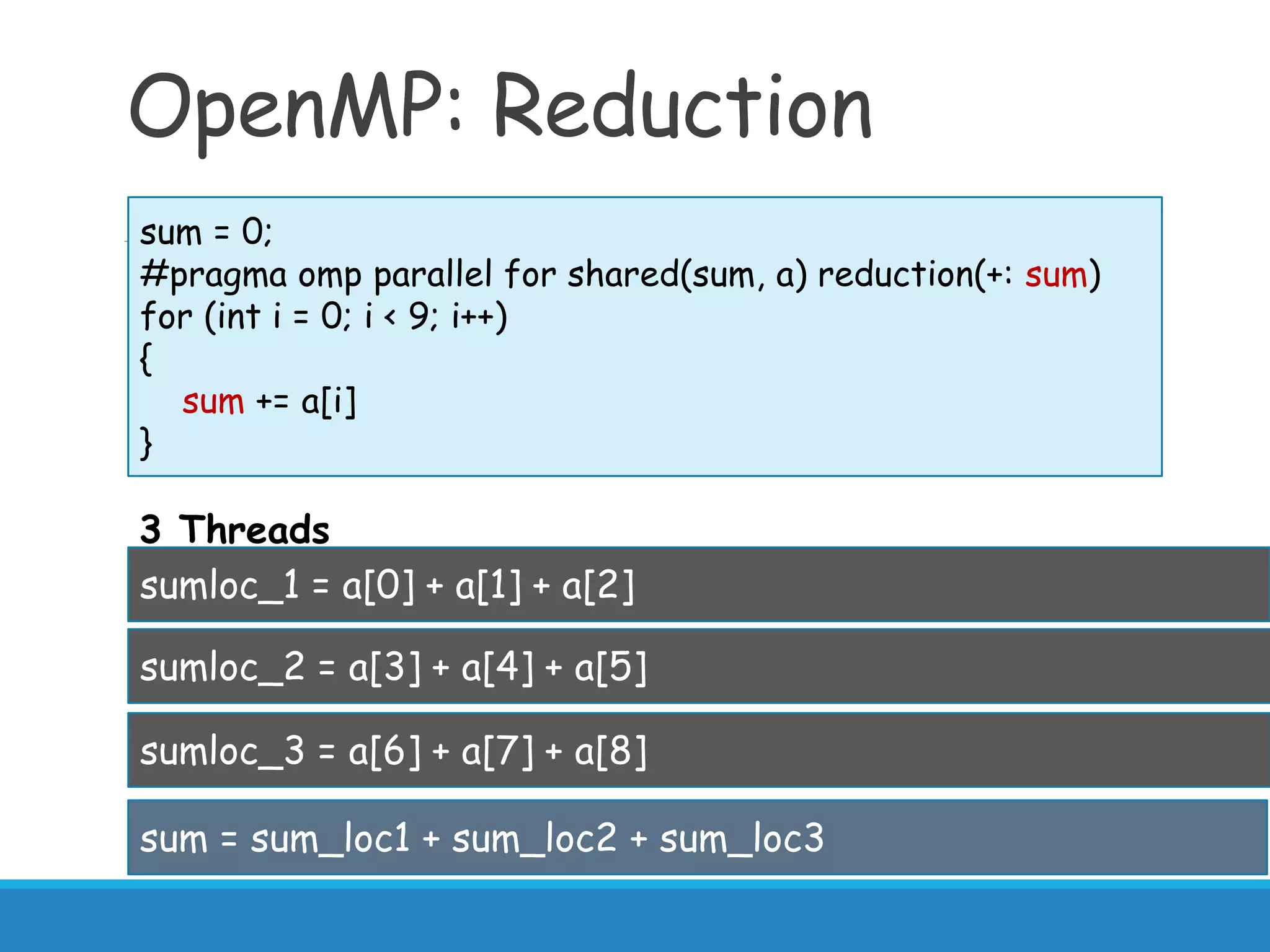
Here's how it works behind the scenes:
- OpenMP creates a private copy of the reduction variable (e.g.,
sum) for each thread. - Each private copy is initialized to the identity value for the operator (e.g., 0 for
+, 1 for*). - Each thread runs its assigned loop iterations, accumulating a partial result in its own private copy. Since each thread is writing to its own private variable, there is no race condition and no waiting.
- After the loop finishes, OpenMP combines the partial results from all threads into the original shared variable using the specified operator.
This strategy minimizes synchronization. Instead of synchronizing on every single addition, we only synchronize once at the very end to combine a small number of partial results (one per thread).
The following image provides a great visual summary of this process.
Now, let's watch a video that demonstrates this in action, comparing a serial implementation to one using the reduction clause.
Parallel C++: OpenMP Reduction
This video from the channel 'Nick' provides a fantastic walkthrough of implementing a reduction in C++. It compares serial vs. parallel performance and even looks at the underlying machine code, which you might find interesting given your C++ background.
Watch the video from the beginning until 05:17. This will cover: The concept of reduction and why it's needed (00:00 - 00:51). A baseline serial implementation of a sum-of-squares calculation (00:51 - 01:59). The parallel implementation using #pragma omp parallel for reduction(+:sync) and a clear explanation of how it creates private copies to avoid synchronization overhead inside the loop (01:59 - 05:17).
4. Demystifying the reduction Mechanism
To really understand why the reduction clause is so effective, it's helpful to see how you would implement its logic manually. You would create a private variable for a local sum, run the parallel loop, and then use an atomic or critical directive after the loop to safely add your local sum to the global total.
The following video does an excellent job of showing this manual implementation, which perfectly demystifies what reduction does for you automatically.
Episode 4.8 - Parallel Reduction
This video by Vadim Karpusenko explains the 'magic' behind the reduction clause by showing you how to build it yourself.
Watch the segment from 00:00 to 03:07. Pay close attention to the 'alternative implementation' at 01:21. It shows how combining a private variable with a final atomic update achieves the same result as the reduction clause, but with more code. This highlights the convenience and efficiency of the built-in clause.
5. Applying Reductions: Operators and a Practical Example
OpenMP's reduction clause supports a variety of common operators, allowing you to do more than just summation.
Available Operators:
- Arithmetic:
+,*,- - Bitwise:
&,|,^ - Logical:
&&,|| - Min/Max:
max,min
You can find a list of these operators and more examples in the following resource.
This guide from 'The Art of HPC' is a great reference for the details of OpenMP reductions.
Please read section '20.1.1 Reduction clause' for a C example of calculating pi. Then, skim section '20.2.1 Operators' to see the list of available arithmetic and logical operators.
Complete Example: Dot Product
Let's apply what we've learned to a common operation in engineering and physics: the dot product of two vectors. The dot product is the sum of the products of corresponding elements: . This is a perfect use case for a reduction.
Here is the serial C++ code:
#include <vector>

double dot_product_serial(const std::vector<double>& a, const std::vector<double>& b) {
    double result = 0.0;
    size_t N = a.size();
    for (size_t i = 0; i < N; ++i) {
        result += a[i] * b[i];
    }
    return result;
}
And here is the efficient parallel version using a reduction:
#include <vector>
#include <omp.h>

double dot_product_parallel(const std::vector<double>& a, const std::vector<double>& b) {
    double result = 0.0;
    const size_t N = a.size();

    // The 'result' variable is initialized to 0.
    // OpenMP creates private copies, also initialized to 0.
    // Each thread calculates a partial dot product.
    // Finally, the partial results are summed together into the original 'result'.


    #pragma omp parallel for reduction(+:result)
    for (size_t i = 0; i < N; ++i) {
        result += a[i] * b[i];
    }
    return result;
}
This implementation is clean, correct, and performs well by minimizing synchronization overhead.
For advanced use cases, OpenMP also allows you to define your own reduction operations for custom data types (e.g., a Matrix class) or complex logic, but the built-in operators cover the vast majority of scenarios.
Conclusion
In this lesson, we tackled the critical challenge of performing aggregation operations in parallel. We saw how naive approaches lead to race conditions and how simple fixes with atomic or critical directives severely limit performance.
Key Takeaways:
- Aggregation operations like sum, product, or max require special handling in parallel code to avoid race conditions.
- Using
atomicorcriticalinside a loop serializes the updates, creating a performance bottleneck. - The
#pragma omp parallel for reduction(operator:variable)clause is the standard, efficient solution for aggregations. - The
reductionclause works by having each thread compute a partial result in a private variable, then combining all partial results in a final, single synchronization step.
Preview of the Next Lesson
We've now seen atomic and critical as tools for ensuring correctness, but noted they are often slow. We then learned reduction is a superior tool for a specific pattern (aggregation).
However, there are many situations where a race condition occurs that cannot be solved with a simple aggregation. For example, you might need to protect updates to a complex data structure like a hash table, manage a queue of tasks between threads, or simply ensure all threads reach a certain point before any can proceed.
In our next lesson, we will dive deeper into OpenMP's general-purpose synchronization constructs: critical, atomic, and barrier. You will learn when and how to use them to manage more complex race conditions where the reduction clause doesn't apply.