Hello! Welcome to your next lesson in the "Infrastructure for Scalable Systems" module.
In our previous lessons, we explored the foundational layers of scalable systems, looking at how we can provision infrastructure using virtualization and package applications with containerization. Now, we're moving up the stack to examine the architectural patterns that govern how distributed applications themselves are organized. Today's lesson addresses the learning outcome: Describe the client-server and peer-to-peer distributed computing models.
We will define each of these fundamental models, explore how they work, and analyze their respective strengths and weaknesses, which are crucial for designing and understanding any distributed system.
1. The Client-Server Model
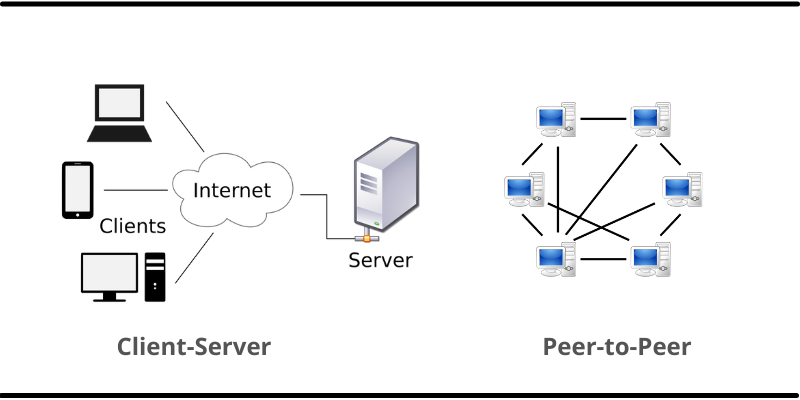
The client-server model is the most traditional and widely understood architecture for network applications. The logic is divided between two types of parties: clients and servers.
- A Server is a powerful process or computer that provides a specific service, such as hosting a website, managing a database, or sending emails. It passively listens for incoming requests.
- A Client is a process or computer (like your laptop or smartphone) that requests services from a server. It actively initiates the communication.
In this model, communication is centralized: clients talk to the server, but they do not talk to each other.
To get a concise overview of this model, including its main advantages and disadvantages, let's watch a short video.
Client Server and Peer-to-Peer Networking - CompTIA Network+ N10-005: 3.5
This segment from Professor Messer provides a clear and straightforward explanation of the client-server architecture.
Please watch from the beginning until 01:23. Focus on the roles of the client and server, the flow of communication, and the pros and cons mentioned.
As the video explained, the characteristics of the client-server model can be summarized as follows:
| Advantages | Disadvantages |
|---|---|
| Centralized Administration: All data and application logic is in one place, making it easier to manage, maintain, and update. | Single Point of Failure: If the central server fails, the entire service becomes unavailable for all clients. |
| Enhanced Security: Security policies can be enforced at the central server, providing a single point of control for access and data protection. | Performance Bottleneck: As the number of clients increases, the server can become overloaded, leading to slow response times for everyone. |
| Reliability: Servers are typically powerful, dedicated machines with reliable hardware and network connections. | High Cost: Dedicated server hardware and maintenance can be expensive. |
A classic example is web browsing. Your web browser (the client) sends a request to a web server (e.g., www.google.com), and the server responds by sending back the webpage's data.
2. The Peer-to-Peer (P2P) Model
The peer-to-peer (P2P) model offers a fundamentally different, decentralized approach. In a P2P network, every participant is an equal, known as a peer. Each peer can act as both a client and a server. It can request resources from other peers and simultaneously provide resources to others.
Let's begin with a quick introduction to the concept from the same video.
Client Server and Peer-to-Peer Networking - CompTIA Network+ N10-005: 3.5
Now, let's get a high-level overview of the peer-to-peer model.
Please watch from 01:23 to 02:47. Notice how this model contrasts with the client-server architecture.
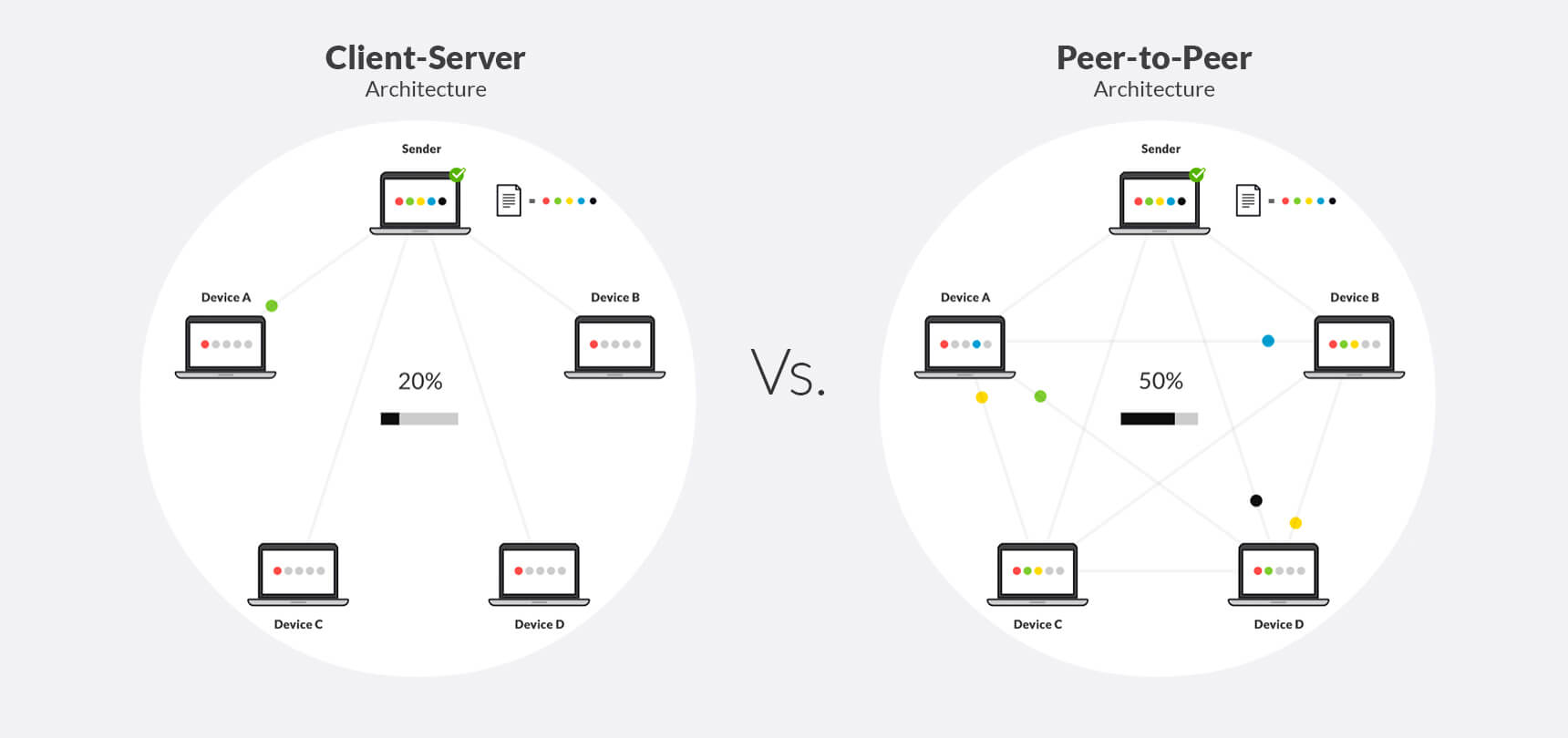
The P2P model truly shines in scenarios where the client-server model hits its limits, particularly with scalability. To understand this in a practical way, we'll walk through a detailed example. Your background in engineering will be helpful in appreciating the quantitative analysis of the performance bottleneck.
How Peer to Peer (P2P) Network works | System Design Interview Basics
This video from ByteMonk uses a compelling example—distributing a large file to thousands of machines—to demonstrate why P2P architectures are so powerful for certain tasks.
Please watch the following two segments: 00:32 - 04:07: This section sets up the problem and shows the mathematical bottleneck of a client-server approach. 04:07 - 06:41: This part explains how the P2P solution works and calculates the dramatic performance improvement.
As the video powerfully demonstrated, by enabling every downloader to also be an uploader, the P2P network's total distribution capacity grows as more peers join. This elegant solution completely overcomes the single-server bottleneck.
A crucial question in P2P systems is: "How do peers find each other and the data they need?" This process is called peer discovery. Let's watch the final segment of the video, which introduces the common strategies.
How Peer to Peer (P2P) Network works | System Design Interview Basics
Now let's look at how P2P networks handle the challenge of peer discovery and data location.
Please watch from 09:03 to 11:01. Focus on the concepts of a central tracker, gossip protocols, and Distributed Hash Tables (DHTs).
The video introduced a few key approaches for peer discovery:
- Hybrid P2P (Central Tracker): A central server (the "tracker") doesn't store the files, but it keeps track of which peers have which pieces of data. This is a mix of client-server and P2P (e.g., the original Napster, BitTorrent trackers).
- Unstructured P2P (Gossip/Flooding): Peers connect to a random set of other peers. To find a file, a query is "flooded" through the network until the file is found. It's robust but can be inefficient.
- Structured P2P (DHT): This is a more advanced and efficient method. A Distributed Hash Table (DHT) is used to create a global, decentralized index. A file's key is hashed to determine which specific peer is responsible for tracking it, allowing for very fast lookups without a central server.
3. A Head-to-Head Comparison
To solidify your understanding, let's consult a text resource that summarizes and compares these two architectural styles.
Distributed System Architectures and Architectural Styles
This article provides a clear, written summary of both architectures and includes a helpful comparison table.
Please read the sections under the heading '4) System Level Architecture', which cover both 'Client Server Architecture' and 'Peer to Peer (P2P)'. Then, review the comparison table under '5) A Comparison Between Client Server and Peer to Peer Architectures'.
Based on the resources we've reviewed, here is a summary of the core trade-offs:
| Feature | Client-Server Model | Peer-to-Peer Model |
|---|---|---|
| Architecture | Centralized. Clear separation of roles. | Decentralized. All peers are equal. |
| Scalability | Poor. Performance degrades as clients are added. Scaling requires upgrading the server (vertical scaling). | Excellent. Performance can improve as more peers join, since each new peer adds capacity to the network. |
| Reliability | Low. The server is a single point of failure. | High. No single point of failure; the network can function even if many peers leave. |
| Cost | High. Requires investment in powerful, dedicated server hardware and maintenance. | Low. Leverages the existing hardware and network connections of the participants. |
| Administration | Simple. All management, updates, and backups are done on the central server. | Complex. Difficult to deploy software updates or enforce policies across all peers. |
| Security | Easier to secure. Access control and data protection are managed centrally. | Difficult to secure. Data is distributed across many machines, making it hard to manage and protect. |
Conclusion
In this lesson, we have described the two primary models for organizing distributed systems.
Key Takeaways:
- The Client-Server model uses a powerful central server to provide services to many clients. It is simple to manage and secure but suffers from scalability bottlenecks and a single point of failure.
- The Peer-to-Peer (P2P) model is a decentralized system where all participants (peers) are equal and can act as both clients and servers. It is highly scalable and resilient but more complex to manage and secure.
- The choice between these models involves a fundamental trade-off between the centralized control and simplicity of the client-server architecture and the scalability and fault tolerance of the P2P architecture.
The client-server model's "single point of failure" and the transient nature of peers in a P2P network both highlight a critical challenge in distributed computing: handling failure. In our next lesson, we will explore this topic directly by focusing on fundamental fault tolerance strategies, such as replication and checkpointing.