Hello! Welcome to your next lesson on data-parallel processing with MapReduce.
In our last session, we traced the entire lifecycle of a MapReduce job, from submission by a client to the orchestrated execution of map and reduce tasks across a YARN cluster. You now have a solid mental model of the system components and how they interact.
Today, we transition from theory to practice. Our learning outcome is to implement a basic word count program using the MapReduce paradigm. This is the quintessential "Hello, World!" of distributed data processing. It's a simple task, but implementing it will make the abstract concepts of mapping, shuffling, and reducing concrete.
1. The Word Count Logic Revisited
Let's begin by recalling the data flow for a word count job. The goal is to take a large collection of text documents and produce a list of every unique word and its total frequency.
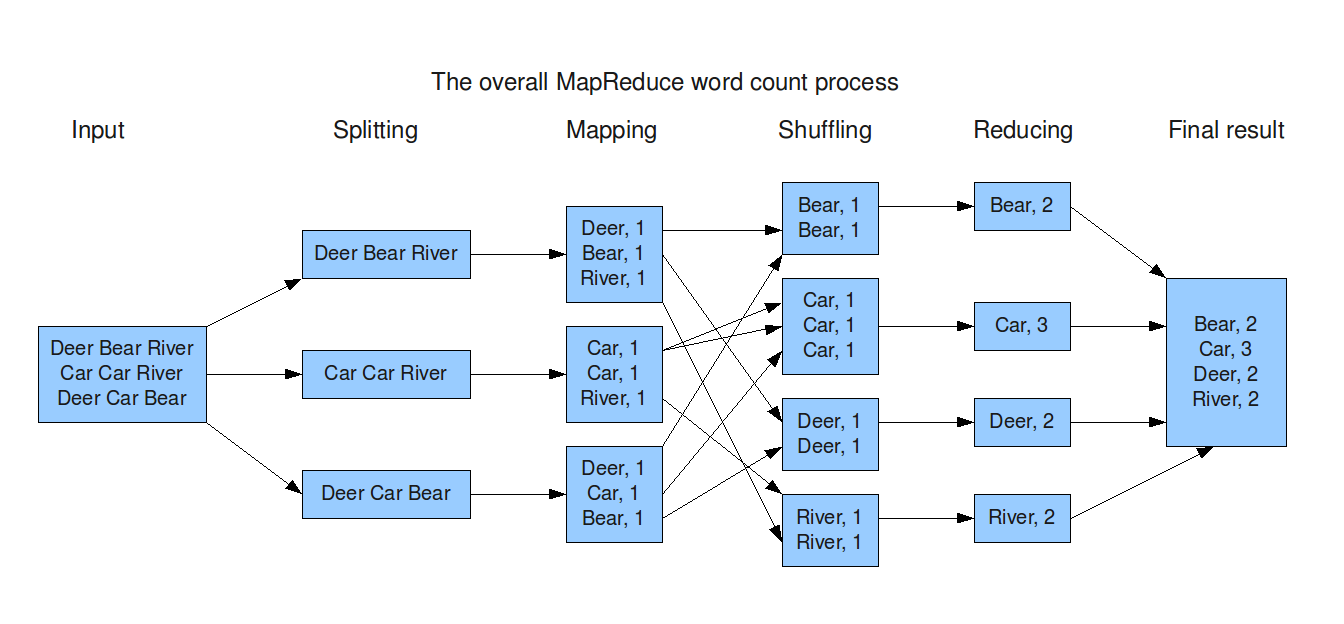
The entire process breaks down into three logical stages:
-
Map: Each mapper task takes a chunk of the input text. It reads the text, breaks it into words (tokenization), and for every word it finds, it emits a key-value pair of the form
(word, 1). The1signifies "one occurrence of this word". -
Shuffle & Sort (The Framework's Magic): After the mappers finish, the framework automatically collects all the emitted key-value pairs from all mappers. It sorts them by key and groups all the values associated with the same key. The result passed to the next phase looks like this:
(word, [1, 1, 1, ...]). For example, if the word "Hadoop" appeared 50 times across all input files, the framework would generate the intermediate pair(Hadoop, [1, 1, ..., 1])where the list contains fifty1s. -
Reduce: Each reducer task is assigned one or more keys. For each key it receives, it processes the associated list of values. In our word count case, the reducer simply sums the list of
1s to get the final count for that word. It then emits the final result:(word, total_count).
To see this flow animated, you can quickly re-watch the segment from the video we saw in the last lesson.
Map Reduce explained with example | System Design
This short segment from the ByteMonk video provides a clear, animated walkthrough of the word count logic we just described.
Please watch from 05:52 to 07:41. This will serve as a quick visual refresher of the data flow before we dive into the code.
Now, let's see how this logic is expressed in code.
2. Implementation with Python and mrjob
While Hadoop is written in Java, many libraries have been developed to make MapReduce programming more accessible in other languages. We'll start with a Python implementation using the mrjob library, which is popular for its simplicity. It abstracts away much of the Java boilerplate, letting you focus on the core map and reduce logic.
MapReduce Jobs For Distributed Hadoop Clusters in Python
The following video by NeuralNine provides a complete, practical walkthrough of creating a word count program in Python using mrjob.
Please watch the following segments to understand how to build and run the job: Mapper Implementation (06:45 - 09:56): Pay attention to how the code reads a line, tokenizes it, and uses yield to emit (word, 1) pairs. Reducer Implementation (09:56 - 11:35): Observe how the reducer receives a key and a generator of values, and yields the final summed count. Running the Job (11:58 - 14:18): See how the mapper and reducer are combined into a single job and executed from the command line.
Let's recap the key points from the video:
- The
MRJobClass: You define a class that inherits frommrjob.MRJob. - The
mapperMethod: This method implements your map logic. The use ofyield token, 1is how a mapper emits its output pairs. In Python,yieldturns a function into a generator, which produces a sequence of values on demand. This is highly memory-efficient, as it doesn't need to store all output pairs in a list before returning. - The
reducerMethod: This method implements the reduce logic. It receives akey(the word) andvalues(a generator that yields all the1s for that word). It then sums them up andyields the final(key, sum)pair. - Conciseness: Notice how clean and concise the Python implementation is.
mrjobhandles the underlying details of running this as a Hadoop job.
3. Implementation with Java (The Native API)
Now let's look at how to write the same program using Hadoop's native Java API. This will be more verbose, but it gives you a clearer view of the framework's core components, such as Mapper, Reducer, and Job configuration. Given your background in C++, the class-based structure will feel familiar.
Hadoop MapReduce Tutorial: WordCount v1.0
The official Apache Hadoop documentation provides a canonical example of a WordCount program written in Java. This resource walks through the source code and its execution.
Please read the section titled 'Example: WordCount v1.0'. Focus on the 'Source Code' and 'Walk-through' subsections. Compare the structure of the Java code to the Python code you just saw.
The Java implementation reveals more about the framework's inner workings:
MapperandReducerClasses: Instead of methods within a single class, you implement separate classes (TokenizerMapper,IntSumReducer) that extend the baseMapperandReducerclasses from the Hadoop API.- The
mapandreduceMethods: The logic is identical to the Python version. Themapmethod tokenizes a line and writes(word, 1)pairs usingcontext.write(). Thereducemethod iterates through the values for a given key, sums them, and writes the final result. JobConfiguration: Themainmethod is where you configure the job. You explicitly tell Hadoop which classes to use for the mapper and reducer, what the data types of your keys and values are, and what the input and output paths are.- Data Types (
Text,IntWritable): Unlike Python's native types, you must use Hadoop's special serializable types.Textis used instead ofString, andIntWritableinstead ofint. This is because the framework needs to serialize data to send it across the network between mappers and reducers. This serialization is a fundamental requirement in any distributed system.
4. A Nod to C++: Hadoop Pipes
Your expertise is in C++, and you might be wondering if you can leverage those skills in the Hadoop ecosystem. The answer is yes. Hadoop provides an API called Hadoop Pipes that allows you to write your map and reduce functions in C++.
Behind the scenes, the Java-based Hadoop task runner launches your C++ program as a separate process. It then uses sockets (or "pipes") to stream data to your C++ process's standard input and read the results from its standard output, effectively bridging the Java and C++ worlds.
Programming Hadoop Map-Reduce with C++
This document contains C++ code snippets demonstrating how to implement the word count mapper and reducer using Hadoop Pipes.
Please review the C++ code under the headings 'Pipes (C++)'. You will see three short code blocks: the mapper, the reducer, and the main function. Notice the familiar map and reduce pattern.
The key takeaway from the C++ example is the consistent design pattern. Whether in Python, Java, or C++, the fundamental structure is the same:
- A
mapfunction/method that processes input pairs and emits intermediate pairs. - A
reducefunction/method that processes grouped intermediate pairs and emits final pairs.
The context.emit() call in the C++ code is the direct equivalent of context.write() in Java and yield in the Python mrjob code.
Conclusion
In this lesson, you have successfully moved from the theory of MapReduce to its practical implementation. We took the classic word count problem and saw how to solve it using the MapReduce paradigm in three different languages.
Key Takeaways:
- The word count algorithm is implemented by having a mapper emit a
(word, 1)pair for each word, and a reducer sum the1s for each unique word. - The shuffle and sort phase, which groups the data by key between the map and reduce stages, is handled automatically by the Hadoop framework.
- The same core logic can be expressed in different languages. Java provides the native API, Python with
mrjoboffers a high-level, simplified interface, and C++ with Hadoop Pipes allows for integration of non-Java code.
In our next lesson, we will build upon this foundation to tackle a more complex and powerful application: "Design a MapReduce algorithm to build an inverted index from a text corpus." This is the core data structure that powers search engines, and it's another classic use case for MapReduce.