Hello! Welcome to the first lesson in our module on "Data-Parallel Processing with MapReduce."
In our last module, we explored the foundational infrastructure that powers scalable systems, culminating in a comparison of cloud service models like IaaS, PaaS, and SaaS. We saw how these services provide the physical and virtual resources needed to run large applications. Now, we shift our focus from the infrastructure to a specific programming model designed to harness that infrastructure for massive data processing.
Today, we will dissect the MapReduce paradigm. This model revolutionized large-scale data analysis and remains a conceptual cornerstone for many modern distributed systems. Our goal is to explain the MapReduce programming model, including the map, shuffle, and reduce phases. We will explore why it was created, how it works, and what makes it such a powerful abstraction for developers.
1. The Challenge of Big Data and the "Divide and Conquer" Solution
Imagine you are tasked with analyzing a petabyte (a million gigabytes) of web server logs stored across thousands of machines. A traditional single-machine program would be completely infeasible. This is the exact problem that engineers at Google faced in the early 2000s, leading them to develop MapReduce.
The core idea is a classic computer science strategy: "divide and conquer." However, applying this in a distributed setting introduces immense complexity:
- How do you split the work and data across thousands of machines?
- How do you handle network latency and machine failures gracefully?
- How do you gather and combine the partial results from all the machines?
MapReduce was designed to provide an abstraction that hides these complex, low-level details from the programmer. To begin, let's read about the problems MapReduce was designed to solve and its conceptual roots in functional programming. Your background in algorithms and programming will make the connection to "divide and conquer" immediately clear.
The following sections from the textbook 'Data-Intensive Text Processing with MapReduce' explain the challenges of traditional parallel programming that motivated MapReduce and connect its design to the 'map' and 'fold' functions from functional programming.
Please read the introduction (before section 2.1) and section 2.1, 'Functional Programming Roots'. In the introduction, focus on the list of challenges (e.g., assigning tasks, coordinating workers, handling faults) that a distributed programming framework must address. In section 2.1, focus on understanding how the map and fold operations provide a conceptual blueprint for the MapReduce model.
As the reading highlights, MapReduce simplifies distributed programming by letting you, the developer, specify what computation to perform, while the framework handles how to execute it across a cluster. The model revolves around processing data in the form of key-value pairs. This simple structure is surprisingly versatile and is the fundamental data unit throughout the entire MapReduce process.
2. The Core Phases: Map, Shuffle, and Reduce
A MapReduce job consists of three main phases. Let's look at a high-level overview of the entire flow using the canonical example: counting word occurrences in a collection of documents.
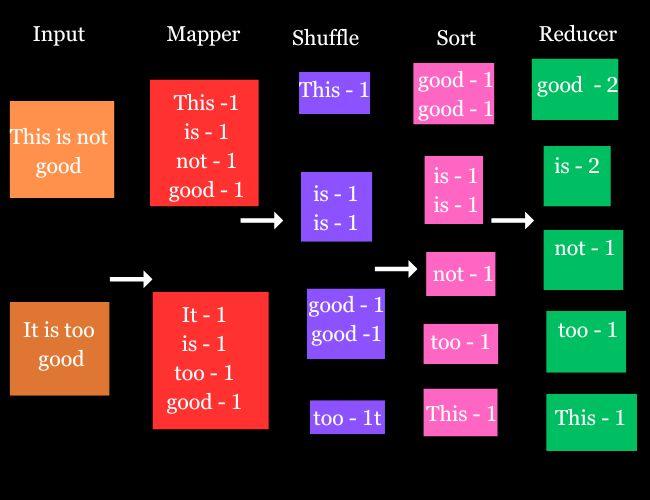
We will now break down each of these phases in detail.
2.1 The Map Phase
The first phase is the Map phase. The goal of the mapper is to take the raw input data, process it, and emit intermediate key-value pairs. This is where the initial "divide" of the problem happens, as many mappers run in parallel across different chunks of the input data.
Map Reduce explained with example | System Design
This short animation from the channel ByteMonk clearly demonstrates the map phase of our word count example.
Watch the segment from 05:52 to 07:01. Notice how each input file is processed independently and in parallel, with each word being transformed into a (word, 1) key-value pair.
Formally, the programmer provides a map function with the following signature:
map(k1, v1) → list(k2, v2)
- It takes a single input key-value pair (
k1,v1). For our text file example,k1might be the document name or line number, andv1is the line of text itself. - It outputs a list of zero or more intermediate key-value pairs (
k2,v2). For word count,k2is the word (astring) andv2is the number1.
2.2 The Shuffle and Sort Phase
This is the crucial intermediate step that connects the Map and Reduce phases. The Shuffle phase is handled entirely by the MapReduce framework. Its job is to collect all the intermediate key-value pairs produced by all the mappers and group them by their key (k2). All values associated with the same key are guaranteed to be sent to the same reducer.
Map Reduce explained with example | System Design
The same video provides a concise explanation of the shuffle phase.
Now watch from 07:01 to 07:21. See how all the pairs for 'Apple' and 'is' are brought together, preparing them for the next phase.
This "group by key" operation is essentially a massive distributed sort. It is the core of the framework's "magic," ensuring that the data is perfectly organized before the final aggregation step.
2.3 The Reduce Phase
The final phase is the Reduce phase. The goal of the reducer is to process the grouped data for a single key and produce the final output. Like the mappers, many reducers can run in parallel, with each one responsible for a distinct set of keys.
Map Reduce explained with example | System Design
Let's see the final step in the word count example.
Watch from 07:21 to 07:51. Observe how the reducer for the key 'is' receives the list [1, 1] and sums them to produce the final output (is, 2).
The reduce function has the following signature:
reduce(k2, list(v2)) → list(k3, v3)
- It takes an intermediate key
k2and the list of all valueslist(v2)associated with that key. - It outputs a list of zero or more final key-value pairs (
k3,v3). In our example, it sums the list of ones to get the total count and emits a single pair like(is, 2).
3. A Complete Walkthrough
Now that we've seen the individual pieces, let's watch a more detailed video that walks through the entire process, illustrating how the framework coordinates these tasks in a distributed environment.
MapReduce - Google Thinks You're Bad At Coding | Distributed Systems Deep Dives With Ex-Google SWE
This video from 'Jordan has no life', by an ex-Google engineer, provides an excellent visual walkthrough of how a MapReduce job is executed. It clarifies the roles of the master and worker nodes.
Watch from 14:15 to 17:40. Pay close attention to: How mappers write their partitioned output to local files. The role of the master node in tracking the locations of these files. How the reducers pull the relevant data from the mappers (this is the shuffle in action). How the final output is written to a distributed file system (like GFS or HDFS).
4. The Programmer's Model: Partitioners and Combiners
While the framework handles most of the complexity, the programmer can provide a couple of other important pieces of logic besides the map and reduce functions.
This final reading from 'Data-Intensive Text Processing with MapReduce' introduces two additional, but crucial, components of the programming model: Partitioners and Combiners.
Please read section 2.4, 'Partitioners and Combiners'. For Partitioners, understand their role in deciding which reducer gets which key. The default hash(key) % num_reducers is the key takeaway. For Combiners, focus on their purpose as a performance optimization. Think about why summing counts locally on each mapper before the shuffle is far more efficient for our word count example.
To summarize:
- Partitioner: A function that determines which reducer will process a given intermediate key. This controls how data is distributed during the shuffle.
- Combiner: An optional "mini-reducer" that runs on the output of each mapper before the shuffle. It's a critical optimization that reduces the amount of data sent over the network. For any operation that is commutative and associative (like addition), the reducer itself can often be used as the combiner.
Conclusion
In this lesson, we have demystified the MapReduce programming model. By providing a simple abstraction built on key-value pairs and user-defined map and reduce functions, it enables developers to write code that can process enormous datasets in parallel across large clusters, without needing to become experts in distributed systems programming.
Key Takeaways:
- MapReduce is a programming model and execution framework designed to simplify large-scale, data-parallel computation.
- It is based on a key-value data model.
- The Map phase runs in parallel, processing input data and transforming it into intermediate key-value pairs.
- The Shuffle phase is a framework-managed step that automatically sorts and groups all intermediate values by their key.
- The Reduce phase runs in parallel, processing the grouped data for each key to produce the final result.
- The developer primarily provides the
mapandreducelogic, while the framework handles scheduling, data distribution, synchronization, and fault tolerance.
We have learned the conceptual model of MapReduce. In our next lesson, we will explore the most famous and widely used open-source implementation of this model: the Apache Hadoop ecosystem. We will learn about the components that make it work, including the Hadoop Distributed File System (HDFS) for storage and the YARN resource manager.