Hello! Welcome to the final lesson of your course, "Digital Marketing Basics."
In the last few lessons, we've broken down the key components of a successful social media post. You've learned how to write compelling captions with a clear Hook, Value, and Call-to-Action, how to select effective hashtags to increase discoverability, and how to determine the optimal time to post by analyzing your audience's activity.
Today, we bring it all together. This lesson is about moving from individual components to a complete, cohesive plan. You will learn how to plan a complete social media post, integrating your visual concept, caption, hashtags, and target platform into a single, strategic asset. This is the final step in translating theory into practical social media handling.
From Chaos to Control: The Content Creation Workflow
Creating content on the fly—thinking of what to post right when you want to post it—can be stressful and lead to inconsistent results. The key to effective social media management is having a structured workflow. This means breaking the process down into manageable stages: ideation, planning, creation, and scheduling.
Let's start with a video that introduces this professional approach, often called "content batching." While it discusses creating a month of content at once, the principles are the same even for planning a single post.
1 month of content in 1 hour | Updated guide to content batching & planning + free content calendar!
This video, '1 month of content in 1 hour' by Jade Beason, introduces a powerful workflow. We'll focus on how she breaks down the creative process into distinct, manageable steps.
Watch from 02:27 to 07:16. Pay close attention to the different stages she identifies: ideation (coming up with ideas), and planning (fleshing out those ideas). Notice her emphasis on putting yourself in your audience's shoes during ideation.
As the video highlights, separating the stages of content creation allows you to focus your energy more effectively. For this lesson, we will concentrate on the first two stages: Ideation and Planning.
The Anatomy of a Social Media Post Plan
Before you take a photo or write a single word, a good plan should exist. Think of it as a blueprint for your post. In your previous lesson on content calendars, you saw the big picture; now we're filling in the details for one of those calendar squares.
Every post plan should clearly define the following elements:
- Date and time of posting
- Platform (e.g., Instagram, Facebook)
- Content pillar/theme and the post's goal (e.g., educational, promotional)
- Visual concept (photo, graphic, video idea)
- The caption
- A list of relevant hashtags
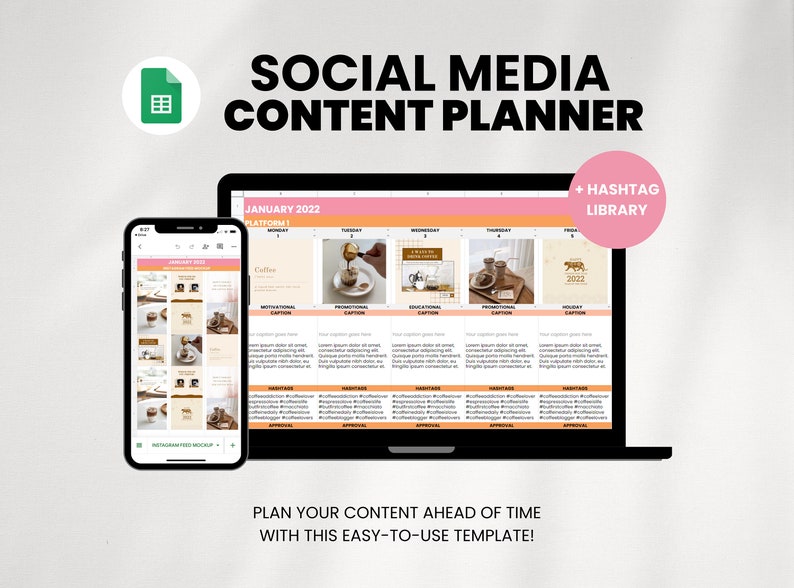
Now, let's walk through how to build this plan, step by step. We'll use a detailed checklist to guide us.
Design to Strategy: Basic Steps for Social Media Content Creation
The document 'Design to Strategy: Basic Steps for Social Media Content Creation' from the University of Tennessee provides an excellent, comprehensive checklist for planning a post. We will use it as our guide for the rest of this lesson.
Please open this PDF and keep it handy. We will be referring to its 15-point checklist throughout the next sections. You don't need to read it all at once; we will walk through it together.
Step-by-Step Post Planning
Let's use the checklist from the "Design to Strategy" resource to build our post plan.
1. The Foundation: Goal and Platform (Checklist Points 1 & 3)
Before anything else, you must know why you're posting and where.
- Goal: What do you want to achieve? Are you building Awareness (e.g., introducing your pharmacy), Consideration (e.g., explaining the benefits of a service), or driving Conversion (e.g., "sign up for flu shots")? This connects back to the marketing funnel we discussed.
- Platform: Which platform best suits this goal and your target audience? As the checklist notes, different generations prefer different platforms. If you're targeting young adults, Instagram or TikTok might be best. For an older demographic, Facebook could be more effective.
2. The Visual Concept (Checklist Points 4, 5, & 9)
Social media is a visual-first environment. Your image or video is the first thing people see.
- Sizing: Is the image correctly sized for the platform? An Instagram post (1080x1080 pixels) is different from a Facebook landscape image (1200x630 pixels). Getting this right prevents awkward cropping.
- Visual Hierarchy: What do you want people to notice first? Use contrasting sizes, colors, and placement to guide their eyes to the most important element.
- Fonts & Colors: If you're creating a graphic (using a tool like Canva), ensure the text is legible and the colors align with your brand's feel.

3. The Message: Caption and Call-to-Action (Checklist Points 13 & 14)
Your caption gives context to your visual and tells your audience what to do next.
- Drafting the Caption: Use the Hook-Value-CTA model.
- Hook: Start with a question or a relatable statement to grab attention.
- Value: Provide useful information, tell a story, or share a helpful tip.
- CTA: Be explicit. "Learn more," "Comment below," "Save this post," or "Click the link in bio."
- Choosing Hashtags: Select a mix of relevant hashtags to improve discoverability. Avoid overly generic or irrelevant tags.
- Review: Read your caption aloud. Is the tone right for your brand? Is the CTA clear? Check for any spelling or grammar errors.
The following video provides a great refresher on how different types of content and captions can achieve different goals, such as getting more likes, saves, or shares.
How To Write Engaging Instagram Captions (6 Copywriting Tips & Examples)
In 'How To Write Engaging Instagram Captions' by Alex Cattoni, you'll see how to tailor your content for specific user actions. This is a great way to think strategically about your post's goal.
Watch from 02:14 to 06:21. Notice how she links different content types to different outcomes: relatable stories for 'likes,' lists/tips for 'saves,' memes/quotes for 'shares,' and simple questions for 'comments.'
4. The Final Steps: Review and Schedule (Checklist Points 11 & 15)
Finally, take a step back and look at the complete package.
- Final Review: Does the visual and caption work together? Does the post align with your brand and speak to your target audience?
- Schedule/Post: Using the optimal time you identified from your analytics, you are now ready to schedule your post or publish it live!
Putting It All Together: A Pharmacy Example
Let's apply this process to a practical scenario relevant to your background.
Scenario: A local community pharmacy wants to promote its free blood pressure monitoring service on Instagram.
-
1. Goal & Platform:
- Goal: Awareness/Consideration. To inform the local community that this free service exists and encourage them to use it for their health.
- Platform: Instagram. It's great for reaching a broad local audience and allows for a friendly, visual approach.
-
2. Visual Concept:
- A high-quality, warm photo of a pharmacist gently smiling while talking to a patient (actor/model) in a bright, clean area of the pharmacy. The focus is on care and professionalism, not the medical device itself.
- Sizing: 1080x1080 pixels for the Instagram feed.
-
3. Caption & Hashtags:
- Hook: "Did you know high blood pressure often has no symptoms? 🤔"
- Value: "It's called the 'silent killer' for a reason. Regular monitoring is key to staying on top of your cardiovascular health. We offer free, quick, and confidential blood pressure checks right here at the pharmacy."
- CTA: "Stop by anytime for your free check-up – no appointment needed! Your health is our priority. ❤️ #BloodPressure #HeartHealth #CommunityPharmacy #[YourTownName] #HealthyLiving"
- Hashtags: A mix of health topic (#HeartHealth), service (#BloodPressure), industry (#CommunityPharmacy), and location-based (#[YourTownName]).
-
4. Posting Time:
- Based on Instagram Insights from the previous lesson, the audience is most active on weekdays at 6 PM.
- Plan: Schedule the post for 5 PM on a Tuesday to capture the early wave of evening scrollers.
You've now created a complete, strategic plan for a single post!
Test your understanding!
Now it's your turn. Imagine you work for a pharmacy that wants to promote a new line of natural, organic sunscreens just before summer. Your target audience is health-conscious families on Instagram.
Briefly outline a plan for one Instagram post. What would be your:
- Visual Concept?
- Caption Hook?
- Call-to-Action (CTA)?
- Three example hashtags?
Show answer
Here's one possible approach:
- Visual Concept: A flat-lay photo on a light-colored background featuring the sunscreen bottle next to some natural elements like a seashell, a clean towel, and a pair of sunglasses. This creates a summery, clean, and appealing vibe.
- Caption Hook: "Ready for the sun, but not the chemicals? ☀️"
- Call-to-Action (CTA): "Ask our pharmacists which formula is right for your family's skin type on your next visit! Find the full range in our skincare aisle."
- Three Example Hashtags: #NaturalSunscreen #FamilySkincare #[YourTown]Summer
Conclusion
Congratulations on completing the final lesson and the entire course! You have successfully brought together all the practical skills from this module to create a comprehensive plan for a social media post. By following a structured workflow, you can create content that is not only creative but also purposeful and effective.
Key Takeaways:
- A successful social media post starts with a solid plan that includes the goal, platform, visual, caption, hashtags, and posting time.
- Breaking down content creation into stages (Ideation, Planning, Creation, Scheduling) makes the process more manageable and efficient.
- Use a checklist to ensure you've considered all key elements, from image sizing and visual hierarchy to caption review and a clear call-to-action.
- Always ground your plan in strategy: connect your post's goal to your marketing funnel and your content to your target audience's needs.
You have now built a strong, career-oriented foundation in digital marketing principles and practical social media handling. The next step is to put this knowledge into practice. Consider starting a personal project, offering to manage the social media for a friend's small business, or even creating a mock portfolio for a hypothetical brand. The more you practice, the more confident you will become. Well done, and best of luck on your digital marketing journey