In our last lesson, we established the key roles within the Avalanche network: the full node, the validator, and the delegator. You learned that both validators and delegators must "stake" their AVAX tokens to participate in securing the network. This lesson dives deeper into the AVAX token itself, the lifeblood of the Avalanche ecosystem.
Your goal is to run a validator business, so understanding the economic engine you'll be participating in is non-negotiable. By the end of this lesson, you will be able to explain the three primary roles of the AVAX token: its use for staking, paying for transaction fees, and receiving rewards.
The Three Pillars of AVAX Utility
Think of the AVAX token not just as a currency, but as a multi-purpose tool that enables the entire Avalanche network to function. Its utility can be broken down into three main functions which create a self-sustaining economic cycle.
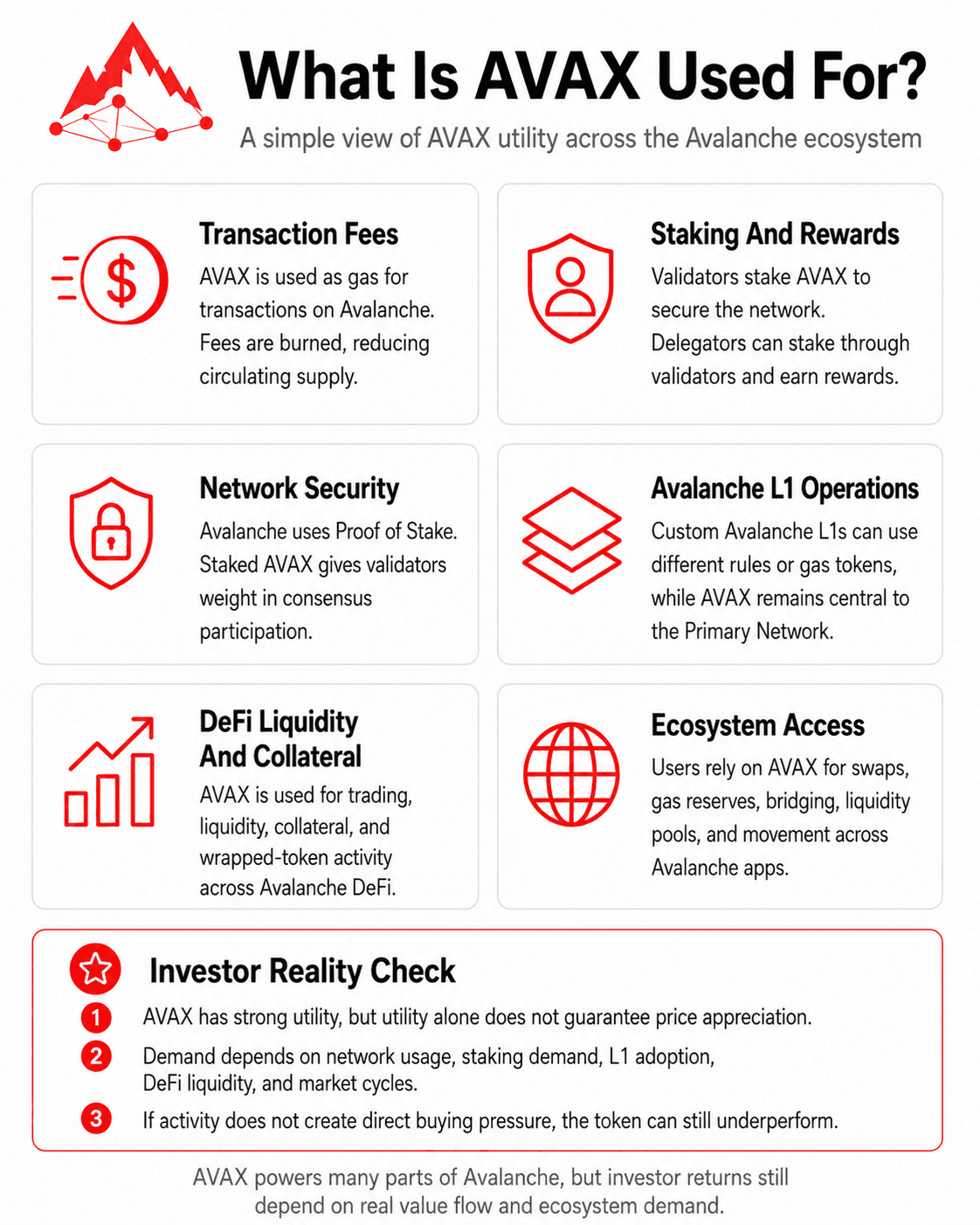
As you can see from the "What is AVAX Used For?" image, the token has several jobs. Let's focus on the ones most central to your goal of running a validator.
1. AVAX for Staking and Security
As we touched on previously, Avalanche uses a Proof-of-Stake consensus mechanism. The "stake" is a deposit of AVAX tokens that a validator locks up to gain the right to process transactions and create blocks.
- Validator's Stake: This is your "skin in the game." By staking a significant amount of your own capital (a minimum of 2,000 AVAX on Mainnet), you are making an economic commitment to act honestly. Your staked AVAX essentially acts as collateral.
- Delegator's Stake: Your future customers, the delegators, will also stake their AVAX (a minimum of 25 AVAX). However, they do so by delegating their stake to your validator node, increasing its total weight and influence in the consensus process.
This staking mechanism is the foundation of the network's security. Because a validator's ability to participate is proportional to their total stake (their own plus all delegated funds), the network is secured by the collective economic value that participants have locked up.
To solidify these concepts, the following reading selection connects the tokenomics of AVAX directly to the act of staking.
Avalanche Basics - AVAX for Beginners - Learn Crypto
This article from Learn Crypto provides a clear overview of AVAX's economic model, or "tokenomics," and its relationship to staking.
First, read the section "AVAX Tokenomics." Pay close attention to the parts describing the token's purpose and how new tokens are issued as rewards. Next, read the following section, "Avalanche (AVAX) Staking," focusing on the passage that distinguishes between the two ways to participate and their staking requirements.
2. AVAX for Transaction Fees
Every action that modifies the state of the blockchain requires a transaction, and every transaction costs a small fee, paid in AVAX. These fees are often referred to as "gas." This includes common activities like:
- Sending AVAX or other tokens from one wallet to another.
- Swapping tokens on a decentralized exchange (DEX).
- Executing the transaction to become a validator or to delegate your stake.
What makes Avalanche's fee model particularly interesting is what happens to these fees. Unlike some other blockchains where fees are paid to the block producers, on Avalanche, all transaction fees are burned—meaning they are permanently removed from circulation.
This burning mechanism creates a deflationary pressure on the AVAX supply. While new AVAX is constantly being created as rewards (an inflationary pressure), the burning of fees from network activity works in the opposite direction. A busy network with high transaction volume will burn more AVAX, potentially offsetting the creation of new tokens. This is a key part of the token's long-term economic design.
The "Fees" and "Fee Revenue" sections in the Learn Crypto article you just reviewed provide more context on this mechanism, comparing it to Ethereum's model.
3. AVAX for Rewards
If fees are burned, how are validators compensated for their work? The answer is through staking rewards. New AVAX tokens are minted and distributed to validators and their delegators as a reward for securing the network.
However, these rewards are not guaranteed. They are conditional on performance. To earn a reward, a validator must be sufficiently responsive and online during its validation period. The official documentation clarifies the specific uptime required.
How to Stake - Avalanche Builder Hub
This document from the official Avalanche documentation details the mechanics of staking and rewards. It's a bit more technical but provides the ground truth for how the system works.
Start by reading the introduction under "Staking Parameters on Avalanche". Then, read the subsection "Mainnet" to understand the uptime requirement. Finally, jump down to the FAQ section and read the answer to the question: "How Is It Determined...".
As you read, you saw that a validator must maintain at least 80% uptime as measured by its peers to be eligible for a reward. This is why running a stable, reliable node is the core of the business.
Reward Calculation and Distribution
The amount of the reward isn't a fixed number; it's calculated by a formula that takes into account the amount staked and, most importantly, the duration of the stake. Longer staking periods earn a higher rate of return. While the full mathematical formula is complex, the key takeaway is that rewards are a function of commitment, both in capital (stake amount) and time (staking duration).
For your validator business, the most important mechanism is how these rewards are shared:
- The total reward for the stake delegated to your node is calculated.
- Your node takes a delegation fee—a percentage you set—from the delegator's portion of the reward. This fee is your primary revenue.
- The remaining reward is distributed to the delegator.
The official documentation explains this process for both delegators and validators.
How to Stake - Avalanche Builder Hub
Let's continue with the same official documentation to understand how your customers (delegators) and you (the validator) get paid.
First, read the section on Delegator Rewards. Then, review the FAQ entry on how fees are distributed.
This fee is your compensation for providing the hardware, maintenance, and security for the delegator's capital. Setting a competitive but profitable delegation fee will be a key business decision down the line.
Conclusion
In this lesson, we dissected the central role of the AVAX token. You learned that it is a versatile asset that underpins the entire network's security and economic model.
Here are the key takeaways:
- Staking: AVAX is locked up by validators and delegators as collateral to secure the network and participate in consensus.
- Fees: All network transactions require a fee paid in AVAX, which is then burned, reducing the total supply.
- Rewards: New AVAX is minted and paid out to validators and delegators with high uptime as compensation for their service. A validator's primary revenue comes from the delegation fee charged on these rewards.
This economic loop—staking capital, paying fees for activity, and earning rewards for service—is what you will be plugging into. Your success as a validator will depend on your ability to reliably perform your duties to maximize rewards for yourself and your delegators.
In our next lesson, we will explore the architecture of the Avalanche network itself. You'll learn about its unique three-chain structure (the P-Chain, X-Chain, and C-Chain) and identify which chain is specifically responsible for handling all staking and validation activities.