Hello! In our last lesson, we focused on the AVAX token and its three crucial roles: staking, fees, and rewards. We established that staking is the economic foundation of your future validator business. Now, it's time to zoom out and understand the structure of the network where this all happens.
This lesson addresses a unique and powerful feature of Avalanche: its multi-chain architecture. Instead of processing every type of task on a single, congested blockchain, Avalanche divides the labor among three specialized chains. Your goal for this lesson is to summarize this "Primary Network"—the P-Chain, X-Chain, and C-Chain—and, most importantly, identify exactly which one is responsible for handling staking and validation.
The Primary Network: Specialization for Performance
Most blockchains, like early versions of Ethereum or Bitcoin, are "homogeneous," meaning a single chain handles everything from simple token transfers to complex smart contract executions and network governance. This can be like a single highway trying to accommodate commuter cars, long-haul trucks, and emergency vehicles all at once, leading to traffic jams.
Avalanche takes a different approach by creating a "heterogeneous" network. At its core is the Primary Network, which consists of three distinct, built-in blockchains, each optimized for a specific job. This division of labor allows the overall system to operate more efficiently and at a massive scale.
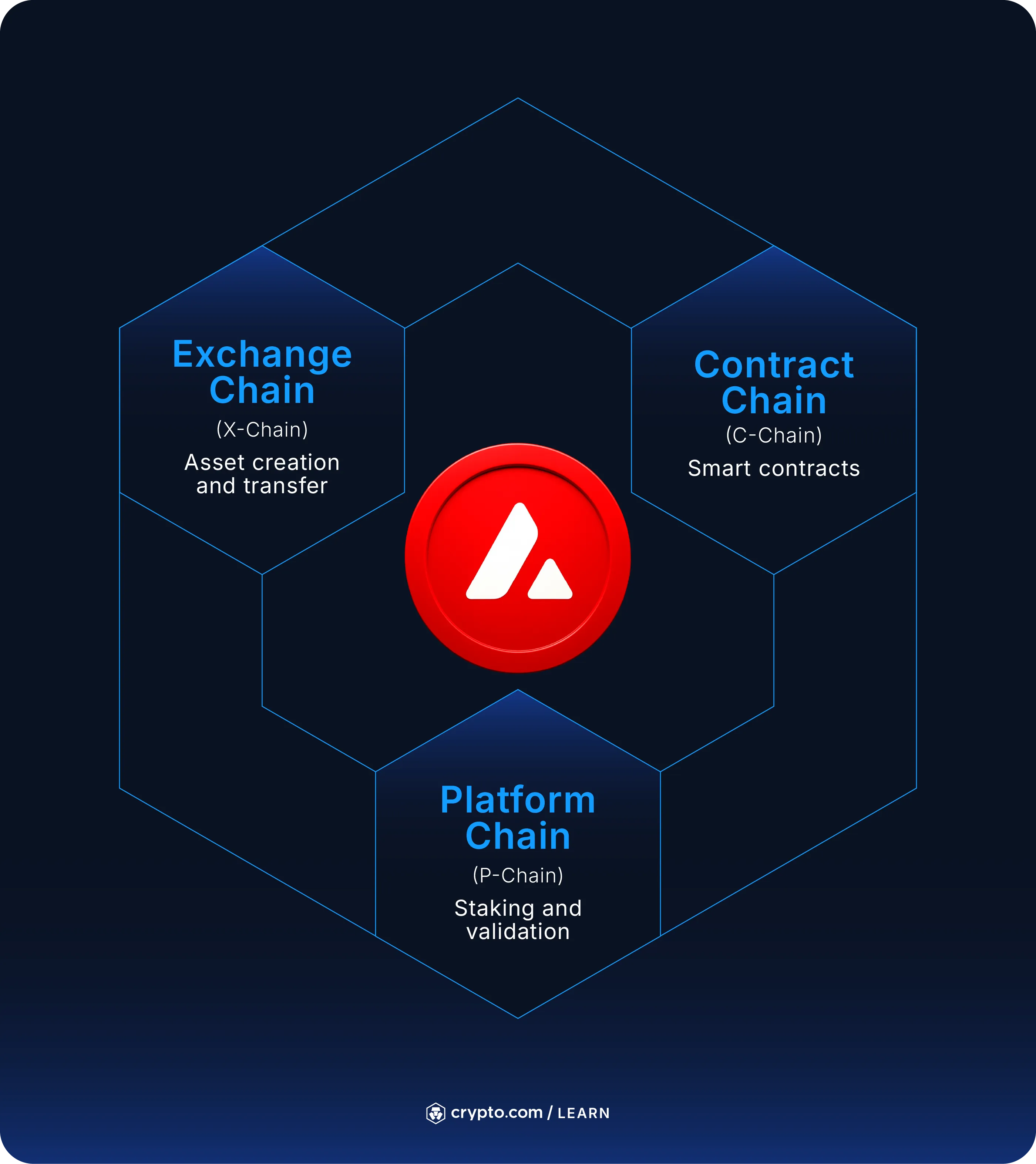
Let's dissect the role of each of these chains. The following reading provides a clear breakdown of their individual functions.
Avalanche Multi-Chain 101: Inside X-, P-, and C-Chains | GetBlock.io
This article from GetBlock.io offers a great introduction to Avalanche's multi-chain architecture, explaining why it exists and what each chain does.
Start by reading the section "What is the Primary Network?" to understand the core concept of why Avalanche uses three networks. Next, read the descriptions for each of the three chains to learn their specific purpose: C-Chain: Read the section "What Is C-Chain?". This is where most user activity like DeFi and NFTs happens. P-Chain: Read the section "What Is P-Chain?". Pay close attention here, as this section is the most relevant to your goal. X-Chain: Read the section "What Is X-Chain?".
The Three Chains: A Functional Summary
As you saw in the reading, each chain has a distinct and specialized purpose:
-
The X-Chain (Exchange Chain): This chain is optimized for one thing: the creation and fast transfer of digital assets. Think of it as the network's high-speed asset ledger. When you want to send or receive AVAX or other native Avalanche tokens, the X-Chain is designed to handle this with incredible speed. It is not compatible with smart contracts.
-
The C-Chain (Contract Chain): This is where the vast majority of user-facing activity on Avalanche takes place. The "C" stands for "Contract," as its primary purpose is to execute smart contracts. It is compatible with the Ethereum Virtual Machine (EVM), which has made it extremely popular for developers building decentralized applications (dApps), NFTs, and DeFi protocols. As a user, this is the chain you will interact with most often through wallets like MetaMask.
-
The P-Chain (Platform Chain): This is the most important chain for your objective. The "P" stands for "Platform." This chain is the nervous system of the Avalanche network. It coordinates the validators, manages active subnets (custom blockchains), and, crucially, handles all staking operations.
To become a validator, you will submit your transaction on the P-Chain. When your future customers delegate their AVAX to your node, that transaction also occurs on the P-Chain. It is the administrative backbone that secures the entire network.
A Practical Guide: Which Chain to Use?
Understanding these distinctions is not just theoretical; it has direct, practical consequences. The image below provides an excellent "cheat sheet" that summarizes the roles of each chain and helps you decide which one to use for a given task.
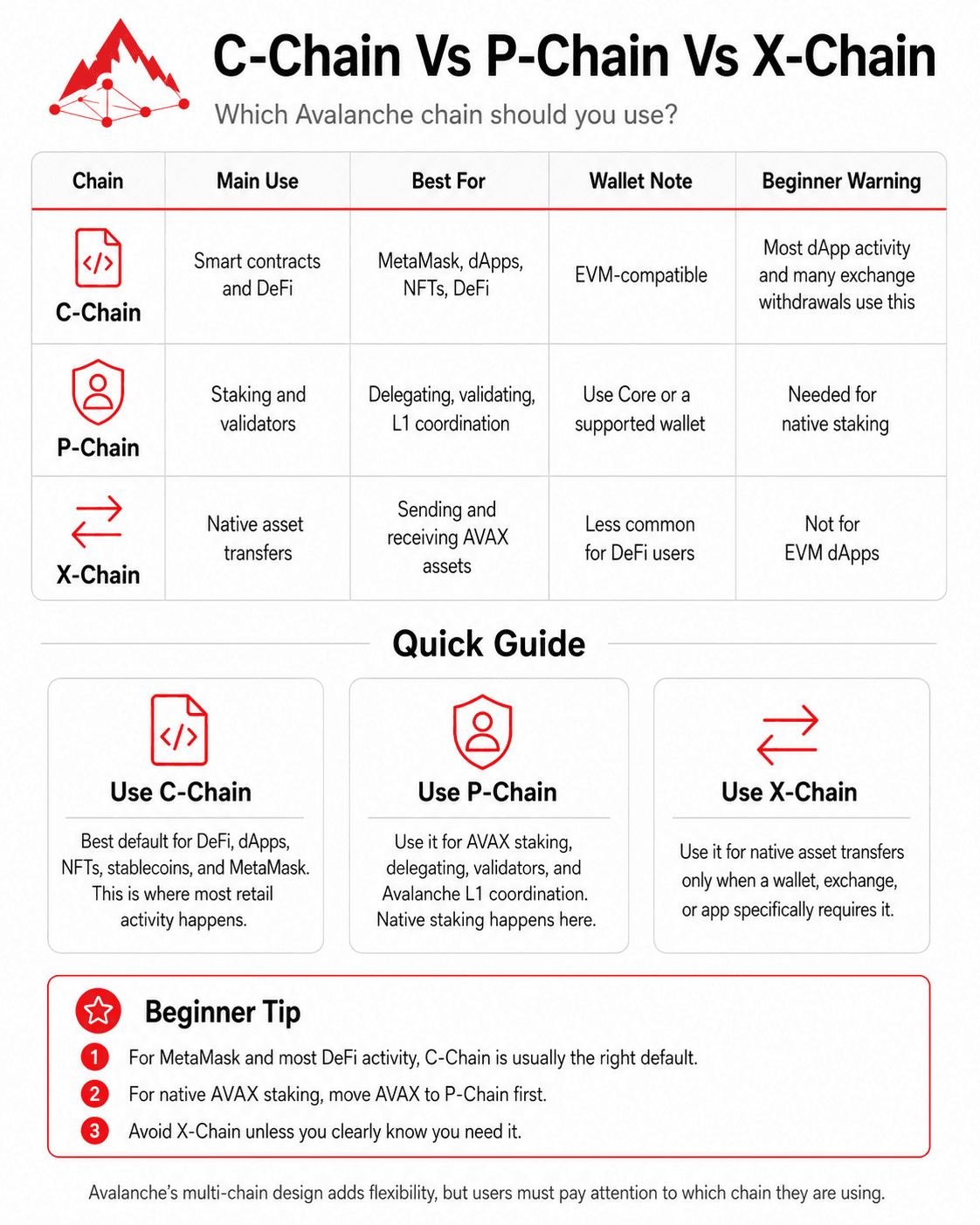
Look closely at the row and box for the P-Chain. It explicitly states its main use is for "Staking and validators" and it's best for "Delegating, validating, L1 coordination." This is the heart of your business operations.
Also, notice the "Beginner Tip" at the bottom: "For native AVAX staking, move AVAX to P-Chain first." This is a critical point and a preview of a hands-on task you will perform later. Most AVAX is bought and held on the C-Chain, so you will need to learn how to perform a cross-chain transfer to move your funds to the P-Chain before you can stake them.
Conclusion
In this lesson, you've learned about the fundamental architecture of the Avalanche Primary Network. This three-chain system is a core design choice that enables Avalanche's high performance and scalability by assigning specialized roles to different chains.
Here are the key takeaways:
- The Primary Network is composed of three chains: the X-Chain, C-Chain, and P-Chain.
- The X-Chain is for creating and exchanging assets.
- The C-Chain is for smart contracts and dApps, where most end-user activity occurs.
- The P-Chain is the platform chain that coordinates validators, manages subnets, and is where all staking and delegation activities take place.
For your goal of running a validator node, the P-Chain is the most important piece of this architectural puzzle. All of your administrative actions to start and manage your validator will be executed on this chain.
Now that you know where staking happens, our next lesson will detail what is required to do it. We will cover the specific hardware, stake amount, and uptime requirements you must meet to become a validator on the Avalanche Mainnet.