Hello again. In our previous lessons, we've covered the foundational concepts of what a validator is, the resources it requires, and why the Fuji testnet is our essential, risk-free training ground. You now have a solid understanding of the role you'll be playing in the Avalanche network.
This lesson concludes our first module by answering a critical question for your business goal: How does a validator actually make money? We will break down the mechanics of validator rewards, exploring the three key factors that determine your profitability: your node's uptime, the amount of AVAX staked on it, and the delegation fee you charge. Understanding these levers is fundamental to building a successful and sustainable validator operation.
Uptime: The Prerequisite for Rewards
Before you can earn any rewards, you must first prove that your validator is a reliable and contributing member of the network. The primary measure of this is uptime.
Avalanche requires your validator to be online and responsive for a minimum percentage of its staking period to be eligible for a reward.
How to Stake - Avalanche Builder Hub
This document from the official Avalanche documentation outlines the core parameters for staking, starting with the most important one: the uptime requirement.
First, read the paragraph under the Mainnet heading. Pay close attention to the specific percentage required. Next, jump down to the FAQ section and read the answer to the question "How is it determined whether a validator receives a staking reward?". This explains the decentralized voting mechanism that enforces the uptime rule.
As you read, the key takeaway is that on the Mainnet, you must maintain an uptime of over 80% to qualify for rewards. This isn't a suggestion; it's a hard requirement enforced by the collective of other validators. If your uptime falls below this threshold during your staking period, you will receive no reward at all.
Think of uptime not as a variable that scales your reward, but as a binary switch:
- Uptime > 80%: The reward eligibility switch is ON.
- Uptime <= 80%: The switch is OFF.
This is why, as the documentation notes, your goal should always be 100% uptime. Every moment of downtime pushes you closer to that 80% cliff. In later modules, we will focus heavily on building a resilient server setup to maximize uptime.
Stake Amount and Staking Period: The Core Reward Calculation
Once your validator has met the uptime requirement, the actual reward amount is calculated. This calculation is primarily based on two factors:
- The total amount of AVAX staked (your own stake plus any stake delegated to you).
- The duration of the staking period.
Avalanche uses a specific mathematical formula to determine the yield. While the formula itself is complex, its principle is straightforward: the more you stake and the longer you stake it for, the greater your reward.
How to Stake - Avalanche Builder Hub
This next section in the same document introduces the reward formula and clarifies an important distinction between uptime and staking period.
Please find the section titled "Reward Formula". You don't need to memorize the mathematics. The purpose here is to see that the reward is a predictable function of Stake and StakingPeriod. Crucially, read the Note box right below the formula. It clarifies that uptime is only for eligibility; the reward itself is calculated based on the full staking duration you committed to.
This means if you stake for 12 months and have an uptime of 95%, you are eligible for a reward. That reward will then be calculated based on the full 12-month period, not just the 95% of the time you were online.
Delegation Fee: Your Validator Business Margin
As a validator, your total stake is composed of your own required stake (e.g., 2,000 AVAX on Mainnet) plus the stake from other AVAX holders who choose to delegate to your node. This is where your business model truly takes shape.
When delegators stake their AVAX to your node, they also earn rewards based on the formula we just discussed. In exchange for providing the secure and reliable infrastructure, you, the validator, keep a small percentage of their reward. This is called the delegation fee.
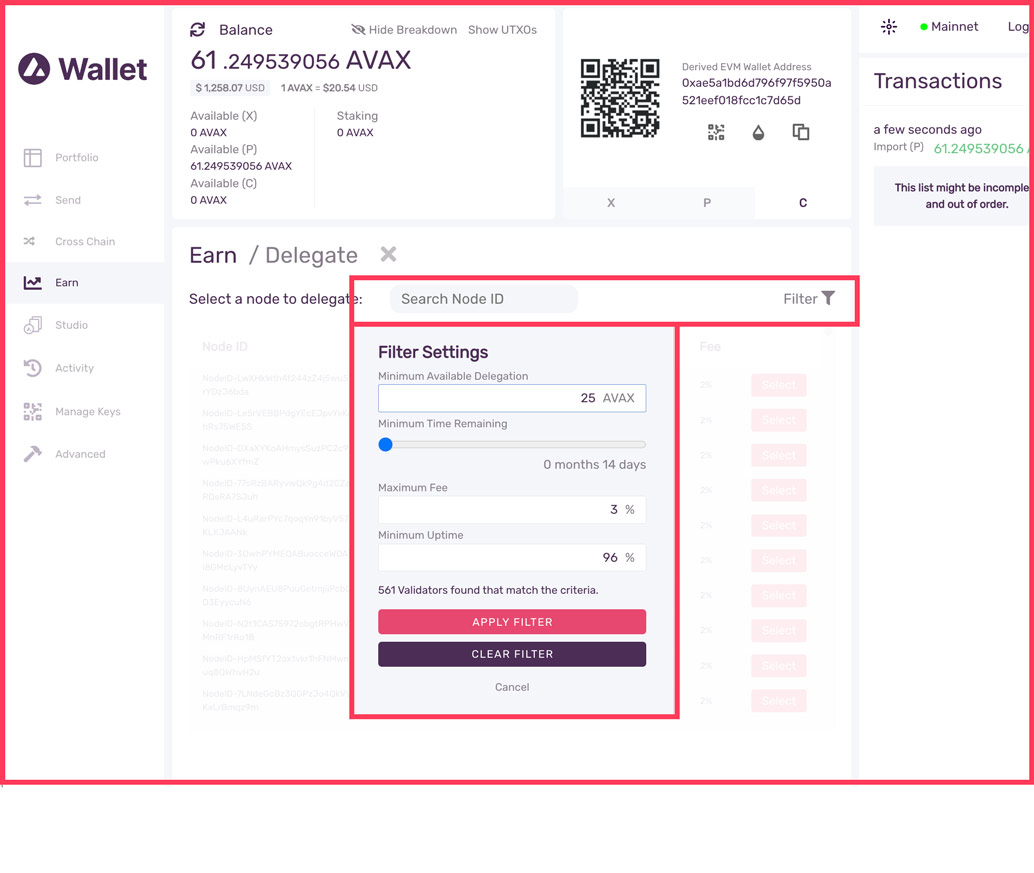
This image shows exactly how a potential delegator sees the world. Notice the "Filter Settings." A user can set their desired "Minimum Uptime" and "Maximum Fee." This creates a competitive market where validators who offer high reliability (uptime) and fair fees are more likely to attract delegations. Your delegation fee is a direct trade-off: a lower fee might attract more delegators, while a higher fee earns you more per delegator.
The mechanics of how you receive this fee are straightforward.
How to Stake - Avalanche Builder Hub
Let's return to the documentation one last time to see how the delegation fee is officially described.
Read the section on Delegator Rewards. This confirms that the validator keeps a portion of the delegator's reward. Then, read the FAQ entry "How Are Delegation Fees Distributed To Validators?" to understand when you actually receive this income.
In short, if your validator earns a reward, your delegators also earn a reward. Your fee is taken from their portion and paid to you at the end of your validation period.
Case Study: Validator Profitability
Let's put these three concepts—uptime, stake amount, and delegation fee—together to see how they translate into a net profit. For this, we can look at some economic models that illustrate the business case.
The following resource analyzes validator profitability and provides clear, practical tables.
ACP-247: Delegation Multiplier Increase | Avalanche Builder Hub
This document, although a technical proposal, contains excellent, easy-to-understand tables that model validator income. It's a perfect way to see how the numbers work in practice. We'll assume a validator with 2,000 AVAX self-stake, 8.25% annual yield (APY), a 5% delegation fee, and $150/month in server costs.
First, look at the table in Scenario 1. This shows the profit for a validator with zero delegations. Next, examine the table in Scenario 3. This models a validator that has successfully attracted the maximum amount of delegations. Pay close attention to the Validator self-share and Delegation fee income lines.
Let's break down the difference between the two scenarios:
Scenario 1: Solo Validator (No Delegations)
- Total Stake: 2,000 AVAX (your own)
- Monthly Rewards: $275 (from your stake)
- Delegation Fee Income: $0
- Total Income: $275
- Net Profit: $275 (Income) - $150 (Costs) = $125
As you can see, running a validator with only your own stake is marginally profitable. The real potential is unlocked by attracting delegators.
Scenario 3: Validator at Full Delegation Capacity
- Total Stake: 10,000 AVAX (2,000 self-stake + 8,000 delegated)
- Income from Self-Stake: $275 (same as before)
- Income from Delegations: $55 (5% fee on the reward generated by 8,000 AVAX)
- Total Income: $275 + $55 = $330
- Net Profit: $330 (Income) - $150 (Costs) = $180
By attracting delegators, you've increased your net profit significantly without any additional capital investment. This is the core business model of a public validator: leveraging your secure infrastructure to earn fees from the capital of others.
Conclusion
You now have a complete picture of the economic engine that drives an Avalanche validator. This concludes the first module of our course, providing you with all the necessary conceptual knowledge to move forward.
Let's summarize the key takeaways on validator rewards:
- Uptime is a gatekeeper: You must maintain over 80% uptime to be eligible for any reward. Your operational goal should be 100%.
- Rewards scale with stake and time: The size of the reward is determined by a formula based on the total stake (your own + delegated) and the staking duration.
- Delegation fees are your profit margin: You earn income by charging a percentage fee on the rewards generated by the AVAX that other users delegate to your node. Attracting delegators is key to a profitable business.
Having covered the "what," "why," and "how much" of validation, you are now ready to begin the practical journey. In our next lesson, we will launch into Module 2 and start building the foundation of your operation: provisioning and securing your first cloud server on the Fuji testnet.