Welcome to the next stage of your journey toward launching a validator business. In our last session, we outlined the significant commitments required to run an Avalanche validator on the Mainnet: a powerful server, a substantial stake of 2,000 AVAX, and near-perfect uptime. These high stakes underscore the importance of precision and expertise.
Given the financial risk involved, it would be unwise to attempt your first setup on the live network. This lesson introduces the solution: a crucial, risk-free training environment. We will explore the fundamental difference between the Avalanche Mainnet and its public test network, Fuji. By the end of this lesson, you will understand why practicing on Fuji is a non-negotiable step for any serious validator operator.
The Concept of a Digital Proving Ground
In complex and high-stakes fields, professionals rarely perform a critical task for the first time in a live environment. Airline pilots spend hundreds of hours in flight simulators, and surgeons practice procedures on anatomical models. The world of blockchain has an equivalent concept: the testnet.
A testnet is a parallel blockchain that functions just like the real one—the "Mainnet"—but with one critical difference: the tokens on a testnet have no real-world monetary value. It's a sandbox where developers, and aspiring validator operators like you, can experiment, learn, and make mistakes without any financial consequences.
Avalanche's public testnet is named Fuji. The following article from the Avalanche Builder Hub explains the core purpose of testnets.
Why Test Networks Like Fuji Exist — and Who They're For | Avalanche Builder Hub
This official documentation provides the foundational 'why' behind using a testnet. It establishes the concept of a safe, low-stakes environment for validation and development.
Please read the section "Why Testnets Matter" to understand the fundamental purpose of a testnet. Then, read "The Takeaway" section to see how Fuji fits into the development lifecycle before deploying to Mainnet.
As the article highlights, a testnet is a "proving ground." It's where you can build your skills and test your setup, ensuring everything works perfectly before you commit real capital and put your business's reputation on the line.
Mainnet vs. Fuji Testnet: The Key Differences
The distinction between Mainnet and Fuji can be summarized by one core concept: risk. Mainnet is the live, production environment where every action has real economic consequences. Fuji is the rehearsal space where actions have consequences only for your learning and preparation.
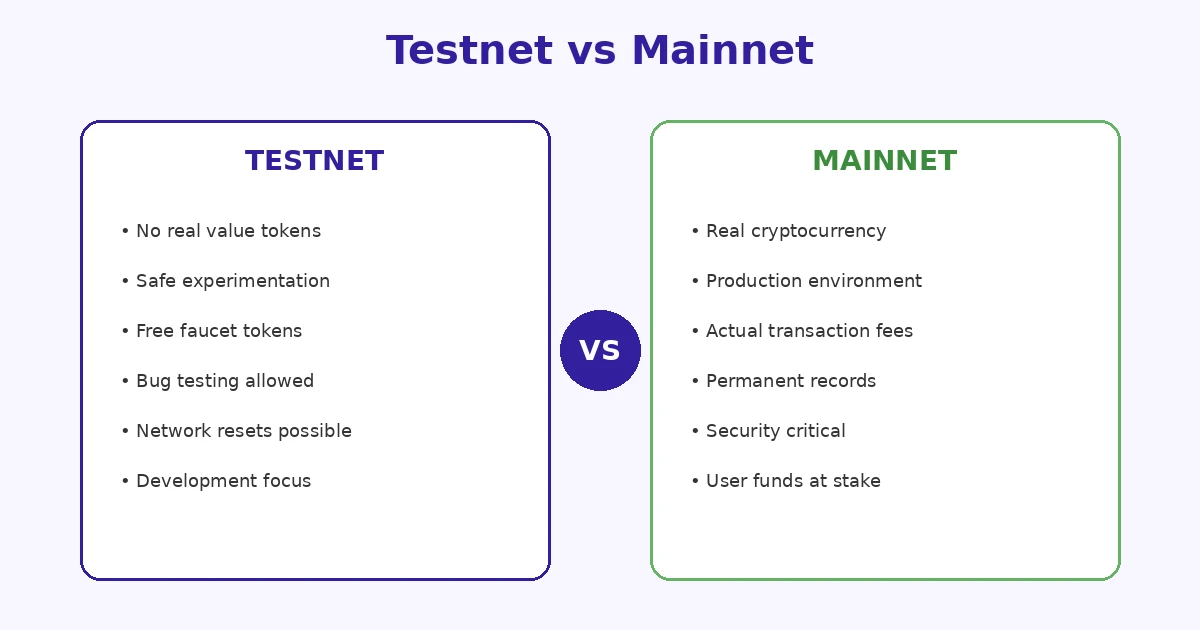
The image below provides a clear, side-by-side comparison of their characteristics.
Let's break down the most important points for your goal of running a validator:
-
Value and Cost:
- Mainnet: Uses real AVAX tokens that you must purchase. All transaction fees (gas) are paid with real AVAX. The 2,000 AVAX stake is a significant capital investment.
- Fuji: Uses valueless "test AVAX." You can acquire these tokens for free from a service called a faucet. This means you can practice the entire process of staking and paying transaction fees with zero financial risk.
-
Purpose and Permanence:
- Mainnet: This is the live economy. Transactions are permanent and irreversible. Its purpose is to provide a secure and stable platform for real financial applications. Security is paramount because user funds are at stake.
- Fuji: This is a development and testing environment. While it aims for stability, the network can be reset or altered by the core developers if needed. Its records are not considered permanent, and its purpose is experimentation.
-
Your Role:
- On Mainnet: You are a service provider responsible for securing a live network. Mistakes can lead to financial loss for you and your delegators.
- On Fuji: You are a learner. Mistakes are expected and are valuable learning opportunities. A server crash or misconfiguration on Fuji is a free lesson in what to avoid on Mainnet.
How This Looks in Practice
The difference between these two networks isn't just conceptual; it appears in the actual commands and configurations you will use to set up your validator. When you eventually submit the transaction to become a validator, you will have to specify which network you are targeting.
The following resource shows how to add a validator. While we will cover these steps in detail later, for now, just observe how the parameters change between Fuji and Mainnet.
Turn Node Into Validator | Avalanche Builder Hub - Avax.network
This technical guide shows the practical side of the Fuji vs. Mainnet distinction. It demonstrates how the choice of network directly impacts the commands and parameters you'll use.
First, read the paragraph that describes the staking parameters for the Core web interface. Notice the difference in stake amounts mentioned in this sentence: staking requirements. Next, scroll to the table under the "Key Flags" heading. Examine the descriptions for the --stake and --network flags.
As you can see, the difference is explicit:
- The
--stakeamount is2000on Mainnet but just1on Fuji. - The
--networkflag is set tomainnetorfujito tell your node which blockchain to interact with.
This is a powerful illustration of why Fuji is so critical. A typo in the stake amount on Fuji is harmless. On Mainnet, it could have significant financial implications.
Why Practicing on Fuji is Non-Negotiable
For your goal of launching a commercial validator business within a few weeks, think of the Fuji testnet as your mandatory training ground. It's the environment where you will execute every step of the process at least once before doing it for real.
On Fuji, you will practice:
- Provisioning and securing a cloud server.
- Installing and configuring the AvalancheGo software.
- Obtaining free test AVAX from the faucet.
- Creating your node's identity and submitting the staking transaction.
- Monitoring your validator's uptime and performance.
- Performing a disaster recovery drill.
Every challenge you overcome and every mistake you make on Fuji is a free lesson that strengthens your operational readiness for Mainnet. Skipping this step is equivalent to a pilot attempting to fly a passenger jet without ever having used a simulator—it's an unnecessary and professionally unacceptable risk.
Conclusion
You now understand the distinct roles of the Avalanche Mainnet and the Fuji testnet. The Mainnet is the live, high-stakes production environment where real value is transacted and secured. The Fuji testnet is its functional replica, a risk-free sandbox for learning, testing, and perfecting your setup using valueless tokens.
The key takeaways are:
- Mainnet is for production; Fuji is for practice.
- Mainnet uses real, valuable AVAX; Fuji uses free, valueless test tokens from a faucet.
- Using Fuji first is a critical risk-management step to ensure your validator setup is secure and reliable before committing real capital.
From this point forward, every hands-on lesson in this course—from setting up a server to running your AI agent—will be performed on the Fuji testnet.
In our next and final lesson of this introductory module, we will cover how validator rewards are calculated. This will complete your foundational understanding of a validator's role and incentives before we dive into the practical, hands-on work of building your node in Module 2.