Hello! Welcome back to our final module on The Final Proofing Stage.
In our last lesson, you mastered the practical skills of marking up a PDF proof using Adobe Acrobat's annotation tools. You now know how to communicate corrections clearly and efficiently to a typesetter.
Today, we're expanding our focus from individual pages to the entire book. The goal of this lesson is to learn how to perform a quality check on a full proof set, including front matter, back matter, and running heads. A "proof set" isn't just the main story or argument; it's every single page from the first to the last. This final quality check is a holistic review to ensure the entire book is consistent, correctly structured, and ready for printing.
We'll cover the standard components of a book, what to look for in each section, and how to verify crucial elements like page numbers and running heads across the whole document.
1. The Anatomy of a Book
Before you can check a proof set, you need to know its constituent parts. Professionally published books follow a conventional structure, which is generally divided into three main sections: the front matter, the text, and the back matter.
Understanding this structure is the first step in performing a systematic quality check. Let's get a formal overview from the publishing industry's key reference guide.
The Chicago Manual of Style 17 – 1
The Chicago Manual of Style (CMOS) provides the definitive outline for the parts of a book. This section introduces the three main divisions and their general purpose.
Please read section 1.3, 'Divisions and parts of a book—overview.' It's a short paragraph that sets the stage for everything we'll discuss today.
As CMOS explains, each part serves a distinct function:
- Front Matter (or Prelims): Introduces the book and provides key information about its publication.
- Text: The main content of the book—the narrative, argument, or core information.
- Back Matter (or End Matter): Contains supplementary material that supports the text, such as sources, notes, and indexes.
Now, let's get a more visual and descriptive tour of what you'll find in the front and back matter.
FRONT matter vs BACK matter | Parts of a Book | Book Publishing
This video from the Eleanor Marie Rose YouTube channel gives a clear and accessible walkthrough of the various pages that make up the front and back matter. It will help you visualize the elements we'll be checking.
Please watch the entire video (around 5 minutes). The first half covers the front matter, and the second half covers the back matter. As you watch, notice the variety of pages that can appear and their different purposes.
2. The Front Matter Quality Check
The front matter sets the stage for the entire book, and errors here look particularly unprofessional. It requires a meticulous check of both content and formatting.
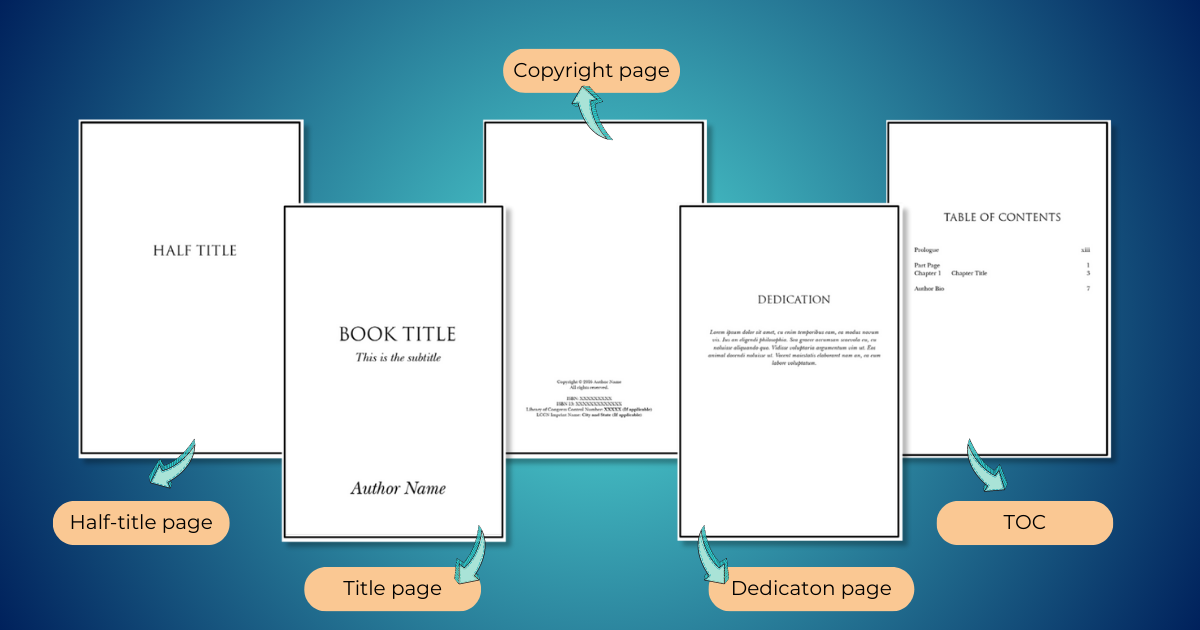
Your job during the quality check is to ensure everything is present, in the right order, and accurate. The standard order and pagination are crucial.
The Chicago Manual of Style 17 – 1
Let's return to the CMOS for the authoritative guide on the structure of the front matter. This table is your master checklist for what goes where.
First, review the 'Front matter' portion of the table in section 1.4. This shows the standard order and how pages are numbered with lowercase roman numerals (i, ii, iii...). Then, read sections 1.17 through 1.39, which provide detail on each element from the half title page through the table of contents. You don't need to memorize everything, but familiarize yourself with the purpose of each page.
Based on these resources, here is a practical checklist for the front matter:
- Order: Are the pages in the correct sequence (e.g., half-title, title page, copyright page, dedication)?
- Pagination:
- Is the front matter paginated with lowercase Roman numerals (i, ii, iii, etc.)?
- Are page numbers (folios) hidden on "display" pages like the title page, copyright page, and dedication? This is called a "blind folio."
- Title Page: Is the title, subtitle, and author's name spelled correctly? Does it match the cover and half-title?
- Copyright Page: This is a legally important page. Check that the author's name and publication year are correct. Confirm the ISBNs listed match the correct format (e.g., hardcover, ebook).
- Table of Contents (TOC): This is a high-risk area for errors.
- Do the chapter titles in the TOC exactly match the titles in the main text? Check for wording, capitalization, and spelling.
- Do the page numbers in the TOC match the actual starting page of each chapter? Spot-check several chapters to be sure.
3. Checking Running Heads and Pagination
Running heads and page numbers are the reader's navigation system. They must be consistent and accurate throughout the entire proof set.

The rules for running heads can be surprisingly complex.
The Chicago Manual of Style 17 – 1
CMOS provides clear guidelines on how to format and when to use (or omit) running heads and page numbers.
Please read sections 1.5 to 1.9 on pages and page numbers, and then sections 1.10 to 1.16 on running heads. Focus on the conventions for recto (right-hand) and verso (left-hand) pages, and the rules for omitting running heads on display pages like chapter openers.
Here is your checklist for running heads and pagination:
- Pagination Sequence:
- Does the main text begin on an odd-numbered page (usually page 1 or 3) with an Arabic numeral?
- Do the page numbers run consecutively through the text and into the back matter?
- Are odd numbers always on recto (right-hand) pages and even numbers on verso (left-hand) pages?
- Running Head Content:
- Is the content correct? A common convention is the book title on the verso page and the chapter title on the recto page. Check that this is consistent.
- If a chapter title is long, is it shortened logically and consistently in the running head?
- Running Head Placement:
- Are running heads and page numbers omitted from display pages (part titles, chapter opening pages, and pages with only full-page images)?
- Are they consistently placed (e.g., top-right on rectos, top-left on versos)?
4. The Back Matter Quality Check
The back matter contains supplementary material. While it comes at the end, its accuracy is just as important as the rest of the book.
The Chicago Manual of Style 17 – 1
Finally, let's review the standard components of the back matter.
Please read sections 1.59 to 1.68. This covers appendixes, glossaries, notes, bibliographies, and indexes. Pay attention to the expected order of these elements.
Here's a checklist for the back matter:
- Order: Are the sections in the correct sequence (e.g., Appendixes, then Notes, then Bibliography, then Index)?
- Pagination: Does the Arabic numbering from the main text continue seamlessly through the back matter?
- Notes: If there are endnotes, do the note numbers in the text correspond correctly to the note entries? Spot-check a few.
- Bibliography/References: Is the list alphabetized correctly? Is the formatting consistent?
- Index: A full index verification is a separate, specialized task, but for a quality check, you should spot-check about 5-10 entries. Do they point to the correct page numbers in the text?
5. Bringing It All Together: A Systematic Process
Performing a full quality check requires a systematic approach to ensure nothing is missed. It's about moving from a page-by-page view to a bird's-eye view of the book's structure and consistency.
To see this mindset in action, the following video shows an author's personal proofreading process. While her workflow is for self-publishing, her meticulous attention to detail—checking every single page, tracking timelines in the front and back, and looking for consistency—is exactly the kind of rigor required for a quality check.
HOW I PROOFREAD my books | EDITING VLOG | day in the life of an author preparing for a book release
Watch author Bethany Atazadeh describe her process for proofreading a physical proof. Focus on the scope of her check—how she considers everything from the copyright page to timeline notes she keeps in the back of the book.
Please watch from 03:22 to 05:16 and from 08:58 to 10:45. Notice her emphasis on checking 'every single page' and her method for tracking large-scale consistency issues like timelines.
To formalize this process, many proofreaders use a checklist. This ensures all points are covered for every project.
Professional proofreader Louise Harnby has created an excellent, comprehensive checklist for proofreading page proofs. This document summarizes and organizes all the checks we've discussed today into a practical tool.
Read through this two-page checklist. You'll see it's divided into Prelims (Front Matter), Main Text, and End Matter, covering all the key areas like pagination, running heads, and chapter titles. This is a great model for the kind of systematic check you'll be expected to perform.
Conclusion
You now have a comprehensive framework for conducting a full quality check on a proof set. This process moves beyond finding typos on a single page to verifying the structural integrity and consistency of the entire book.
Key Takeaways:
- A full proof set consists of three parts: front matter, text, and back matter.
- The front matter is paginated with lowercase Roman numerals and contains elements like the title page, copyright page, and table of contents.
- The text and back matter are paginated with continuous Arabic numerals.
- Running heads and page numbers serve as navigation and must be checked for accuracy, consistency, and correct placement (or omission on display pages).
- A quality check is a systematic process that verifies the order, content, and formatting of every part of the book, from the half-title page to the index.
Next Up:
In our final lesson, we will address the last step in the proofing workflow: Compile and communicate a final, collated corrections list for a typesetter. This involves organizing all of your annotations into a clear, final report.