Hello! Welcome to the ninth module of our course, "Genre and Format Considerations."
In the previous modules, you've built a comprehensive skill set covering the entire editorial workflow, from manuscript assessment and developmental editing to the final proofreading checks. You've mastered the core mechanics of how to edit a book. Now, we'll explore how to adapt and specialize that process. An editor's approach isn't one-size-fits-all; it must be tailored to the specific type of book they are working on.
This lesson focuses on one of the most fundamental distinctions in the publishing world. Our goal is to compare the conventions, reader expectations, and developmental editing priorities for literary versus commercial fiction.
Understanding this spectrum is crucial. It informs everything from your initial assessment of a manuscript to the specific feedback you'll give an author. This theoretical foundation will prepare you for our next lesson, where you'll apply these principles to practical editing exercises.
1. The Fiction Spectrum: Literary, Commercial, and Upmarket
At a high level, the distinction seems simple: literary fiction is often seen as "art," driven by character and theme, while commercial fiction is "entertainment," driven by plot. However, the reality is a spectrum, not a binary.
To get a clear overview of the landscape, let's start with a short video that introduces the three key categories agents and editors use to classify fiction: literary, commercial, and the important category that bridges the two, upmarket.
Literary vs. commercial fiction
This video from editor Alyssa Matesic provides a concise and helpful introduction to the core differences between literary, upmarket, and commercial fiction.
Please watch the full video (it's less than 3 minutes). As you watch, note the key characteristics Matesic assigns to each category, particularly regarding the focus (plot vs. character), the aim (art vs. entertainment), and the nature of the ending.
As the video explains, these categories are signals about the reading experience.
- Literary Fiction: Tends to be character-driven, focuses on the craft of writing, and often explores complex themes with ambiguous or open endings.
- Commercial Fiction: Tends to be plot-driven, follows established genre conventions, and aims to provide a fast-paced, entertaining experience with a satisfying, closed ending.
- Upmarket Fiction: Blends the two, featuring the accessible, plot-driven nature of commercial fiction with the character depth and quality prose of literary fiction. Think of bestselling book club favorites.
2. Deeper Distinctions: Conventions and Reader Expectations
Now that we have a basic framework, let's explore the conventions and reader expectations for each category in more detail. An editor must be acutely aware of what the target audience for a manuscript is looking for.
This next resource, an article from Writer's Digest, reinforces these distinctions and introduces the concept of "transparent" prose in commercial fiction.
Learn to Write for a Target Audience
In 'Learn to Write for a Target Audience,' author Nancy Kress breaks down the practical differences between literary and commercial fiction from a writer's—and editor's—perspective.
Please read the sections titled 'What kind of show is it?' through to the end of the description of commercial fiction. Pay attention to the descriptions of pacing, style, and worldview for each category.
To synthesize this information and explore the underlying "why," this next video offers a thoughtful analysis of the purpose, plot scale, and writing style that differentiate these categories.
This video, 'Literary vs. Genre Fiction' from the Quotidian Writer channel, goes beyond simple definitions to discuss the philosophies and reader motivations behind each category. It provides an excellent model for thinking about these distinctions.
Please watch from 02:32 to 12:12. Focus on the three key differences the video identifies: purpose, plot scale, and writing style. Note how these factors influence what a reader expects from the story.
Let's consolidate these ideas into a clear comparison.
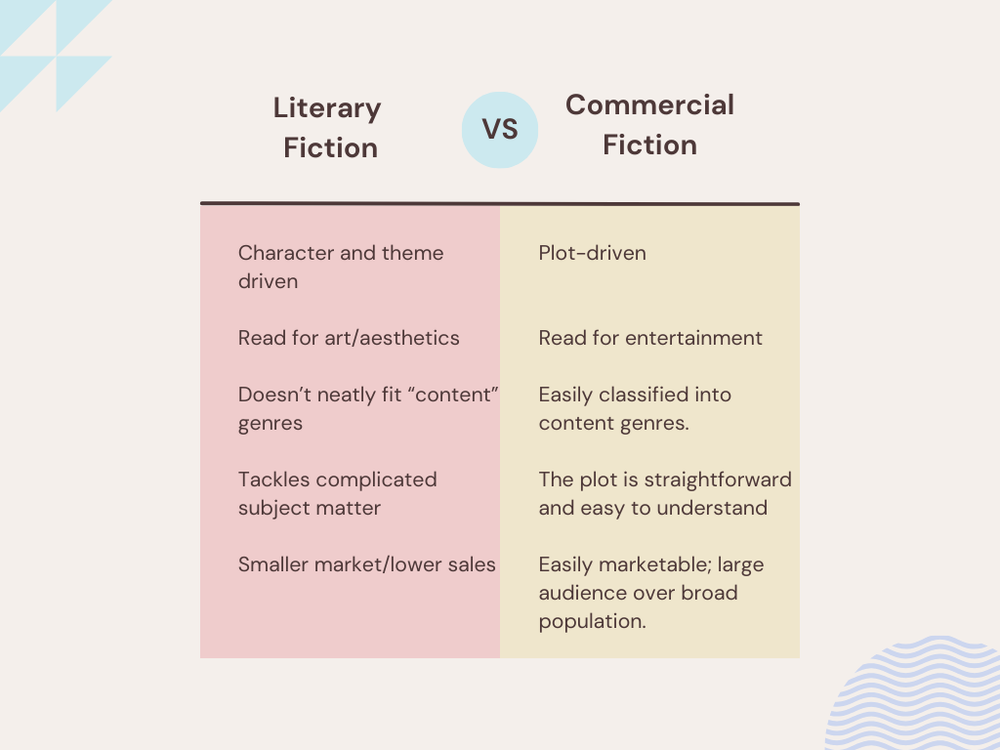
As you can see, the differences are fundamental:
| Aspect | Literary Fiction | Commercial Fiction |
|---|---|---|
| Primary Drive | Character, theme, voice | Plot, external conflict |
| Pacing | Slower, more contemplative | Faster, page-turning |
| Prose Style | Lyrical, stylized, noticeable | "Transparent," accessible |
| Ending | Often open, ambiguous, or bittersweet | Usually closed and satisfying |
| Reader's Goal | To be challenged, moved, and to reflect | To be entertained, thrilled, and to escape |
3. From Convention to Practice: Developmental Editing Priorities
Understanding these differences is not just an academic exercise. As a developmental editor, you must use this knowledge to focus your feedback. Your job is to help the author best fulfill—or artfully subvert—the expectations of their target audience. Your editing priorities will shift dramatically depending on whether you're working on a literary novel or a commercial thriller.
This final resource offers a practical look at how an editor's focus changes based on genre.
The article 'Fiction Developmental Editing' from BubbleCow provides an excellent breakdown of genre-specific editing priorities. It shows exactly how an editor tunes their analysis to meet reader expectations.
First, read the subsection titled 'Literary and Book Club.' Note the three 'Nonnegotiables'—thematic resonance, interiority, and narrative form. Then, contrast this with the priorities listed for a commercial genre like 'Mystery and Thriller.' Finally, read the FAQ point that begins, 'Do developmental edits differ by genre...'
Based on this, we can establish a clear set of different priorities for developmental editing.
Editing Priorities for Literary Fiction
When editing a literary manuscript, your primary focus is on depth and execution. You'll ask questions like:
- Interiority: Is the character's internal journey the driving force of the narrative? Is their inner life rendered with complexity and authenticity?
- Thematic Resonance: Does the novel explore a central question or theme in a nuanced way? Do the plot, characters, and setting all contribute to this exploration?
- Voice and Prose: Is the writing style distinctive and purposeful? Does the language itself contribute to the novel's meaning and emotional impact?
- Narrative Form: If the author is using an unconventional structure (e.g., non-linear timeline, multiple perspectives), does it serve the story's artistic goals?
Editing Priorities for Commercial Fiction
When editing a commercial novel, your focus shifts to momentum and satisfaction. Your questions will be more like:
- Plot and Pacing: Is the opening hook compelling? Is the pace relentless, with rising stakes and tension? Does every scene serve to advance the plot?
- Genre Conventions: Does the story deliver on the core promises of its genre? For a thriller, is the suspense maintained? For a romance, is the central relationship arc clear and emotionally engaging?
- Clarity and Stakes: Is the central conflict clear and the goal well-defined? Are the stakes (what the protagonist stands to lose) high enough to keep the reader invested?
- Satisfying Payoff: Is the climax effective? Is the ending resolved in a way that feels earned and satisfying to the reader, closing off the main plotlines?
You can see how the same core skill—developmental editing—is applied with a completely different lens. For literary fiction, you're a partner in artistic exploration. For commercial fiction, you're the reader's advocate, ensuring the ride is thrilling and the destination is worth it.
Conclusion
In this lesson, you've learned to differentiate between literary and commercial fiction by comparing their core components.
Key Takeaways:
- Conventions: Literary fiction is typically character-driven, with a focus on prose and theme, while commercial fiction is plot-driven and adheres more closely to genre formulas.
- Reader Expectations: Literary readers seek an artful, thought-provoking experience, while commercial readers seek entertainment, escapism, and a satisfying resolution.
- Developmental Editing Priorities: An editor's focus must align with these expectations. For literary work, priorities include interiority and thematic depth. For commercial work, priorities are plot, pacing, and delivering on genre promises.
- It's a Spectrum: These categories are not absolute. "Upmarket" fiction successfully blends literary characterization with commercial plotting to appeal to a broad audience.
In our next lesson, you will put this theory into action. You will be given two manuscript excerpts—one literary and one commercial—and asked to provide developmental feedback for each, applying the distinct priorities we've discussed today.