Hello! Welcome to the final module of our course, "Author Management and Editorial Strategy."
In our previous lessons, we've explored the editor's role across different formats, culminating in the unique challenges of curating multi-author collections. We focused on creating cohesion among many voices. Now, we shift our focus to the deeply collaborative, one-on-one relationship between an editor and a single author. This relationship is often built and defined by one key document: the editorial letter.
Today, we will tackle the art and science of this crucial form of communication. Your goal for this lesson is to learn how to draft a comprehensive and constructive editorial letter that balances macro-level feedback with encouragement.
This is where your skills in analyzing a manuscript merge with your ability to communicate effectively and diplomatically. A great editorial letter doesn't just critique a book; it provides the author with a clear, inspiring roadmap for revision.
1. The Philosophy of a Constructive Editorial Letter
Before we get into the structure of an editorial letter, it's essential to understand its purpose and the mindset required to write a good one. An editorial letter is a tool for developmental editing. It's not about line-level corrections but about addressing the "big picture"—the manuscript's fundamental strengths and weaknesses in plot, structure, character, and argument.
More importantly, it's a conversation starter. Receiving extensive feedback can be an emotional and overwhelming experience for an author. Your goal is to empower them, not dishearten them.
Let's start with a short video from editor Alyssa Matesic, who perfectly articulates this core principle.
10 Years of Book Editing in 10 Minutes
In this clip from '10 Years of Book Editing in 10 Minutes,' pay close attention to the distinction between simply finding problems and communicating solutions in an empowering way. The 'doctor analogy' is particularly insightful.
Watch the section from 06:01 to 07:17.
As the video emphasizes, the art of editing lies in communication. A successful editorial letter achieves three things:
- Builds Trust: It shows the author you understand and respect their vision, even while critiquing the execution.
- Provides Clarity: It gives a clear, prioritized diagnosis of the manuscript's issues.
- Inspires Action: It offers specific, actionable suggestions and questions that spark the author’s own creativity to find solutions.
2. The Anatomy of an Editorial Letter
Now that we've established the "why," let's break down the "how." A well-structured letter is easier for an author to digest and act upon. We'll use a detailed guide and template as our foundation.
How to Write a Good Edit Letter for a Book (Plus a Template!)
The article 'How to Write a Good Edit Letter for a Book (Plus a Template!)' by editor Tracy C. Gold offers a superb, practical framework. It covers everything from the emotional angle to a section-by-section template.
Please read the following sections: 'The Emotional Angle', 'Edit Letter Introduction', 'Edit Letter Body', and 'Edit Letter Conclusion'. We will be referring to this structure throughout the lesson.
Based on this framework and other professional practices, a comprehensive editorial letter generally contains the following components.
A. The Opening: Praise and Purpose
How you begin the letter sets the tone for everything that follows. Many experienced editors agree that starting with genuine, specific praise is crucial. It’s not about flattery; it’s about acknowledging what the author has achieved and demonstrating that you "get" their book.
I Edited 51 Novels Last Year. These are 9 Things EVERY Writer Should Know.
This short clip from editor John Adkins (Bookfox) explains why starting with praise is so effective and reassuring for authors.
Watch the section from 00:50 to 01:37.
Your opening should accomplish two things, as outlined in the article by Tracy C. Gold:
- "What I Loved": Start with a paragraph or two detailing the manuscript's greatest strengths. Be specific. Instead of "Your characters are great," try "The protagonist's internal conflict in the first act is incredibly compelling, and your use of dialogue to reveal her past trauma is masterful." This shows you've read carefully and appreciate the author's craft.
- "What to Work On": After the praise, provide a high-level summary of the 1-3 most significant areas for revision. This acts as a thesis statement for the rest of the letter and helps the author focus on what's most important.
B. The Body: The "Critique Sandwich"
The body of the letter is where you'll dive into the details. A common and effective approach is to structure your feedback for each major element like a "critique sandwich": positive comments, followed by constructive criticism and suggestions, and ending with encouragement.
Editor September C. Fawkes advocates for a clear separation of "Strengths" and "Concerns" within each category, which achieves a similar balancing effect. Let's look at how this is put into practice.
How I Write an Editorial Letter or Critique Letter
In this article, 'How I Write an Editorial Letter or Critique Letter,' Fawkes provides a sample letter that clearly demonstrates this balanced structure. It's a great model for organizing your thoughts.
First, read the brief introductory paragraphs just before the 'Sample Editorial Letter' heading to understand the author's philosophy. Then, read the sample letter itself, paying close attention to how feedback is organized under the headings for 'Setting & Worldbuilding,' 'Characters,' and 'Plot.' Notice the clear separation of Strengths and Concerns.
The key categories you'll typically address in the body include:
- Plot/Structure: For fiction, this covers pacing, stakes, conflict, and narrative arc. For nonfiction, it's about the logic, flow, and organization of the argument.
- Character: Character arcs, motivation, consistency, and voice. Are the characters believable and compelling?
- Theme: Is the central message or idea clear and effectively woven throughout the manuscript?
- Worldbuilding/Setting: Does the world feel immersive and consistent?
- Voice/Style: Does the prose style serve the story and the target audience?
- Target Market: Does the manuscript meet the expectations of its intended genre and readership?
For each point of criticism, remember the principle from the first video: provide actionable suggestions. Instead of "The middle of the book is slow," try "The pacing in the middle sags because the protagonist becomes too passive. Consider introducing a new obstacle or a ticking clock on page 150 to reignite the central conflict and give her a more active goal."
C. The Conclusion: The Encouraging Send-off
End the letter on a positive and forward-looking note. Reiterate your belief in the project and the author's ability to successfully complete the revisions. Briefly summarize the key revision priorities and open the door for a follow-up conversation. This reinforces the idea that editing is a partnership.
3. Practical Application: Analyzing and Outlining
Let's look at a real-world example and then put your knowledge to the test.
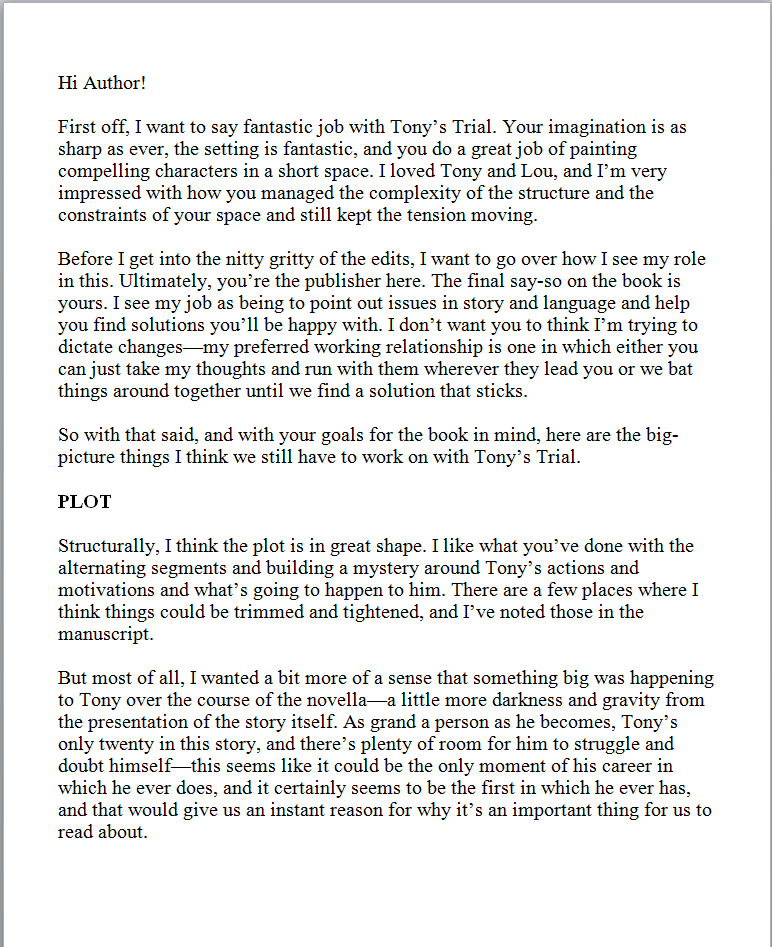
This example effectively models the principles we've discussed. The editor opens with specific praise, sets a collaborative tone ("I'm just a guide"), and then introduces the main point of developmental feedback in a constructive way.
Your Turn: Outlining an Editorial Letter
Now, it's your turn to apply this structure. Imagine you've just finished reading a 300-page manuscript for a young adult (YA) fantasy novel. Here is a summary of your findings:
- The Manuscript: The Sunstone Cipher
- Strengths:
- The magic system is incredibly original and well-conceived.
- The main character, Elara, has a witty, engaging voice that will resonate with YA readers.
- The description of the capital city is vivid and immersive.
- Weaknesses:
- The main plot doesn't kick in until around page 100. The first third of the book is mostly worldbuilding and backstory.
- The antagonist is a flat, "evil for the sake of evil" villain with unclear motivations.
- A major "twist" in the climax relies on information the reader was never given, making it feel unearned.
Your Task:
Based on this assessment, draft the Introduction section of your editorial letter to the author. Your introduction should include:
- A "What I Loved" paragraph with specific, genuine praise.
- A "What to Work On" paragraph that identifies the two most important macro-level issues (from the list above) that the author should focus on.
Take about 10 minutes to write this. Focus on achieving that crucial balance of encouragement and clear, constructive direction.
My Approach:
Here is how I would approach that task.
-
Subject: Editorial Letter for The Sunstone Cipher
-
Dear [Author's Name],
Thank you so much for sharing The Sunstone Cipher with me. It was a true pleasure to get lost in the world you've created. I was immediately captivated by Elara's sharp, witty voice; she feels like a character who will step right off the page and into the hearts of YA readers. Your magic system, centered on the linguistics of light, is one of the most original and fascinating I've encountered in a long time. It’s a brilliant concept, and the way you described the glowing architecture of the capital city was breathtaking. You have built a truly special world with a fantastic hero to guide us through it.
In this letter, I'm going to outline my thoughts on the manuscript, focusing on the big picture. Overall, I believe the manuscript is strong, and with some structural revisions, it can be truly exceptional. My two main suggestions, which we'll explore in detail, are to quicken the pacing of the opening act to get the main plot moving sooner and to deepen the antagonist's motivations to raise the emotional stakes of the central conflict.
The following pages contain my detailed notes. Please know that these are all suggestions aimed at helping you realize your vision for this wonderful story. I'm excited to discuss them with you.
Conclusion
Drafting an editorial letter is a core competency for any developmental editor. It is a document that must be as thoughtfully constructed as the manuscript it analyzes.
Key Takeaways:
- An editorial letter's primary goal is to empower and inspire an author, providing a clear and constructive roadmap for revision.
- Structure is key: Start with specific praise, group feedback into logical categories (Plot, Character, etc.), and always balance strengths with concerns.
- Be constructive, not just critical: For every problem you identify, suggest a potential solution or ask a guiding question to help the author find their own answer.
- Tone is everything. Maintain a supportive, collaborative tone from the opening sentence to the final sign-off.
In our next lesson, we'll address what happens after you send the letter. We will discuss how to apply strategies for managing common author-editor disagreements and resolving conflicts constructively, ensuring the author-editor relationship remains productive and positive.