Hello! Welcome back to our course on editorial publishing.
In our last lesson, we defined the scope and objectives of developmental editing, establishing it as the crucial "big picture" stage focused on a manuscript's foundational elements. We discussed how a developmental editor assesses everything from plot and pacing to character and theme, all with the goal of helping the author realize their vision and elevate the manuscript to a professional standard.
Today, we take our first deep dive into one of those foundational elements: narrative structure. Your work in journalism has already given you an intuitive sense of how to arrange information to create impact. Now, we'll formalize that intuition and expand it to book-length manuscripts in both fiction and nonfiction. Our goal is to analyze the function of narrative arc and structure in both fiction and nonfiction. Understanding these frameworks is the key to diagnosing a manuscript's core strengths and weaknesses.
What is a Narrative Arc? A Theoretical Foundation
At its most basic, a narrative arc is the underlying structure that gives a story its shape—a beginning, a middle, and an end. While this sounds simple, scholars have found that this structure isn't just an artistic convention; it follows a surprisingly consistent and quantifiable pattern.
Let's begin with a look at a fascinating study that used text analysis to empirically prove the existence of a common narrative structure.
The narrative arc: Revealing core narrative structures through text ...
The paper 'The narrative arc: Revealing core narrative structures through text...' provides a scientific basis for what storytellers have long known intuitively. It demonstrates how language patterns reveal a story's underlying architecture.
Please read the 'INTRODUCTION' section and the two sections that follow it (ending just before 'RQ1'). Focus on how the authors propose to quantify three core narrative processes: staging, plot progression, and cognitive tension. Note the linguistic markers they associate with each process.
The research you just read confirms what classical theorists like Aristotle and Gustav Freytag proposed centuries ago. A compelling narrative reliably unfolds through three key phases, which can be identified by the type of language used:
- Staging: This is the setup. The author establishes the world, the characters, and the context. Linguistically, this phase is rich in words that create context and relationships, like prepositions ("in," "on," "by") and articles ("a," "the"). This is highest at the beginning of a story.
- Plot Progression: This is the action. Once the reader understands the world, the story begins to move. Characters act and interact. This phase sees a rise in pronouns ("he," "she," "they") and auxiliary verbs ("is," "was," "did"), which propel the narrative forward.
- Cognitive Tension: This is the conflict and sense-making. The characters grapple with a central problem. This phase is marked by cognitive processing words ("think," "believe," "understand," "cause") as characters (and the narrator) work through the story's central challenge. This tension typically builds, peaks, and then resolves.
Visually, these processes combine to form the classic narrative arc, which is often depicted in a diagram like this:
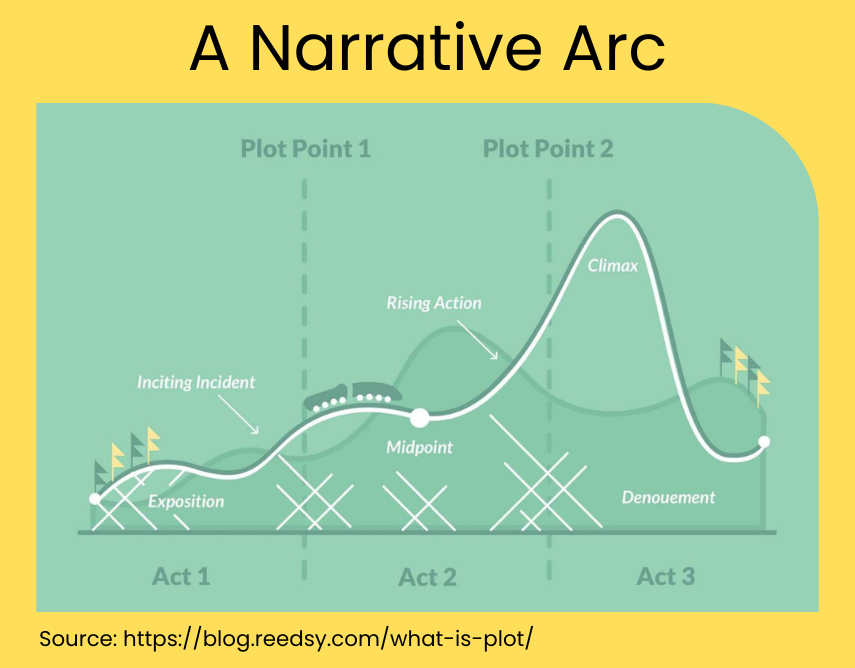
This theoretical model provides you with a powerful diagnostic lens. When a manuscript feels "flat" or "confusing," it's often because one of these structural processes is underdeveloped or out of sequence.
Narrative Structures in Fiction
While the three processes above are universal, fiction writers and editors often use more specific models to build and analyze stories. These structures are not rigid formulas, but rather proven frameworks for creating a satisfying emotional journey for the reader.
The following video gives an excellent—and critical—overview of several popular story structures. The presenter's ranking is subjective, but his analysis of each model's strengths and weaknesses is highly valuable from an editorial perspective.
Story Structures Ranked from Worst to Best
In 'Story Structures Ranked from Worst to Best,' John from Bookfox walks through several key frameworks. Pay attention not just to what each structure is, but why an editor might find it useful or limiting.
Please watch the video from the beginning to the end. I'd like you to focus particularly on these four structures he discusses: Three-Act Structure (00:08 - 01:40) Freytag's Pyramid (01:40 - 02:57) Save the Cat (07:08 - 09:30) The Hero's Journey (10:35 - 14:14) Consider how each one provides a different set of 'checkpoints' for an editor.
Let's distill the key functions of these models for a developmental editor:
- Three-Act Structure (Setup, Confrontation, Resolution): This is the most fundamental model. Its simplicity is its weakness for a complex novel, but it provides a basic test: Does the story have a clear beginning that establishes the world, a middle driven by escalating conflict, and an end that resolves it?
- Freytag's Pyramid: This model is especially useful for analyzing tragedies or stories with a clear turning point. The key concept for an editor is the "point of no return". Has the author established an event midway through the book from which the characters cannot turn back, raising the stakes irrevocably?
- Save the Cat: While prescriptive, this model offers concrete beats that readers have come to expect. For an editor, two are particularly useful diagnostic tools:
- Introduction of the B Story: Does a subplot (often a relationship) emerge after the main plot is established, adding depth and thematic resonance?
- "All is Lost" / "Dark Knight of the Soul": Before the climax, does the protagonist face a moment of total defeat (an event) and despair (an emotional reaction)? This beat makes the final victory feel earned and more powerful.
- The Hero's Journey: This is a deeply character-centric model. For an editor, its stages are invaluable for assessing character arc. For example:
- Refusal of the Call: Does the hero show realistic hesitation before embarking on their quest? A hero who jumps in too easily can feel less relatable.
- Belly of the Whale: Does the hero face an early, significant setback that signals their commitment and the true danger of the journey?
As an editor, your job isn't to force a manuscript into one of these structures. It's to understand these frameworks so you can identify why a story's pacing might feel off, its stakes might feel low, or its hero's journey might feel unconvincing.
Narrative Structure in Nonfiction
Applying narrative structure to nonfiction can feel counterintuitive, especially coming from a world of journalism where "just the facts" is paramount. However, for a book-length work to hold a reader's attention, it too needs a story. The function of structure in nonfiction is to transform information into a compelling emotional and intellectual journey.
Let's hear from an expert on this.
A Masterclass in Narrative Nonfiction with Ben Rawlence
In 'A Masterclass in Narrative Nonfiction,' author Ben Rawlence discusses the art of turning facts into a story. He addresses the core challenge for nonfiction writers and editors.
Please watch two short clips from this masterclass: From 00:49 to 01:45, where he defines narrative nonfiction and the concept of story as an 'emotional journey.' From 03:08 to 03:59, where he explains the central task of a nonfiction writer: to 'bend reality into your story arc.'
As Rawlence explains, the art of nonfiction storytelling lies in selection and arrangement. You don't invent, but you do shape. The editor's role is to help the author find the inherent story within their research and present it in the most engaging way.
So, how is this done in practice? Let's turn to a resource written for editors.
Tools for Nonfiction Developmental Editors
This paper, 'Tools for Nonfiction Developmental Editors,' provides practical advice on applying narrative techniques to nonfiction projects.
Please read the sections titled 'Creative/Narrative Writing Conventions' and 'Thesis or Argument.' Notice how narrative elements are used not to falsify, but to clarify, organize, and create reader engagement.
This resource gives us a clear picture of the function of narrative in nonfiction:
- Sustaining Interest: A narrative structure gives readers a reason to turn the page, even when the subject matter is dense or complex. As editor Betsy Lerner notes, it prevents the writing from turning into "wallpaper."
- Creating Clarity: For abstract or instructional topics, a narrative provides concrete examples and "vignettes of the idea in action," making the concepts easier to grasp.
- Guiding the Reader: A clear argument or thesis functions as the "cognitive tension" in nonfiction. It poses an unresolved question at the beginning, and the book's structure is the journey the author takes the reader on to find the answer. Each chapter should provide a "deepening, more complicated understanding."
- Adding Emotional Resonance: By using scenes, sensory details, and character-driven anecdotes, an author can help readers connect to the material on a personal level.
As an editor, you'll constantly be asking your nonfiction authors: What is the story here? What is the central question you are answering for the reader? How can we structure this information to feel like a journey of discovery rather than a lecture?
Conclusion
Today we've moved from the abstract definition of developmental editing to the concrete analysis of narrative structure, a cornerstone of the craft. You've seen that whether a manuscript is fiction or nonfiction, its success hinges on a well-executed structure that guides the reader on a satisfying journey.
Key Takeaways:
- A narrative arc is a universal feature of storytelling, defined by the progression of staging, plot development, and cognitive tension.
- In fiction, structural models like the Three-Act Structure and The Hero's Journey are not rigid rules but diagnostic tools that help an editor assess pacing, stakes, and character development.
- In nonfiction, structure is created by carefully selecting and arranging factual material to tell a story, answer a central question, and sustain an emotional and intellectual journey for the reader.
Next Up:
Now that we understand the function of a strong narrative structure, we can begin to identify what it looks like when that structure fails. In our next lesson, we will focus on identifying common structural problems in nonfiction, such as a weak thesis or poor chapter organization.