Hello! Welcome to the next lesson in our module on Line Editing: Practical Application.
In our previous lesson, we focused on rewriting complex sentences to improve their clarity and flow. We practiced untangling syntax to ensure an author's meaning is communicated effectively. Now, we'll shift our focus from the clarity of individual sentences to the cohesive feel of an entire passage.
Today's lesson addresses the learning outcome: Revise a passage to resolve tonal inconsistencies and align it with the established tone. As an editor of book-length manuscripts, you'll find that maintaining a consistent tone is one of the most critical—and challenging—aspects of your work. An inconsistent tone can confuse or alienate the reader, pulling them out of the world the author has created.
This lesson will equip you with the theoretical framework and practical tools to identify and correct these inconsistencies, ensuring a smooth and immersive reading experience.
1. Understanding Tone: The Attitude of the Text
You are already familiar with the concept of tone from your work in journalism and content writing, where tailoring the tone to a specific audience and publication is paramount. In book editing, we apply the same principles but with a focus on internal consistency over hundreds of pages.
First, let's solidify our understanding of what tone is and how it differs from related concepts like voice and mood.
Tone in Writing: 42 Examples of Tone For All Types of Writing
The article 'Tone in Writing' from The Write Practice offers an excellent and comprehensive overview of this topic. We'll start by reading the sections that define tone and explain its importance.
Please read the first two main sections: 'Definition of Tone in Writing' and 'Why Does Tone Matter in Writing'.
The key takeaway is that tone is the writer's attitude toward the subject and the audience. To add a layer of nuance that is especially useful for editors, let's consider who "controls" the tone versus the style.
How to Talk about Tone, Style, and Voice in Writing
Author and editor Anne Janzer makes a sharp distinction between tone and style. This perspective clarifies the editor's role in shaping the reader's experience.
Please read the sections 'Tone Belongs to the Reader' and 'Style Controls Tone'.
This is a powerful concept for an editor: while an author intends a certain tone, it is the reader who perceives it. Your job is to manipulate the style—the controllable elements like word choice, syntax, and grammar—to ensure the reader's perception aligns with the author's intent.
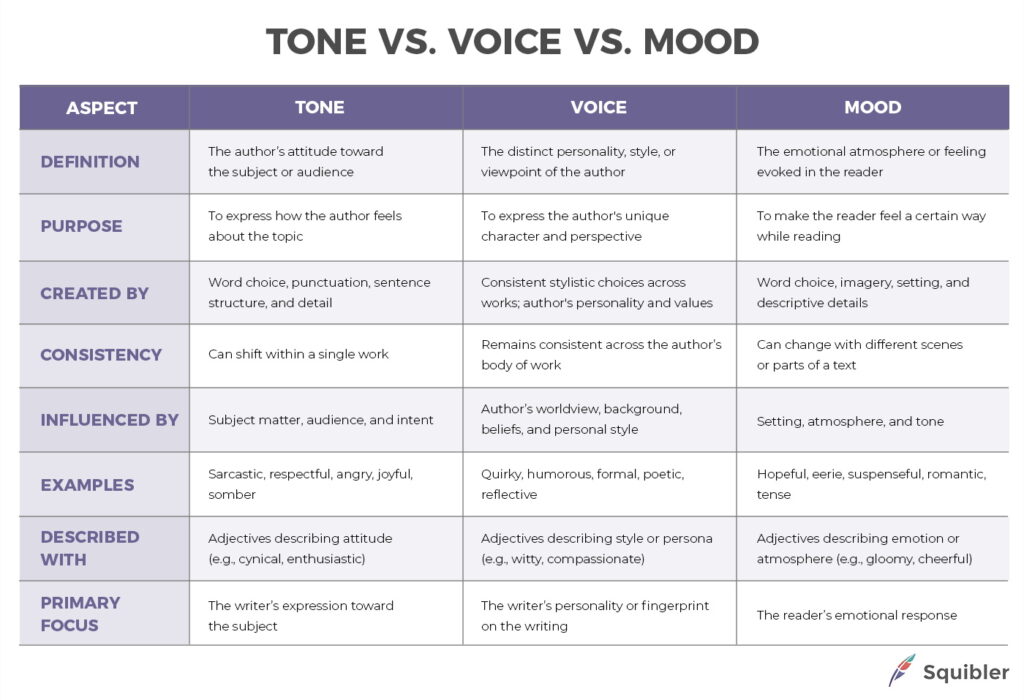
To help visualize these distinctions, here is a helpful table comparing tone, voice, and mood.
A simple but effective framework for analyzing tone is to think of it along four primary dimensions:
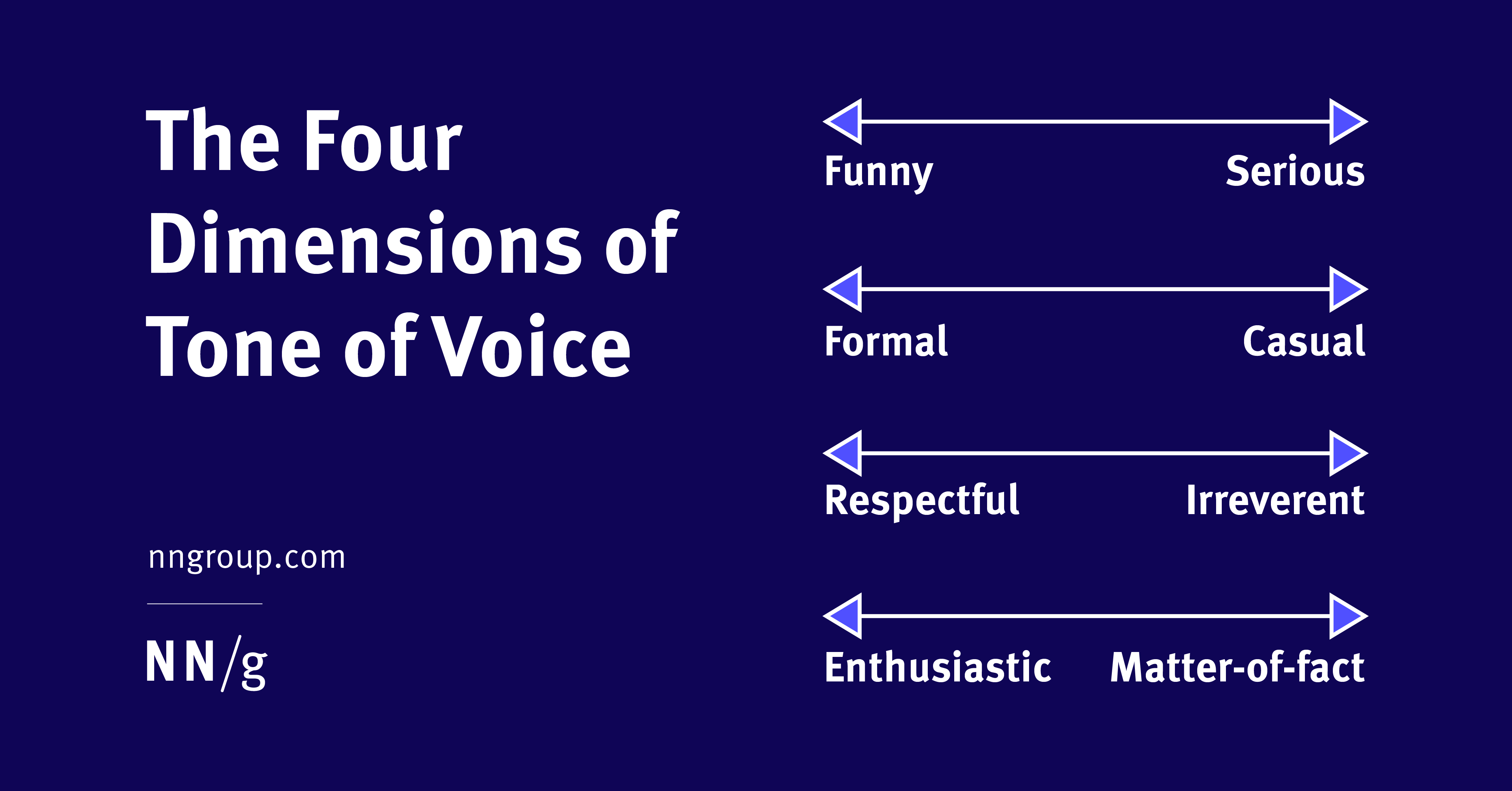
When you identify a tonal inconsistency, you can often describe it as an inappropriate shift along one of these axes (e.g., a passage becomes too casual for the established formal tone).
2. Identifying Tonal Inconsistencies in a Manuscript
Now that we have a solid theoretical foundation, let's focus on the practical skill of spotting tonal problems. An inconsistent passage feels "off" to a reader, even if they can't articulate why. As an editor, you must be able to diagnose the problem precisely.
Tone in Writing: 42 Examples of Tone For All Types of Writing
Let's return to the 'Tone in Writing' article to learn about the specific stylistic clues that signal a text's tone.
Please read the section 'How to Identify Tone in Writing'. This section provides a checklist of elements (word choice, sentence structure, punctuation, etc.) to analyze when assessing tone.
Tonal inconsistencies often arise when the narrative voice is not yet fully settled or when the author attempts an emotional effect that doesn't quite fit. Let's watch a professional editor diagnose these exact issues in a fantasy manuscript.
Let's Edit Ep. #2: Invisible POV Character Epic Fantasy Novel Editing Demonstration
In this video from her 'Let's Edit' series, editor Ellen Brock provides feedback on an epic fantasy novel. She identifies several moments where the intended humorous tone is inconsistent or doesn't land effectively.
Please watch the following four clips. Notice how she pinpoints specific reasons for the tonal dissonance, such as an unestablished sense of humor, confusing sarcasm, an unclear narrator, and inconsistent point of view. 5:14 - 5:49: Humor that doesn't work because the 'vibe' isn't established. 7:07 - 8:04: Sarcasm that is initially confusing. 8:34 - 9:31: The narrator 'holding back' and not guiding the reader's interpretation. 41:46 - 42:30: Inconsistent point of view (omniscient vs. limited) muddying the narrative voice and tone.
As you can see from the video, tonal problems are not about "bad writing." They are about a misalignment between different stylistic elements. A joke might be clever, but if it appears in an otherwise serious scene, it breaks the mood. A description might be beautiful, but if it's from a point of view that doesn't fit the rest of the chapter, it feels jarring.
3. The Editor's Toolkit: Aligning a Passage's Tone
Once you've identified an inconsistency, your task is to revise the passage to align it with the established tone. This involves making deliberate choices about style. Your main tools are the very same elements you use to identify tone in the first place: word choice and sentence structure.
Let's watch two clips from a video we viewed in our last lesson, but this time focusing on how these stylistic choices specifically shape tone and mood.
12 Ways to Write Better Sentences for Creative Writers
In '12 Ways to Write Better Sentences for Creative Writers,' Ellen Brock explains how specific stylistic choices create a desired feeling in the reader. These are the levers you'll pull to correct tonal inconsistencies.
Please watch these two segments: 3:51 - 5:38: 'Set the tone with word choices.' Pay attention to how different verbs and similes evoke entirely different moods. 11:24 - 14:16: 'Set the pace with sentence length.' Notice the direct link between sentence structure, reading speed, and the emotional tone of a scene (e.g., short sentences for urgency, long sentences for reflection).
The process for resolving tonal inconsistencies is as follows:
- Identify the established tone of the manuscript, chapter, or scene. Is it formal and academic? Fast-paced and suspenseful? Witty and irreverent?
- Pinpoint the words, sentences, or phrases that deviate from this established tone.
- Diagnose the cause. Is the vocabulary too casual? Is the sentence structure too simple for a reflective passage? Does a metaphor introduce an unintended feeling?
- Revise. Replace words, restructure sentences, or adjust pacing to bring the passage back into alignment. This often involves a delicate touch to preserve the author's voice while refining the tonal expression.
4. Practical Application: A Revision Exercise
It's time to put theory into practice. Below is a passage from a draft of a narrative nonfiction book about urban history. The established tone of the book is reflective, serious, and slightly melancholic. However, the author has inserted a few sentences that are tonally inconsistent.
Your task is to identify these sentences and revise them to align with the established tone.
Original Passage:
The Grand Majestic theater, once the jewel of the city’s cultural life, now stood as a silent monument to a bygone era. Its marble facade was stained with decades of neglect, and the ornate marquee, where the names of stars once shone, was now a lattice of rust. Honestly, the city council just dropped the ball, big time. Inside, the velvet seats were torn, and a thick layer of dust covered the stage where legends had once performed. The decay was a slow, creeping tragedy, a physical manifestation of the city’s economic decline. Oh great, another beautiful building left to rot. It’s almost like they wanted the whole downtown to look like a dump.
Instructions:
- Read the passage and identify the sentences that break from the established reflective, serious, and melancholic tone.
- Analyze why they are inconsistent (referencing the four dimensions of tone can be helpful).
- Rewrite the passage, revising or removing the inconsistent sentences to create a cohesive tone throughout.
Take about 10-15 minutes for this exercise.
Analysis and Sample Revision
Here is one possible way to revise the passage. Remember, there are multiple correct solutions in editing; the goal is alignment, not a single "right" answer.
Analysis of Inconsistencies:
- "Honestly, the city council just dropped the ball, big time."
- Problem: The tone is overly casual and informal. The slang ("big time") and conversational opening ("Honestly") clash with the formal, melancholic tone of the surrounding descriptions.
- "Oh great, another beautiful building left to rot. It’s almost like they wanted the whole downtown to look like a dump."
- Problem: The tone is sarcastic and irreverent. This breaks the serious mood and introduces a voice of bitter complaint rather than somber reflection.
Revised Passage:
The Grand Majestic theater, once the jewel of the city’s cultural life, now stood as a silent monument to a bygone era. Its marble facade was stained with decades of neglect, and the ornate marquee, where the names of stars once shone, was now a lattice of rust. This gradual dereliction was a fate the city's leadership seemed unable, or unwilling, to prevent. Inside, the velvet seats were torn, and a thick layer of dust covered the stage where legends had once performed. The decay was a slow, creeping tragedy, a physical manifestation of the city’s economic decline, and a symbol of a wider civic indifference.
Justification for Edits:
- The first inconsistent sentence was replaced with: "This gradual dereliction was a fate the city's leadership seemed unable, or unwilling, to prevent." This revision maintains the serious, formal tone while still conveying the idea of institutional failure.
- The sarcastic sentences at the end were replaced with: "...and a symbol of a wider civic indifference." This phrase extends the final thought, reinforcing the melancholic theme of decline and neglect without breaking the established tone.
Conclusion
Mastering tone is a hallmark of a skilled editor. It requires moving beyond simple error correction to engage with the emotional and attitudinal core of a text. By learning to identify and resolve tonal inconsistencies, you help the author present their work in its most powerful and cohesive form.
Key Takeaways:
- Tone is the author's attitude toward the subject and audience, perceived by the reader.
- Style is the editor's primary tool for shaping and aligning tone.
- Tonal inconsistencies arise from misaligned word choice, sentence structure, point of view, or emotional beats.
- Resolving these issues involves identifying the dominant, established tone and carefully revising outlier passages to match it.
Next Up:
In our next lesson, we will zoom in on a specific and powerful element of tone and voice: dialogue. We will focus on how to refine dialogue in a fiction excerpt to enhance subtext and character voice, a skill crucial for bringing characters to life on the page.