Hello! Welcome back to your course on Raman spectroscopy.
In our first lesson, we established the fundamental difference between IR and Raman spectroscopy: IR is an absorption process, while Raman is a scattering process. We briefly mentioned that the selection rule for Raman involves a property called "polarizability," which explains why the two techniques provide complementary information.
Today, we will dive deep into that concept. Our learning outcome is to define polarizability and explain its role in determining the Raman activity of a vibrational mode. By the end of this lesson, you will understand what polarizability is, why a change in this property during a vibration is essential for Raman scattering, and how this directly contrasts with the IR selection rule you're already familiar with.
What is Polarizability?
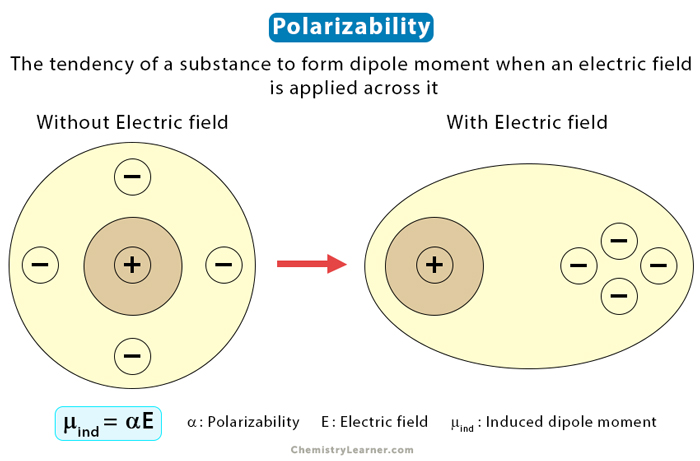
Conceptually, polarizability () is a measure of how easily the electron cloud of a molecule can be distorted or deformed by an external electric field, such as the one from the incident laser light. You can think of it as the "squishiness" or "stretchiness" of the molecule's electron cloud.
When a molecule is placed in an electric field (), its electron cloud is pulled one way and its nuclei the other, creating a temporary separation of charge. This is called an induced dipole moment (). The magnitude of this induced dipole is directly proportional to the strength of the electric field, and the proportionality constant is the polarizability, .
The image below provides a simple visual for this concept.
To build on this definition, let's read a short, clear explanation.
The following text from a presentation by Northwestern University's NUANCE center offers a very intuitive definition of polarizability and provides a helpful comparison.
On page 5 of the PDF, please read the two short paragraphs under the 'Raman Spectroscopy' heading. They begin with 'Polarizability is how easily...' and end with the 'Comparison Example' of Helium vs. Iodine.
As the reading highlights, molecules with large, diffuse electron clouds (like I₂) are highly polarizable, while small atoms with tightly held electrons (like He) have very low polarizability. This principle extends to chemical bonds: non-polar bonds, like C-C or C=C, often have very polarizable electron clouds.
The Selection Rule for Raman Activity
Now we come to the core of the lesson. Just as IR spectroscopy has a selection rule, so does Raman, but it's different.
- IR Rule: A vibration is IR active if it causes a change in the molecule's permanent dipole moment.
- Raman Rule: A vibration is Raman active if it causes a change in the molecule's polarizability.
Why is this? The oscillating electric field of the laser interacts with the molecule's electron cloud. If a vibration causes the polarizability to oscillate (e.g., making the electron cloud more or less "squishy" at the vibrational frequency), this modulates the induced dipole. It is this modulation that allows for an inelastic exchange of energy between the photon and the molecule, leading to Raman scattering.
A classic example to illustrate this is carbon dioxide, CO₂.

Let's analyze the two stretching modes shown in the image:
-
Symmetric Stretch (top): The two C=O bonds stretch and compress in unison.
- Dipole Moment: The molecule starts with zero dipole moment and remains symmetric throughout the vibration. There is no change in dipole moment. Therefore, this mode is IR inactive.
- Polarizability: As the bonds stretch, the molecule becomes larger and its electron cloud more diffuse and elongated. As they compress, it becomes smaller and less polarizable. There is a clear change in polarizability. Therefore, this mode is Raman active and produces a strong peak.
-
Asymmetric Stretch (bottom): One C=O bond compresses while the other stretches.
- Dipole Moment: This motion breaks the molecule's symmetry, creating an oscillating dipole moment. There is a significant change in dipole moment. Therefore, this mode is IR active.
- Polarizability: While the polarizability of each individual bond changes, the overall change for the molecule effectively cancels out during this vibration. There is essentially no net change in polarizability. Therefore, this mode is Raman inactive (or very weak).
This complementarity is a fundamental principle. Let's see it applied to another classic molecule that should be familiar from your chemistry studies.
A Deeper Look: Theoretical Basis
This video from Thermo Scientific uses the ring-breathing mode of benzene to further explain the concept. Benzene's high symmetry makes it an excellent case study.
Please watch from 00:56 to 05:45. The video directly contrasts the IR selection rule (change in dipole moment) with the Raman requirement (change in polarizability) and introduces the concept of the induced dipole moment.
The benzene ring-breathing mode is perfectly symmetric. Like the CO₂ symmetric stretch, it produces no change in dipole moment and is thus IR inactive. However, the expansion and contraction of the entire ring cause a very large change in the volume and shape of its highly polarizable -electron system, resulting in one of the strongest and most characteristic peaks in the Raman spectrum of benzene.
A More Formal View: Polarizability and Raman Intensity
Given your background in physical chemistry, we can state the Raman selection rule more formally. The intensity of a Raman peak is proportional to the square of the rate of change of the polarizability with respect to the displacement along the normal coordinate () of the vibration, evaluated at the equilibrium position.
This means that for a vibration to be Raman active, the derivative must be non-zero. Furthermore, the larger this change, the more intense the Raman peak will be.
The following reading briefly introduces this concept from a theoretical standpoint.
DEEP UV RAMAN SPECTROSCOPY by RAJ PATIL
This excerpt from a thesis on UV Raman spectroscopy provides a slightly more mathematical look at the origin of the Raman selection rule, based on Placzek's polarizability theory.
Please read section 2.4, 'Placzeks Simplified Polarizability Theory' (pages 27-28). Focus on how polarizability (α) is expanded in terms of the normal coordinate (Q) and the conclusion that Raman intensity is proportional to the square of the derivative, (∂α/∂Q)². You can skim over the discussion of depolarization for now.
Practical Implications for Biospectroscopy
Understanding polarizability is not just a theoretical exercise; it directly informs how you will interpret the spectra of your target samples, like fungi.
- Symmetric & Non-Polar Bonds: These are the stars of Raman spectroscopy. The backbones of many biomolecules are made of C-C, C=C, and C-N bonds. Polysaccharides like chitin and glucan in fungal cell walls have skeletons rich in C-O-C glycosidic linkages. Disulfide bridges (S-S) in proteins are another classic example. These bonds are often symmetric and non-polar, making them weak in an IR spectrum, but their polarizability changes significantly during vibration, making them strong Raman scatterers.
- Polar Bonds: Functional groups like C=O (carbonyl) and O-H (hydroxyl) are very polar and dominate IR spectra. They are also Raman active, but Raman spectroscopy's unique strength lies in its sensitivity to the non-polar molecular framework.
This is precisely why we observed the complementary nature of the IR and Raman spectra of L-Cysteine in the last lesson. The S-S stretch, a non-polar but highly polarizable bond, is prominent in Raman, whereas the polar C=O group gives a strong IR signal.
Summary
Let's recap the key takeaways from this lesson:
- Polarizability () is the measure of the deformability of a molecule's electron cloud in an electric field.
- The selection rule for Raman spectroscopy is that a vibration must cause a change in polarizability to be Raman active.
- This rule is distinct from the IR selection rule, which requires a change in dipole moment.
- This difference explains why Raman and IR are complementary techniques, with Raman being particularly sensitive to the symmetric, non-polar bonds that form the backbones of many biological macromolecules.
Looking Ahead
In our next lesson, we will use what we've learned about polarizability to develop a classical model of Raman scattering. We will see how combining the oscillation of the laser's electric field with the oscillating polarizability of a vibrating molecule mathematically gives rise to Rayleigh, Stokes, and anti-Stokes scattering.