Hello! Welcome to the first lesson in your course on the fundamentals of Raman spectroscopy.
Given your extensive background in IR spectroscopy, you're in an excellent position to quickly grasp the core principles of Raman. This first lesson builds directly on what you already know. Our goal is to explain the fundamental difference between absorption (the mechanism of IR) and scattering (the mechanism of Raman).
We will explore how these two techniques, while both probing molecular vibrations, are based on distinct physical processes. By the end of this lesson, you will be able to describe how light interacts with a molecule in each case and understand why this leads to the complementary nature of IR and Raman spectroscopy.
From Absorption to Scattering
You are well-acquainted with infrared (IR) spectroscopy as an absorption technique. In IR, a molecule absorbs a photon of infrared light only if the photon's energy precisely matches the energy required to promote the molecule from a lower to a higher vibrational state. This is a resonant, one-photon process. The energy of the absorbed photon is consumed to induce the vibration.
Raman spectroscopy, on the other hand, is a light scattering technique. Instead of using light that matches the vibrational energies, we use a high-energy, monochromatic light source, typically a laser in the visible or near-infrared (NIR) range. This light is not absorbed in the traditional sense.
To start, let's watch a very brief video that directly states this core difference.
This short clip from METTLER TOLEDO AutoChem gets straight to the point, defining Raman as a scattering phenomenon and contrasting it with IR as an absorption technique.
Please watch from 00:21 to 01:06. Notice the distinction it makes between elastic (Rayleigh) and inelastic (Raman) scattering.
As the video mentions, scattering can be either elastic or inelastic.
- Elastic scattering (Rayleigh scattering) is when a photon interacts with a molecule and is scattered without any change in energy. This is the most common outcome but provides no information about the molecule's vibrations.
- Inelastic scattering (Raman scattering) is when the photon either loses energy to the molecule or gains energy from it during the interaction. This energy exchange is the source of the Raman signal and is what provides vibrational information.
The "Virtual State" and Energy Exchange
So, what exactly happens during this inelastic scattering event? The process is best described using the concept of a "virtual energy state."
When the high-energy laser photon strikes the molecule, it momentarily excites the molecule to a non-quantized, extremely short-lived state called a virtual state. This is not a real electronic or vibrational energy level; its energy is simply determined by the energy of the incident laser photon. From this transient state, the molecule immediately relaxes and emits a new, scattered photon.
The energy of this scattered photon depends on the final vibrational state of the molecule.
The following video provides an excellent animated explanation of this process.
This video from Thermo Scientific uses energy level diagrams to clearly illustrate the concepts of the virtual state, Rayleigh scattering, and the two types of Raman scattering: Stokes and anti-Stokes.
Please watch the first three minutes (00:00 - 03:19). Pay close attention to how the final energy of the scattered photon differs in Rayleigh and Stokes scattering.
To summarize the video's key points:
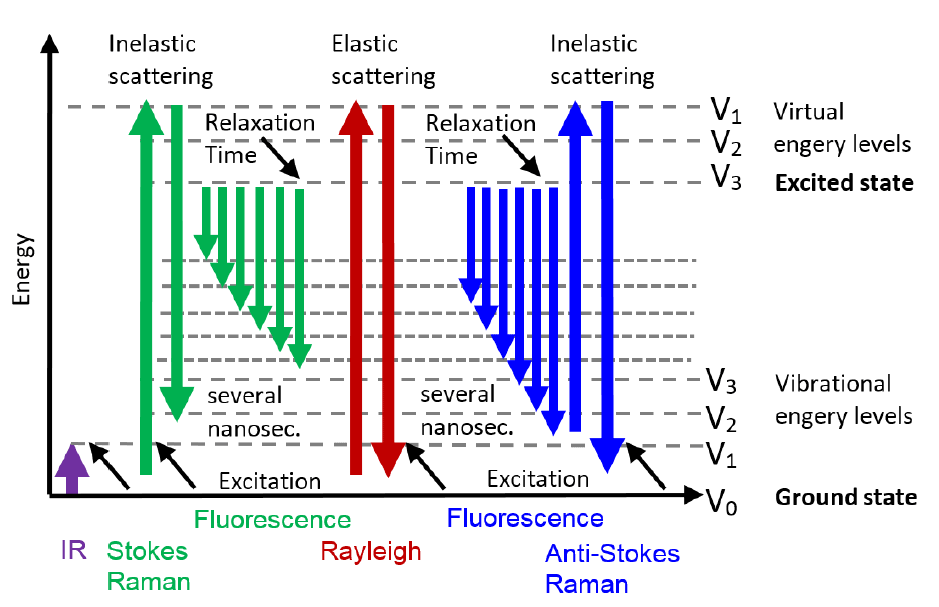
- IR Absorption: A direct transition from the ground vibrational state () to the first excited vibrational state (). The photon's energy () must equal the vibrational energy gap ().
- Rayleigh Scattering: The molecule is excited to a virtual state and immediately returns to the same vibrational state it started in (). The scattered photon has the same energy as the incident laser photon.
- Raman (Stokes) Scattering: The molecule is excited to a virtual state but returns to a higher vibrational state (). It keeps a quantum of vibrational energy. Consequently, the scattered photon has less energy than the incident laser photon. The energy difference corresponds exactly to the energy of the vibrational transition ().
The diagram below provides a static summary of these different light-matter interactions.
A Deeper Dive into the Physical Basis
Now that we have a visual model, let's solidify our understanding by reading a more formal description from a review article focused on biomedical applications, which aligns with your research interests.
Introduction to Infrared and Raman-Based Biomedical ...
This article, 'Introduction to Infrared and Raman-Based Biomedical Spectro-Pathology', provides a concise but thorough explanation of the physical basis of both IR and Raman spectroscopy.
Please read Section 2.1, 'Physical Basis of IR and Raman Spectroscopy'. It's relatively short. Focus on how it describes the IR process (involving the dipole moment) and the Raman process (involving polarizability and the induced dipole moment). The associated Figure 1 is very similar to the diagram we just discussed.
This reading confirms the fundamental distinction:
- IR spectroscopy is a one-photon absorption process.
- Raman spectroscopy is a two-photon scattering process.
A crucial point from the text, and a major practical advantage of Raman for your work in biospectroscopy, is its relationship with water. Since you're interested in analyzing fungi, which exist in aqueous environments, this is a significant difference. Water has a strong changing dipole moment, making it a very strong absorber in the IR region, often overwhelming the signals from the sample. However, water is a very weak scatterer, so its signal in Raman spectroscopy is minimal, allowing for the analysis of aqueous samples with little interference.
Complementary Information: A Practical Example
Because the physical mechanisms are different, the rules that determine whether a vibration will be "active" (i.e., visible in the spectrum) are also different. We will cover these "selection rules" in detail in the next lesson.
For now, the important takeaway is that IR and Raman spectroscopy are complementary. Some vibrations that are strong in IR are weak or absent in Raman, and vice versa. This means that by using both techniques, you can get a more complete picture of a molecule's vibrational modes.
Let's look at a real-world example with the amino acid L-Cysteine.
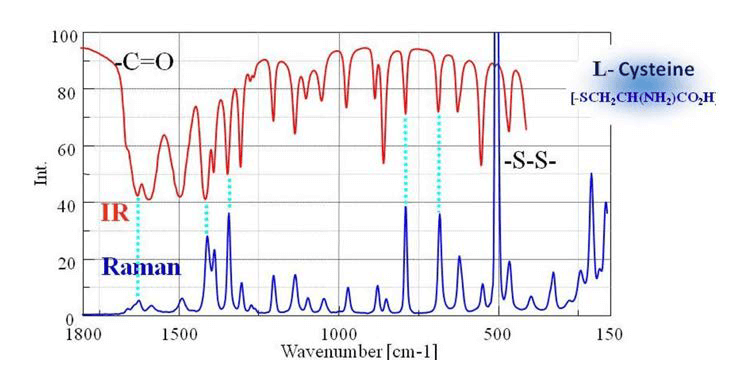
This complementarity is a direct result of the different ways the two techniques interact with the molecule. IR is sensitive to vibrations that cause a change in the permanent dipole moment, while Raman is sensitive to vibrations that cause a change in the molecule's polarizability (the "deformability" of its electron cloud). Symmetrical bonds, like the S-S bond, often have strong Raman signals.
Lesson Summary
Let's recap the key points of this introductory lesson:
- IR spectroscopy relies on the absorption of a photon whose energy precisely matches a molecular vibrational transition. It is a resonant, one-photon process.
- Raman spectroscopy is an inelastic scattering process. A high-energy laser excites the molecule to a temporary "virtual state," and the energy of the subsequently emitted photon is analyzed.
- The energy difference between the incident and scattered photons in Raman spectroscopy corresponds to the molecule's vibrational energy levels.
- Because the underlying physical mechanisms are different, IR and Raman provide complementary information about a molecule's structure.
- A significant practical advantage of Raman, especially for your goal of analyzing biological samples, is its low interference from water.
Looking Ahead
In our next lesson, we will formalize the concepts we touched upon here. We will define polarizability and explain its central role in determining whether a vibrational mode is Raman active. This will lead us to the selection rules for Raman spectroscopy and a direct comparison with the IR selection rules you are already familiar with.