Hello! Welcome to the next lesson in your course on UK electrical grids.
In our last session, we looked at the physical infrastructure at the end of the distribution network: the distribution substations and pole-mounted transformers that deliver power to our communities. We saw how they step down voltage to a safe, usable level.
Today, we shift our focus from the hardware to the organisations that own and operate it. The learning outcome for this lesson is to identify the 14 Distribution Network Operators (DNOs) in Great Britain and their regions. We will explore who these companies are, how the country is divided between them, and how you can find out which DNO is responsible for your area.
1. What is a Distribution Network Operator (DNO)?
A Distribution Network Operator, or DNO, is a company responsible for owning, operating, and maintaining the electricity distribution network in a specific geographical area. They manage the towers, poles, cables, and substations that take electricity from the high-voltage national transmission grid and deliver it to homes and businesses.
It's important to distinguish between a DNO and an electricity supplier (the company that sends you your bill).
- DNO: Manages the physical wires and infrastructure. You can't choose your DNO; it's determined by where you live.
- Supplier: Buys energy on the wholesale market and sells it to you. You can choose and switch your supplier.
To get a practical sense of their role, let's watch a short introduction.
Interviewing UK DNOs about Export Limits and More…
This clip from 'Gary Does Solar' provides a quick, clear explanation of what a DNO is and why you would interact with them, for example, when installing solar panels.
Please watch the first 33 seconds of the video. Focus on the DNO's responsibility for ensuring connections to the grid are safe and compliant.
As the video explains, the DNO is the key player for any physical connection to the local grid. They are responsible for the reliability and safety of the power supply in their region.
2. The DNO Groups and their 14 Regions
Great Britain's electricity distribution system isn't run by a single entity. Instead, it's divided into 14 distinct geographical regions, each with its own distribution license. However, these 14 licenses are held by just six large company groups. This can be a point of confusion, so it's helpful to remember: 6 parent companies, 14 licensed regions.
The following video provides a concise overview of these groups and the areas they cover.
This segment from 'The Electric Brit' introduces the six DNO groups and lists the license areas they operate.
Watch from 21:18 to 23:08. The video presents a map and lists the six DNO groups and the regions they cover, such as UK Power Networks covering London and the South East.
To visualise this structure clearly, let's look at a map.
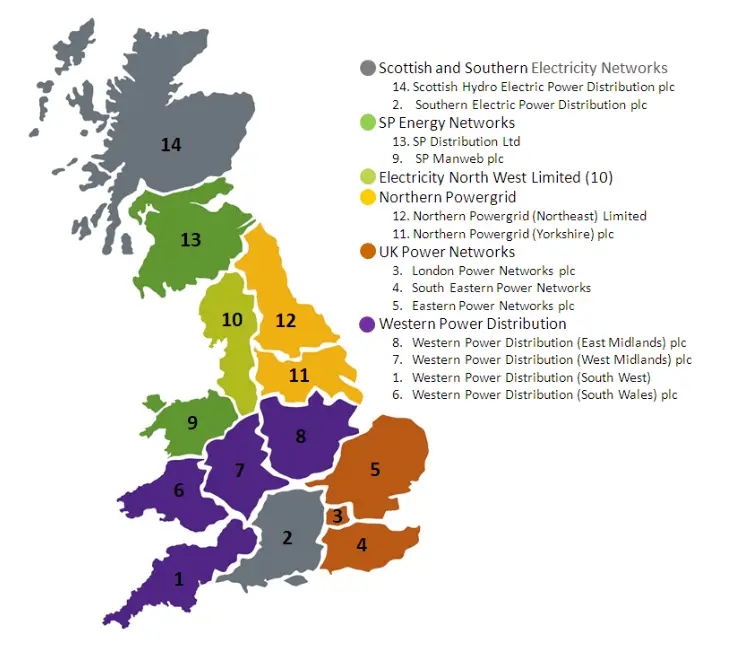
Now that you have a visual overview, let's examine the specific details of each region. The following table provides a clear breakdown of the 14 regions and the DNO responsible for each.
Distribution Network Operators | Explained
This article from Business Energy Deals provides an excellent summary of the DNOs. The table in this section is the core of today's lesson.
First, please study the table under the heading 'MPAN Prefix'. It lists all 14 regions and the corresponding DNO. Then, read the section immediately following it, 'Who are the electricity distribution network operators?', which lists the six parent companies.
To summarise the information from the map and the article, the six DNO groups are:
- UK Power Networks (UKPN): Operates in London, the South East, and East of England.
- National Grid Electricity Distribution (NGED): Formerly Western Power Distribution, it covers the Midlands, South Wales, and the South West.
- SP Energy Networks (SPEN): Covers Central & Southern Scotland, as well as North Wales, Merseyside, and Cheshire.
- Scottish and Southern Electricity Networks (SSEN): Operates in two distinct areas: the North of Scotland and Southern England.
- Northern Powergrid: Covers Yorkshire and the North East of England.
- Electricity North West (ENW): Operates in the North West of England.
3. How to Find Your DNO
Since the DNO is determined by your location, how can you find out which one is yours? There are two main ways.
Using Your MPAN
Every electricity connection in the UK has a unique Meter Point Administration Number (MPAN). This number is usually found on your electricity bill and is often called a "Supply Number". The first two digits of your MPAN identify your DNO.
DNO Distribution Network Operators
This guide from EDF Energy clearly explains how to find your MPAN on an electricity bill and use it to identify your distributor.
Please read the section titled 'Finding your Distribution Network Operators (DNOs)'. Pay close attention to the diagram showing where the MPAN is on a bill and how the first two digits (the 'Distribution ID') are used.
If you refer back to the table from the Business Energy Deals article, you'll see it includes the "MPAN Prefix" for each of the 14 regions. For example, if your MPAN starts with 12, your DNO is UK Power Networks, and you are in the London distribution area.
Using an Online Tool
A simpler method is to use the postcode checker provided by the Energy Networks Association (ENA), which is the trade body for all the network operators. You can enter a postcode, and it will tell you both the gas and electricity network operators for that location. You can find this tool by searching for "ENA find my network operator".
Conclusion
In this lesson, we've mapped out the organisational structure of electricity distribution in Great Britain. You now know who is responsible for operating the local power grids that serve our homes and businesses.
Here are the key takeaways:
- Distribution Network Operators (DNOs) own and operate the regional electricity networks, distinct from the suppliers who sell electricity.
- Great Britain is divided into 14 distribution regions, which are managed by six major DNO groups.
- Each DNO is responsible for a specific geographical area, from the North of Scotland (SSEN) to the South West of England (NGED).
- You can identify your local DNO by checking the first two digits of your MPAN on your electricity bill or by using an online postcode checker.
In our next lesson, we will delve into the operational challenges that DNOs face. We will define common electrical faults (e.g., short circuits) and explain the fundamental principles of network protection (detection, isolation, coordination).