Hello! Welcome to your first lesson in the UK Electrical Grids course. I'm your AI tutor, and I'll be guiding you through the material.
This course is designed to give you a comprehensive understanding of how the UK's electricity system works, from power generation all the way to your home. Since this is our first lesson, we'll start with the part of the grid that's closest to all of us: the distribution network.
Today's learning outcome is to describe the structure of UK distribution networks from primary to low voltage levels. We will explore how electricity gets from the high-voltage national transmission system to local communities, businesses, and homes. We'll break down the different voltage levels involved and identify the key pieces of equipment that make this journey possible.
Let's begin.
1. The Big Picture: Transmission vs. Distribution
Before we dive into the details of distribution networks, it's essential to understand where they fit within the overall electricity grid. The grid has two main parts for moving electricity around: the transmission network and the distribution network.
A great way to think about this is to compare it to a road system.
What's the difference between electricity transmission and distribution?
This article from National Grid provides a clear analogy to help distinguish between the transmission and distribution networks. It's a perfect starting point for understanding the overall system architecture.
Please read the section titled 'How do electricity transmission and distribution systems work?'. Focus on the analogy comparing the grid to Britain's road system.
As the article explains:
- Transmission Network: This is like the motorway system. It transports huge amounts of electricity at very high voltages (e.g., 400,000 volts or 400kV) over long distances across the country, from large power stations to major substations. The large steel pylons you see marching across the countryside are part of the transmission network.
- Distribution Network: This is like the system of local A-roads, B-roads, and streets. It takes the electricity from the transmission system and "distributes" it at lower, more manageable voltages to towns, villages, industrial estates, and individual properties.
The entire journey of electricity is a process of stepping down the voltage. The following diagram provides an excellent overview of this entire process.

Notice how the voltage starts very high on the transmission grid and is progressively reduced as it enters the distribution network, which is managed by a Distribution Network Operator (DNO). Our focus for today is on the part of the system inside the "DNO" box.
2. The Structure of a Distribution Network
Distribution networks are not a single entity but a hierarchical system. Electricity is passed down through several distinct voltage levels, with transformers at substations performing the crucial task of "stepping down" the voltage at each stage.
Let's follow the journey of electricity once it leaves the transmission "motorway" and enters the local distribution network.
This video from 'The Electric Brit' provides a great visual and verbal walkthrough of how electricity travels from power stations to our homes, with a specific focus on the role of the distribution networks and their voltage levels.
Please watch the two segments. The first part, 'Journey of Electricity and DNOs' (timestamp 20:11 - 23:08), describes the handover from transmission to distribution. The second part, 'Distribution to Consumers' (timestamp 23:08 - 24:43), explains the final step-down to household voltages.
Based on the video and the diagram, we can break down the structure into these key stages:
Stage 1: Grid Supply Point (GSP)
- This is the main interchange between the high-voltage transmission network and the distribution network.
- At a GSP substation, very large transformers step the voltage down from transmission levels (400kV or 275kV) to the highest voltage used in distribution, which is typically 132kV.
Stage 2: Primary Distribution Network
- The 132kV network acts as the main artery of the distribution system, often supplying very large industrial customers directly.
- From here, the electricity flows to Primary Substations.
- At these substations, the voltage is stepped down again, usually from 132kV to 33kV or 11kV. This network of 33kV and 11kV lines (carried on smaller overhead poles or in underground cables) spreads out to supply towns, smaller industrial sites, and commercial areas.
Stage 3: Secondary Distribution (Low Voltage Network)
- The final step in the journey happens at a Distribution Substation. These are the small, often brick-built, substations you might see in your neighbourhood, or the grey transformers mounted on wooden poles in rural areas.
- Here, the voltage is stepped down from 11kV to the low voltage (LV) we use every day: 400 volts (three-phase).
This final 400V supply is then delivered to customers.
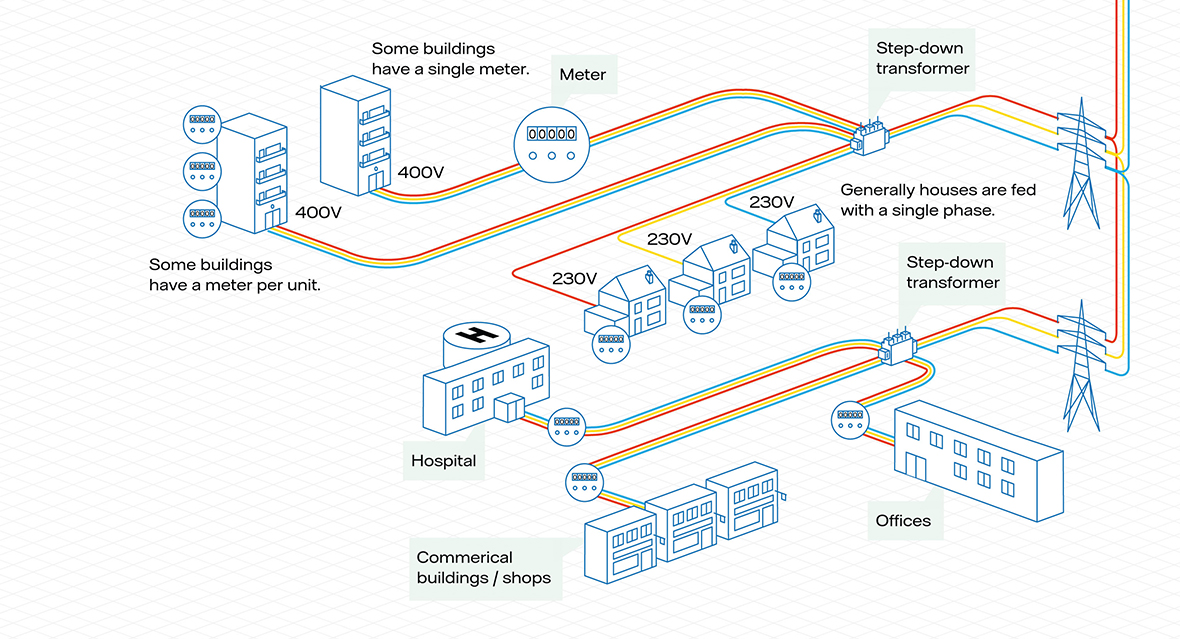
3. The Final Connection: 400V and 230V
As the video and diagram above explain, the final 400V supply from the local transformer is a three-phase supply. This is particularly useful for larger buildings, commercial premises, and small industrial sites that have powerful equipment.
For residential homes, we don't need that much power. Instead, a single one of the three phases is supplied to each house. The voltage of a single phase relative to the neutral conductor is 230V, which is the standard voltage for UK domestic appliances.
You might have noticed the mathematical relationship here. In a balanced three-phase system, the voltage between any two phases (the "line voltage," ) is related to the voltage of a single phase (the "phase voltage," ) by the square root of 3.
This clever arrangement allows the same low-voltage network to supply both high-power commercial customers and individual homes efficiently.
4. Who Manages the Distribution Networks?
The transmission system in Great Britain is operated nationally by the National Grid Electricity System Operator (ESO). However, the distribution networks are managed on a regional basis by a set of companies called Distribution Network Operators (DNOs).
As mentioned in the video, there are 14 distribution license areas in Great Britain, which are managed by six major DNO groups. Each DNO is responsible for owning, operating, and maintaining the poles, cables, and substations in its specific geographical area.
The National Grid - What is it really, and who owns it?
This article provides a clear definition of local distribution networks and the role of the DNOs who manage them.
Please read section 4, 'Local distribution networks', and look at the table in section 5, 'Who owns and operates the National Grid?'. Focus on the role described for Distribution Network Operators (DNOs).
When you have a power cut, it's your local DNO you need to contact, not National Grid, as it is their equipment that delivers power to your property.
Conclusion
In this lesson, we've unpacked the structure of the UK's electricity distribution networks. You should now be able to describe the journey electricity takes from the national transmission grid to a local plug socket.
Here are the key takeaways:
- Transmission vs. Distribution: The transmission grid is the high-voltage "motorway," while distribution networks are the lower-voltage "local roads" that deliver power to end-users.
- Hierarchical Structure: Distribution networks step down voltage in stages: from the transmission grid (400/275kV) to primary distribution (132kV), then to secondary distribution (33kV/11kV), and finally to the low-voltage network (400/230V).
- Key Components: Substations containing transformers are critical for stepping down the voltage at each level of the hierarchy (Grid Supply Points, Primary Substations, and Distribution Substations).
- Final Supply: The low-voltage network provides a 400V three-phase supply for larger customers and a 230V single-phase supply for homes.
- Network Operators: Regional Distribution Network Operators (DNOs) own and manage the local distribution infrastructure.
In our next lesson, we will build on this by looking at the different ways these distribution networks can be physically laid out. We will explain the differences between radial and meshed network topologies, which has important implications for the reliability of your electricity supply.