Hello! Welcome back to your course on the UK electrical grid.
In our recent lessons, we've focused on the physical hardware of the high-voltage transmission system—from overhead lines and substations to the reactive power compensation devices like STATCOMs that keep it all stable. We've essentially been looking at the "what."
Today, we're going to shift our focus from the engineering components to the organisational structure. We'll explore the "who"—the different companies and bodies responsible for owning the assets versus operating the system. This separation of roles is a fundamental concept in the modern UK electricity industry.
This lesson is designed to help you meet the following learning outcome:
Identify the ownership and operation structure of the UK transmission system (National Grid ESO and Transmission Owners).
We'll untangle the often-confusing term "National Grid," clarify the distinct roles of the System Operator and the Transmission Owners, and map out who is responsible for which part of Great Britain's high-voltage network.
1. Untangling the Term "National Grid"
One of the most common points of confusion when discussing the UK grid is the term "National Grid" itself. Depending on the context, it can mean several different things. Before we go any further, it's crucial to clarify these distinctions.
The National Grid - What is it really, and who owns it?
The article 'The National Grid - What is it really, and who owns it?' from Business Energy Deals does an excellent job of breaking down this ambiguity.
Please read the section titled 'What is meant by the National Grid?'. Focus on understanding the four different meanings presented, especially the difference between 'The National Grid' (the network), 'National Grid ESO' (the operator), and 'National Grid Plc' (the company).
As you've just read, the key is to differentiate between:
- The physical network of pylons and wires (often called "The National Grid").
- The company that part-owns and operates some of this network (
National Grid Plc). - The system operator responsible for balancing the entire grid (
National Grid ESO, which has recently been rebranded).
For the rest of this lesson, we will focus on the two key functions: System Operation and Transmission Ownership.
2. The System Operator: The Grid's "Air Traffic Control"
Imagine the transmission network as a system of motorways for electricity. The System Operator is the national traffic controller, responsible for managing the flow of power across the entire system in real-time. Their primary job is to balance electricity generation with demand on a second-by-second basis to keep the system stable and the lights on.
What is National Grid? | What does National Grid do?
This short clip from National Grid provides a simple, high-level overview of this balancing act.
Watch the section from 00:32 to 00:58. It highlights the role of the 'electricity system operators control rooms' in balancing supply and demand across the country.
This critical role is performed by a single entity for the whole of Great Britain (England, Scotland, and Wales).
A Major Change: Introducing NESO
Until recently, this function was carried out by National Grid Electricity System Operator (ESO), which was part of the privately-owned National Grid Plc.
However, in 2024, a significant change took place. To ensure impartiality and avoid any perceived conflict of interest, the system operator role was moved into a new, independent, publicly owned body called the National Energy System Operator (NESO).
The National Grid - What is it really, and who owns it?
Let's return to the Business Energy Deals article, which has a very useful table summarizing the key stakeholders and their roles. We'll also look at a Wikipedia entry that confirms the recent change to NESO.
First, review the table in the section 'Who owns and operates the National Grid?'. Pay close attention to the row for the 'Grid Operator' and its described role. You will see it mentions 'National Energy System Operator (NESO). Previously know as the National Grid Electricity System Operator'.
This Wikipedia article on the National Grid also documents this important transition.
Read the final paragraph in the '2020s – Great Grid Upgrade' subsection. It confirms that in 2024, the publicly owned NESO was established to take over the electricity system operator license from National Grid plc.
So, to be precise, the System Operator for Great Britain is the National Energy System Operator (NESO). Its job is to manage the whole system impartially.
3. The Transmission Owners (TOs): Building and Maintaining the Motorways
If NESO is the air traffic controller, the Transmission Owners (TOs) are the companies that own, build, and maintain the airports and runways. In grid terms, they own and are responsible for the physical high-voltage infrastructure—the pylons, cables, and substations—within their specific geographical region.
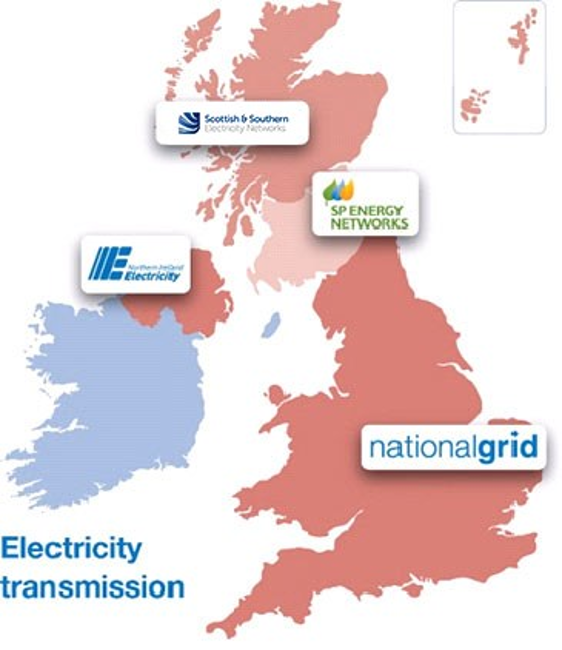
Great Britain is split into three distinct regions, each with its own TO.
The National Grid - What is it really, and who owns it?
The Business Energy Deals article clearly identifies these three companies and their territories.
Read the section '2. High-voltage transmission'. Focus on the three bullet points that name the TNOs (another term for Transmission Owners) and the regions they cover. The table below it provides extra detail on the assets they own.
The three Transmission Owners are:
- National Grid Electricity Transmission (NGET): Covers England and Wales. This company is part of
National Grid Plc. - Scottish Power Transmission (SP Transmission): Covers central and southern Scotland. This company is part of the Spanish utility
Iberdrola. - SSE Transmission: Covers northern Scotland and the Scottish islands. This company is part of
SSE Plc.
The map below provides a clear visual of how Great Britain is divided between these three Transmission Owners.
4. Summary: Ownership vs. Operation
We can now clearly separate the two distinct functions that govern the transmission grid. It's a model that separates the real-time, system-wide operational control from the long-term ownership and maintenance of the physical assets.
| Role | Who? | What do they do? | Geographical Scope | Ownership Model |
|---|---|---|---|---|
| System Operator | National Energy System Operator (NESO) | Balances supply and demand; ensures system stability; manages electricity markets. | All of Great Britain | Publicly owned corporation |
| Transmission Owner (TO) | 1. NGET 2. SP Transmission 3. SSE Transmission |
Owns, builds, and maintains the high-voltage grid infrastructure (pylons, cables, etc.). | 1. England & Wales 2. Southern Scotland 3. Northern Scotland |
Privately owned companies |
This structure is designed to ensure that NESO can operate the system in the most efficient and secure way for the benefit of all users, without being influenced by the commercial interests of any single asset owner.
Conclusion
In this lesson, we have dissected the organisational structure of the UK's high-voltage electricity grid, moving from the physical assets to the entities that own and operate them.
Key Takeaways:
- The UK transmission system has a clear separation between ownership and operation.
- The National Energy System Operator (NESO) is the single, independent, publicly owned body responsible for the real-time operation and balancing of the entire Great Britain grid.
- The physical grid infrastructure is owned and maintained by three regional Transmission Owners (TOs): National Grid Electricity Transmission (in England and Wales), SP Transmission (in Southern Scotland), and SSE Transmission (in Northern Scotland).
- The term "National Grid" can be ambiguous. It is important to distinguish between the physical network, the company
National Grid Plc(which owns NGET), and the system operator (NESO).
Preview of the Next Lesson
We have now completed our overview of the high-voltage transmission system. But how does that electricity get from the large transmission substations to our homes, schools, and offices? The next stage of the journey is through the distribution network. In our next lesson, we will begin Module 5 by exploring the structure of these lower-voltage local networks.