Hello! Welcome to the first lesson of Module 10.
In the previous module, we delved into the fast-paced, millisecond-by-millisecond challenges of maintaining grid stability with new technologies. We focused on the dynamic behaviour of the grid and the risks of software-based control systems interacting in unexpected ways.
Now, we shift our focus from dynamic stability to the more static, physical limitations of the grid's hardware. This lesson addresses the learning outcome: Explain what network capacity constraints are (e.g., thermal limits, voltage levels) and where they occur in transmission and distribution networks.
We will explore the fundamental "rules of the road" for electricity—the physical limits on how much power can be moved through the wires, cables, and transformers that make up the network. Understanding these limits is the first step to understanding why connecting new energy projects can be so slow and expensive.
1. What is a Network Constraint?
Think of the electricity grid as a national road network. It has motorways for carrying heavy traffic (power) over long distances and smaller local roads for delivering it to individual houses.
Just as a road has a speed limit and can only handle a certain number of cars before a traffic jam occurs, an electrical circuit has a physical limit on how much power it can carry. When the amount of power we want to push through a circuit exceeds its safe limit, we have a network constraint. It's an electrical traffic jam.
These constraints are not just theoretical; they have real-world consequences. The people in this control room are responsible for monitoring the grid in real-time to ensure these limits are never dangerously exceeded.
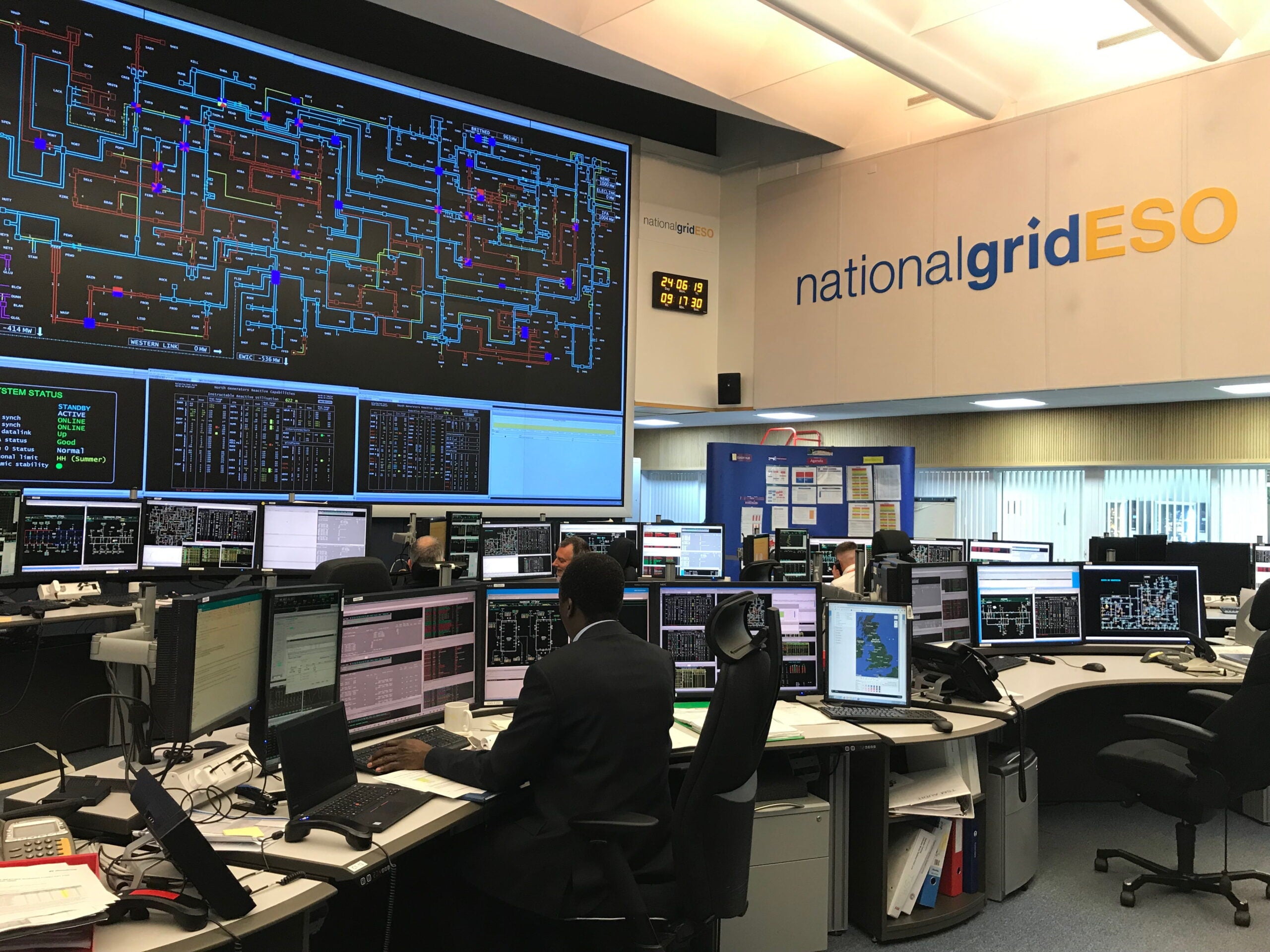
There are several types of constraints, but we will focus on the two most common and important ones: thermal limits and voltage limits.
2. Thermal Constraints: The Heat Limit
The most fundamental limit on any electrical wire is heat. As electricity flows through a conductor, some energy is lost as heat. This is known as Joule heating.
The amount of heat generated is proportional to the square of the current () multiplied by the resistance () of the wire. The formula is . The key thing to notice is the squared term: doubling the current doesn't double the heat, it quadruples it! This makes high currents a major concern for grid operators.
But why is this heat a problem? The following video explains it perfectly.
The video 'How the UK Grid Works' from The Electric Brit channel provides an excellent explanation of why heat is the primary limiting factor for electrical conductors.
Please watch the segment from 06:50 to 08:55. Focus on the explanation of Joule Heating (I²R losses) and the specific problems it causes for both overhead lines and underground cables.
As the video explains, excessive heat creates two distinct problems:
- Overhead Lines: The metal conductors expand when they get hot, causing them to sag. If a line sags too much, it can get dangerously close to trees, buildings, or the ground, creating a risk of a major fault (a short circuit).
- Underground Cables: The insulation around the conductor traps heat. If the cable gets too hot, the insulation can melt and fail. This can lead to a dangerous "thermal runaway" cycle, where higher temperatures increase resistance, which in turn generates even more heat until the cable is permanently damaged.
Where do thermal constraints occur?
Thermal constraints can happen anywhere in the network, from the largest transmission lines to the small cable feeding your house.
On the Transmission Network:
These are the 'motorways' of the grid (400kV and 275kV lines). They move massive amounts of power from generators to demand centres. As the system operator for Great Britain, National Grid ESO has to manage thermal constraints on this network every day. For example, on a very windy day in Scotland, the wind farms might be generating a huge amount of power. If demand is low in Scotland but high in England, the ESO must manage how that power flows south to avoid overheating the transmission lines that form the "bottleneck" at the border between Scotland and England.
The National Electricity System Operator (NESO, formerly National Grid ESO) explains this concept clearly.
What is thermal constraint management and why is it important?
This short article from NESO, titled 'What is thermal constraint management and why is it important?', defines thermal constraints from the perspective of the transmission system operator.
Read the first two paragraphs. Notice how they define the physical limit and mention the actions they take, such as paying generators to change their output.
On the Distribution Network:
These are the 'local roads' (132kV down to 230V) managed by Distribution Network Operators (DNOs). Thermal constraints here occur at a more local level. For example:
- A primary substation transformer, which converts voltage from 33kV to 11kV for a large town, could overheat on a cold winter evening when everyone turns on their heating.
- The underground cable running down a residential street could exceed its thermal limit if everyone on that street plugs in their electric vehicle to charge at the same time.
3. Voltage Constraints: The Pressure Limit
The second major type of constraint relates to voltage. You can think of voltage as being like water pressure in a pipe. All our appliances are designed to work with a specific "pressure". In the UK, the statutory voltage for households must be maintained at 230 Volts, with a tolerance of +10% and -6% (meaning it must stay between 216.2V and 253V).
A voltage constraint occurs when operating the network would push the voltage outside these legal limits. This happens in two ways:
-
Voltage Drop (Low Pressure): When you draw a lot of power through a long wire, the voltage at the far end will be lower than at the start. This is due to the wire's impedance acting like friction in a pipe. If too many people draw too much power, the voltage can drop below the legal limit, causing lights to dim and appliances to function poorly or shut down.
-
Voltage Rise (High Pressure): The opposite happens when you inject power into the network, for instance from rooftop solar panels. This pushes the local voltage up. On a sunny day in an area with lots of solar panels, the combined effect can push the voltage above the legal limit, which can damage sensitive electronics and cause solar inverters to disconnect to protect themselves.
Where do voltage constraints occur?
While voltage is managed across the entire grid, voltage constraints are most commonly a problem on the local distribution networks, especially on the low-voltage (LV) circuits that feed our homes.
Long, overhead power lines in rural areas are particularly prone to both problems:
- On a cold winter evening (high demand), they suffer from voltage drop at the furthest properties.
- On a sunny summer day (high solar generation), they suffer from voltage rise.
This is a major reason why DNOs sometimes have to limit how much electricity a new solar farm or even a home solar system can export to the grid.
Electrification: The local grid challenge
The report 'Electrification: The local grid challenge' by Regen provides an excellent overview of where different constraints occur. Its glossary also gives clear definitions.
First, read the definitions for 'Constraint: thermal' and 'Constraint: voltage' in the Glossary on page 33. Then, look at the table 'Local network overview' on page 14. This table clearly summarises which constraints are most likely on the High Voltage (11 kV) and Low Voltage (LV) parts of the distribution network.
As the Regen report highlights, thermal constraints are the main issue for 11kV networks, while voltage constraints become a dominant problem on the LV networks that directly supply homes and businesses. The report also mentions a third, more subtle constraint: phase imbalance. This occurs on LV networks when the demand isn't spread evenly across the three electrical phases, causing one to become overloaded while others have spare capacity.
Test your understanding!
A DNO is analysing a small town at the end of a long 11kV power line.
- On sunny summer weekends, when demand is low, they see that the voltage in the town is getting very close to the upper legal limit.
- They also forecast that if a new housing development is built, the town's demand on cold winter evenings will cause the main transformer at the local substation to exceed its temperature rating.
What two types of network constraints is the DNO concerned about?
Show answer
- The issue on sunny weekends is a voltage constraint (specifically, voltage rise) caused by local generation (like rooftop solar) pushing the voltage up when demand is low.
- The potential issue from the new housing development is a thermal constraint, as the increased demand would cause the substation transformer to overheat.
Conclusion
In this lesson, we've established the fundamental physical limits of the power grid. These aren't temporary issues but hard physical boundaries that define how much power can be moved.
Key Takeaways:
- A network constraint is a bottleneck where the physical capacity of the grid's equipment is reached.
- The primary constraints are thermal limits and voltage limits.
- Thermal constraints are caused by the heat ( losses) from current flow. They risk causing overhead lines to sag or underground cables to melt. They are a major issue on both the high-voltage transmission network and local distribution assets like transformers.
- Voltage constraints occur when power flow would push the voltage outside of its statutory limits (216V-253V for homes). Voltage drop (from high demand) and voltage rise (from local generation) are key challenges, especially on the low-voltage distribution network.
Now that we know what network constraints are and where they occur, our next lesson will explore their direct consequence. We will examine the process for connecting new generation projects to the grid and see exactly how these capacity constraints lead to the long queues and delays that are a major topic in the UK energy industry today.