Hello! Welcome to your next lesson.
In our last session, we saw how physical network constraints lead to long queues for new energy projects waiting to connect to the grid. A major reason for these delays is the time it takes to build the necessary network upgrades, a process that involves a long and complex journey to get official permission.
Today, we'll dive deep into that journey. This lesson addresses the learning outcome: Describe the role and challenges of the statutory planning and consent process for new energy infrastructure. We will unpack the formal legal process required to get the green light for a major new power line or power station and explore why this process is often one of the biggest hurdles in the energy transition.
1. Why We Need a Planning Process
Building major infrastructure like a new high-voltage power line, a large wind farm, or a nuclear power station has huge consequences. It can transform landscapes, affect communities, and impact the environment. A formal planning process is essential to balance the national need for this infrastructure against its local impacts. It provides a structured and transparent way to make decisions, ensuring that all relevant factors are considered and that affected parties have a voice.
In the UK, the primary legislation governing this for the largest projects is the Planning Act 2008. This Act established a specific regime for Nationally Significant Infrastructure Projects (NSIPs).
So, what counts as an NSIP? The criteria are set out in law.
Consents and planning applications for national energy ...
The government's guidance page, 'Consents and planning applications for national energy infrastructure projects', gives us the official definitions.
Please read the section titled 'Electricity development consents'. Focus on the generating capacity thresholds that determine whether a project is considered an NSIP under the Planning Act 2008 or falls under the local planning system (Town and Country Planning Act 1990).
As you read, for energy projects, the key threshold is typically generating capacity. For example, an onshore power station with a capacity of over 50 megawatts (MW) is classed as an NSIP and must go through this special process. Smaller projects are dealt with by local councils under a different system.
The goal of the NSIP process is to obtain a Development Consent Order (DCO). A DCO is more than just a simple planning permission; it's a powerful legal instrument that combines multiple different consents (for planning, compulsory land acquisition, changes to highways, etc.) into a single order.
To get a better feel for the context and importance of this system, let's hear from some experts.
Demystifying the planning process of major projects... Is the UK’s system broken?
This video, 'Demystifying the planning process of major projects', features two former senior planning inspectors who have overseen some of the UK's largest infrastructure applications. Their insights provide an expert view on how the system works.
Watch the first 6 minutes and 30 seconds of the video. The first part (up to 3:05) sets the scene and introduces the Planning Act 2008, NSIPs, and DCOs. The second part (3:05 to 6:30) explains in more detail what an NSIP is and how a project gets classified as one.
2. The DCO Process: A Six-Stage Journey
The DCO process is a long and highly structured affair, designed to be thorough and fair. It is managed by a government body called the Planning Inspectorate, which examines the application and makes a recommendation to the relevant government minister (the Secretary of State), who makes the final decision.
The process can be broken down into six main stages, as shown in this flowchart:
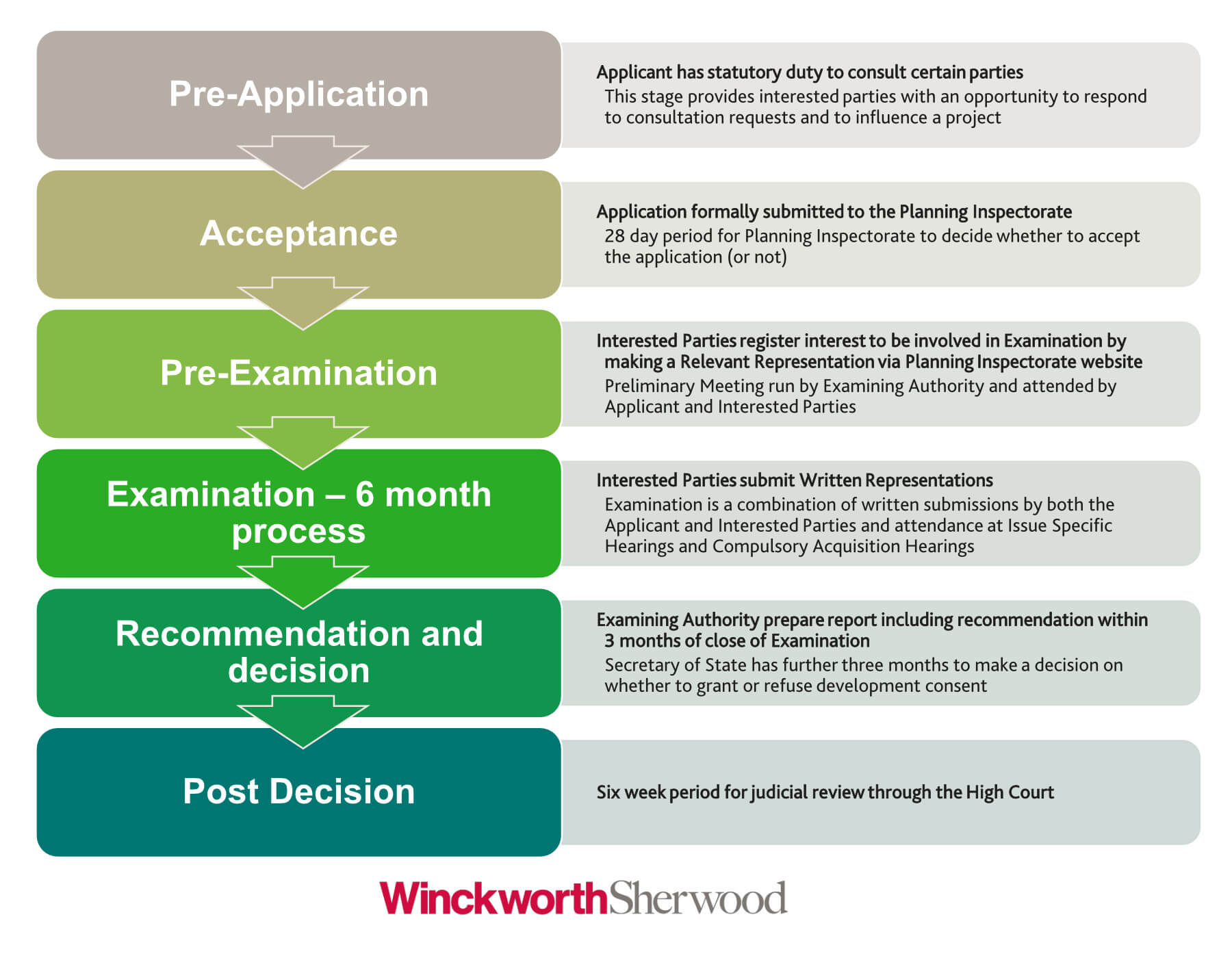
Let's use the expertise from the video to understand what happens at each stage.
Demystifying the planning process of major projects... Is the UK’s system broken?
The former inspectors in the 'Demystifying the planning process' video provide a clear walkthrough of the DCO timeline.
Please watch the section from 06:30 to 10:34. The speaker outlines each of the six stages, from the initial pre-application consultation right through to the final decision and the potential for a legal challenge.
To recap the key stages you just heard about:
- Pre-application (can take years): The developer must carry out extensive consultation with local authorities, statutory bodies (like the Environment Agency), and the public. This is where a lot of the detailed work and negotiation happens.
- Acceptance (28 days): The Planning Inspectorate checks if the application is complete and has met all the pre-application requirements.
- Pre-examination (approx. 3 months): The Inspectorate and all interested parties plan how the examination will be run.
- Examination (6 months): This is a strict, six-month period for the Inspectorate to assess the application in detail. It involves reviewing vast amounts of written evidence and holding public hearings.
- Recommendation and Decision (6 months): The Inspectorate has 3 months to write its recommendation report for the Secretary of State, who then has 3 months to make the final decision.
- Post-decision (6 weeks): Once a decision is made, there is a six-week window where opponents can launch a legal challenge in the High Court, known as a Judicial Review.
Test your understanding!
A developer wants to build a large offshore wind farm (an NSIP). During which stage of the DCO process would they be required to formally consult with the local coastal community, and during which stage would an independent body rigorously assess the project's environmental impact against government policy?
Show answer
The formal consultation with the local community happens during the Pre-application stage. The rigorous assessment against government policy happens during the Examination stage, led by the Planning Inspectorate.
3. The Framework for Decisions: National Policy Statements
A crucial question is: how does the Planning Inspectorate decide whether a project is a good idea? They don't just use their own opinions. Their assessment is guided by a set of official government documents called National Policy Statements (NPSs).
Consents and planning applications for national energy ...
The official GOV.UK guidance page we looked at earlier also explains the central role of these policy documents.
Please read the section titled 'National Policy Statements for energy infrastructure'. Focus on what these documents do and how they are used by the Planning Inspectorate and ministers.
As the guidance explains, each NPS sets out the national need for a specific type of infrastructure and outlines the key issues that applicants must address and that the Inspectorate must consider. There is an overarching NPS for energy (EN-1) and specific ones for renewables (EN-3), electricity networks (EN-5), and so on.
In the video, one of the inspectors describes the NPSs as the "exam questions" for the project. The developer's application is their set of answers, and the Inspectorate's job is to mark them.
4. The Challenges: Cost, Complexity, and Conflict
While the DCO process is designed to be robust, it is widely seen as incredibly challenging. This is a major factor in the long timelines for building the infrastructure needed for the energy transition.
Challenge 1: Immense Cost and Complexity
The sheer scale of the information required is staggering.
Demystifying the planning process of major projects... Is the UK’s system broken?
Let's return to the 'Demystifying the planning process' video, where the inspectors discuss the real-world costs and paperwork involved, using the example of the Lower Thames Crossing road project.
Watch the segment from 26:17 to 37:29. Listen for the figures mentioned regarding the number of pages in the application and the pre-construction costs. The discussion highlights why so much information is needed, touching on environmental surveys, land acquisition, and the need to justify the project's impacts.
The figures are astonishing: an application with over 350,000 pages and pre-development costs running into hundreds of millions of pounds. This is because the developer must provide exhaustive evidence to prove the project's benefits outweigh its harms, satisfying dozens of statutory bodies on everything from ecology to archaeology.
Challenge 2: Balancing National Need and Local Impact
At its heart, the planning process is a forum for a fundamental conflict: the national need for energy versus the desire to protect local environments and communities. This tension is often the source of political debate and public opposition.
Demystifying the planning process of major projects... Is the UK’s system broken?
The final segment of the video addresses this political dimension directly.
Watch from 37:29 to 48:00. The discussion covers the political debate about prioritising development over environmental protection (the 'bats vs. commuters' argument). It explains how government policy (the NPSs) is the key to setting this balance and how clearer policy can lead to faster and more efficient decisions.
As the experts argue, if the government wants to speed up the process, it must provide a clearer policy framework (updated NPSs) that sets out national priorities. This gives the planning system the tools to make difficult trade-offs with confidence.
Challenge 3: Is the System Capturing the Right Projects?
The NSIP regime was designed for the biggest, most complex projects. But what happens when the rules, written over a decade ago, start to catch projects that aren't quite so "nationally significant"?
Electricity network infrastructure: consents, land access ...
A recent government consultation document, 'Electricity network infrastructure: consents, land access ...', discusses this very problem in the context of new power lines.
Please read section 10, 'Nationally Significant Infrastructure Projects Threshold'. Focus on the 'Case for Change' section. It explains how the current threshold for overhead lines (132kV and over 2km long) is now capturing smaller connection projects that may not warrant the full, costly DCO process.
This is a perfect example of the challenges. The push for decarbonisation means more renewable projects are connecting at 132kV. The current 2km length threshold means that even a relatively short power line to connect a new solar farm can be dragged into the full NSIP process, creating disproportionate delays and costs. This highlights the constant need to review and reform the system to keep it fit for purpose.
Conclusion
Today we have explored the complex world of planning and consenting for major energy infrastructure. This process is a critical, if often slow and contentious, part of delivering the UK's energy future.
Key Takeaways:
- Large energy projects are classed as Nationally Significant Infrastructure Projects (NSIPs) and require a Development Consent Order (DCO) under the Planning Act 2008.
- The DCO process is a six-stage journey managed by the Planning Inspectorate, with the final decision resting with the Secretary of State.
- Decisions are not arbitrary; they are made against the policy framework set out in National Policy Statements (NPSs), which define the national need.
- Major challenges include the enormous cost and complexity of applications, the inherent conflict between national and local interests, and the need to ensure the rules remain proportionate and fit for purpose as technology and policy evolve.
In our next lesson, we will move from the process of getting connected to the costs of using the grid. We will investigate Transmission Network Use of System (TNUoS) charges, exploring how network companies charge generators and consumers for using the high-voltage transmission system.