Hello! Welcome to the third lesson in your course on UK electrical grids.
In our last lesson, we distinguished between the three types of AC power:
- Real Power (P), which does useful work (measured in Watts).
- Reactive Power (Q), which sustains magnetic and electric fields (measured in VAR).
- Apparent Power (S), the total power the grid must supply (measured in VA).
A key takeaway was that the grid infrastructure must be built to handle the full Apparent Power (S), even though only Real Power (P) is converted into useful output like heat, light, or motion. This session focuses on the crucial relationship between these two values.
Lesson 3: The Role of Power Factor
Learning Outcome: By the end of this lesson, you will be able to explain the role of power factor in AC systems and its impact on grid efficiency.
We will cover:
- What power factor is and how it's defined.
- The primary causes of poor power factor in electrical systems.
- Why a low power factor is inefficient and problematic for the electricity grid.
- The commercial consequences of poor power factor for large electricity users.
1. Defining Power Factor
Power factor is a measure of how effectively electrical power is being converted into useful work. It's a simple ratio that compares the real power being used to the apparent power being supplied.
Let's start with a very intuitive analogy to build a mental model for this concept.
Power Factor Explained - The basics what is power factor pf
This video from The Engineering Mindset uses the popular 'beer analogy' to provide a simple, non-technical explanation of power factor. It directly builds on the concepts of real, reactive, and apparent power from our last lesson.
Please watch from 00:26 to 02:03. Focus on how the beer represents useful power (kW), the foam represents reactive power (kVAR), and the whole glass represents the apparent power (kVA) you pay for.
As the video explains, the power factor tells you how much "beer" (Real Power) you get for the size of the "glass" (Apparent Power).
Formally, power factor (PF) is defined as:
Since is measured in Watts (or kW) and is measured in Volt-Amps (or kVA), the formula is often written as .
Because Real Power can never be greater than Apparent Power, the value for power factor is always between 0 and 1.
- A PF of 1.0 is ideal ("unity power factor"). It means all supplied power is being used for work ().
- A PF below 1.0 means some power is reactive, and not all supplied power is doing useful work.
Recall the power triangle from our last lesson.
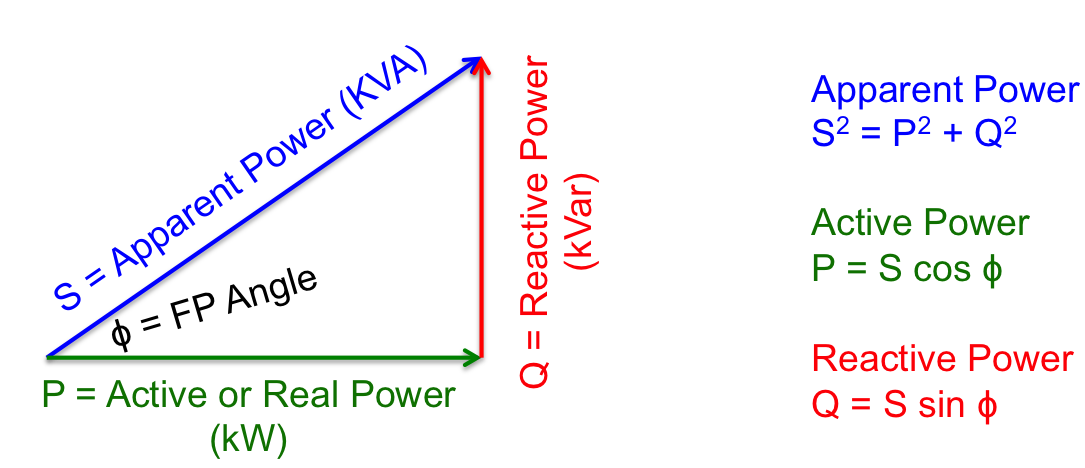
From trigonometry, we know that . Therefore, the power factor is simply the cosine of the phase angle between the voltage and current waveforms.
This is a crucial link: the phase shift we discussed in lesson 1 directly determines the power factor. A larger phase angle means a lower power factor.
2. What Causes Poor Power Factor?
A low power factor is almost always caused by inductive loads. These are devices that use magnetic fields to operate. They consume real power to do work, but also require reactive power to create and sustain their magnetic fields.
Power Factor Explained - The basics what is power factor pf
Let's continue with the same video, which now explains how inductive loads are the primary cause of poor power factor.
Watch from 06:16 to 07:39. The video explains that for an inductive load like a motor, the magnetic field causes the current waveform to fall out of sync with the voltage, creating a 'lagging' power factor.
The most common inductive loads responsible for poor power factor in the UK's electrical system are:
- Induction motors (used in factories, pumps, fans, conveyors)
- Transformers
- High-intensity discharge lighting (e.g., streetlights and large industrial lighting)
Since most industrial and commercial facilities use a lot of motors, they are the main source of low power factor issues on the grid.
3. The Impact of Poor Power Factor on Grid Efficiency
Now we arrive at the core of today's lesson: why does a low power factor matter?
The fundamental problem is that for a given amount of useful power (P), a lower power factor requires more current (I).
Let's look at a simple example. A factory needs a 100 kW motor to run a machine. The grid voltage is 400V.
-
Scenario A: Perfect Power Factor (PF = 1.0)
- Apparent Power
- Current
-
Scenario B: Poor Power Factor (PF = 0.7)
- Apparent Power
- Current
The result is striking: to do the exact same amount of useful work, the system with poor power factor needs to draw over 100 amps more current—an increase of more than 40%!
This extra current, which is only supplying reactive power, has several negative consequences for the grid.
Power Factor Explained - The basics what is power factor pf
This clip explains the practical consequences of this extra current on the electricity network.
Watch from 03:17 to 04:14. Pay attention to the three main problems mentioned: increased losses, reduced capacity, and voltage drops.
Let's break down those consequences:
-
Higher Energy Losses: The energy lost as heat in wires is calculated by . Because the loss is proportional to the square of the current, the 40% increase in current in our example would lead to a 96% increase in wasted energy (). This is a major source of inefficiency.
-
Reduced System Capacity: Every piece of equipment on the grid—generators, transformers, cables—is rated for a maximum apparent power (kVA) or current. When a large portion of this capacity is used to transport "useless" reactive power, there is less capacity available for the real power that serves customers. A power station might be running at its full kVA capacity but delivering much less useful kW.
-
Financial Penalties: Because of these inefficiencies, electricity network operators in the UK (and worldwide) impose financial penalties on large commercial and industrial customers for having a poor power factor (typically below 0.95). This incentivizes them to install equipment to fix the problem.
The following text provides a good summary of these points.
What is Power Factor? Understanding Electrical Efficiency
This article from the Electricity Forum reinforces the concepts we've just discussed.
Please read the first section ('What is Power Factor?') and the first two questions in the 'Frequently Asked Questions' section at the end. This will solidify your understanding of why a high power factor is important and how a low one increases costs.
Lesson Summary
Key Takeaways:
- Power Factor (PF) is the ratio of Real Power (P) to Apparent Power (S). It is a number between 0 and 1 that measures how efficiently electricity is used.
- A low power factor is primarily caused by inductive loads like motors and transformers, which require reactive power to function.
- A low PF is inefficient because it requires more current to deliver the same amount of useful power.
- This excess current causes increased energy losses in grid wiring, reduces the available capacity of the entire power system, and can lead to voltage drops.
- To discourage this inefficiency, utilities often apply financial penalties to large customers with a poor power factor.
Next Lesson Preview
We have established that a low power factor is an expensive problem for both grid operators and end-users. The logical next question is: how do we fix it?
In our next lesson, we will look at the solution: power factor correction. We will learn how to calculate the equipment needed to improve a circuit's power factor and reduce the overall current drawn from the grid.