Hello! Welcome to your next lesson in the "Opportunities for System Improvement" module.
In our last lesson, we explored how smart meters and Demand-Side Response (DSR) platforms empower consumers to help balance the grid, reducing peak load and lowering system costs. We focused on managing the demand side of the equation.
Today, we shift our focus to the operator's toolkit. We'll investigate the advanced "nervous system" of the grid—the sophisticated monitoring and control technologies that give system operators real-time visibility and the ability to manage the network with unprecedented precision. This lesson will describe how advanced grid monitoring and control systems can improve real-time management of congestion and stability.
The New Challenges: Why Old Tools Aren't Enough
The traditional grid was relatively simple: large power stations pushed electricity in one direction through the transmission and distribution networks to consumers. The system had a great deal of physical inertia from the huge spinning turbines in coal, gas, and nuclear plants, which acted as a natural shock absorber against sudden changes.
The modern grid is far more complex:
- Intermittent Renewables: Wind and solar power fluctuate with the weather.
- Distributed Energy Resources (DERs): Millions of small generators (like rooftop solar) and new loads (like EVs) are connecting to the edges of the network, creating two-way power flows.
- Loss of Inertia: As large, synchronous power stations are replaced by converter-connected renewables and interconnectors, the grid loses its natural, physical stability.
These changes create faster-moving, more complex challenges like network congestion and system instability, which require a much faster and more intelligent set of tools to manage.
Part 1: Advanced Monitoring – Upgrading the Grid's Senses
To manage a complex system, you first need to be able to see it clearly. Grid operators are moving from a blurry, delayed picture of the network to a high-definition, real-time view.
From SCADA to WAMS
For decades, the primary tool for grid operators has been SCADA (Supervisory Control and Data Acquisition). SCADA systems allow operators to remotely monitor and control equipment like circuit breakers in substations. While essential, traditional SCADA provides updates every few seconds, which is too slow to see the very fast electrical phenomena that can threaten grid stability.
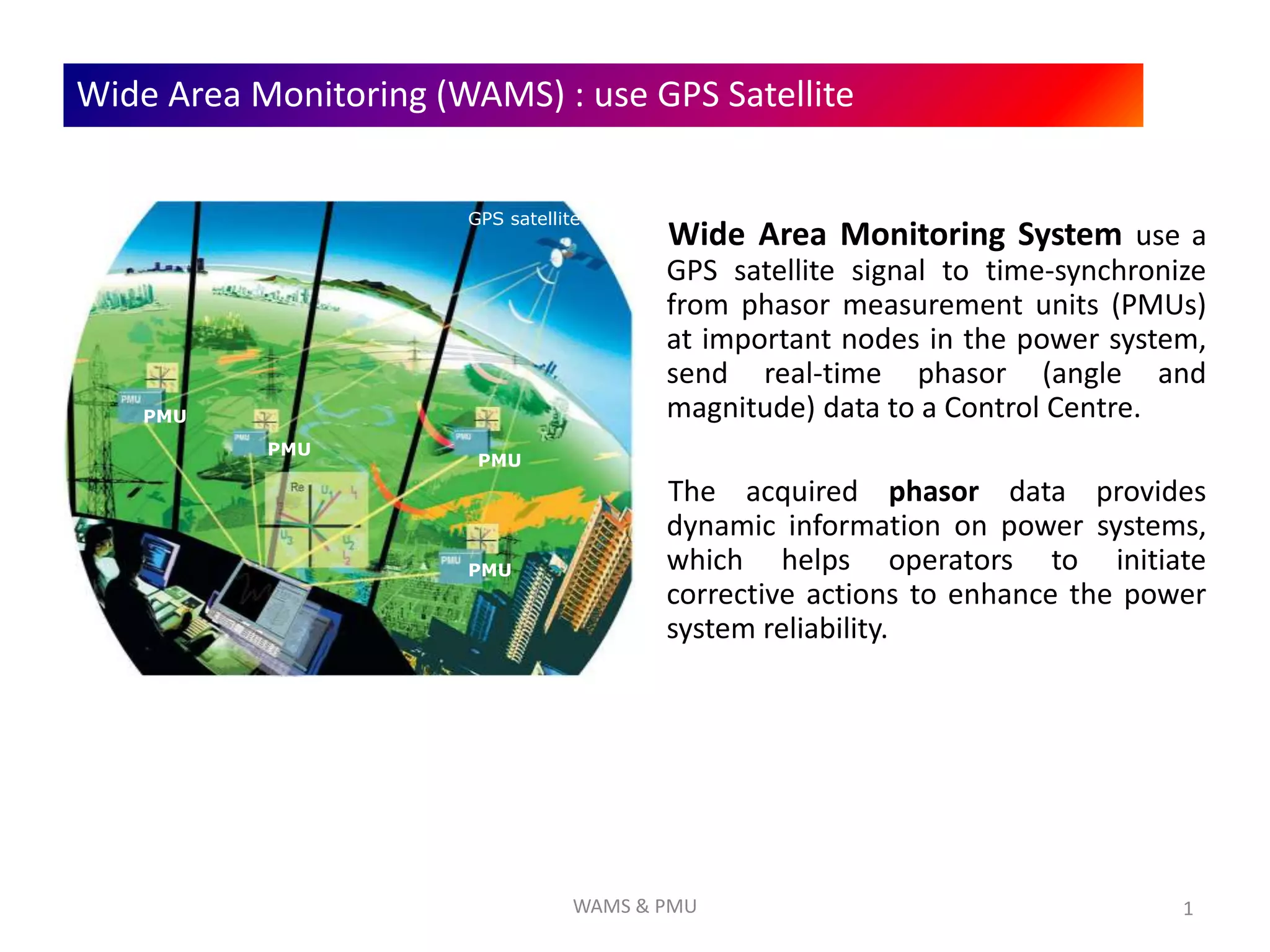
The modern upgrade is the Wide Area Monitoring System (WAMS), which relies on devices called Phasor Measurement Units (PMUs).
- PMUs are high-speed sensors placed at key locations across the grid.
- They use GPS signals for precise time-stamping.
- This allows them to measure the voltage and current phasors (both magnitude and angle) 50 times per second and send this synchronised data to a central control room.
Think of it like the difference between seeing a series of still photographs (SCADA) versus watching a high-speed video (WAMS). This allows operators to see fast-developing instabilities and oscillations in real-time.
Gaining Visibility at the Network Edge
It's not just the transmission system that needs better visibility. Distribution Network Operators (DNOs) like UK Power Networks are installing advanced monitoring on their local low and high voltage networks, which were previously "unseen" by the control room.
Let's explore some real-world examples of how a DNO is increasing its monitoring capabilities. This page from UK Power Networks details several innovative projects.
Please read the following short sections from this page: Start with the introduction under 'Monitoring and control'. Then, read the section on 'Low Voltage Visibility and Monitoring' to see how they are getting data from local substations. Skim the section on 'Stratus' to understand the concept of smart transformers. Finally, read about the 'High Voltage Feeder Monitoring to pre-empt Faults' project.
As you can see, DNOs are using a range of technologies—from monitors in local substations to smart transformers—to get a complete, real-time picture of what is happening on their networks. This data is fundamental for managing congestion caused by local generation and new loads like heat pumps and EVs.
Part 2: Advanced Control – From Intelligent Action
Seeing the problem is only the first step. Advanced control systems use this rich data to take fast, often automated, actions to keep the grid running smoothly.
Active Network Management (ANM)
One of the most important new control technologies is Active Network Management (ANM). ANM is an automated software system that manages local network constraints in real-time.
Imagine a part of the network with several wind farms connected, where the power line has a capacity of 25 MW. On a very windy day, the farms might be able to produce 30 MW. Instead of simply not allowing the final wind farm to connect, an ANM system monitors the line's loading and can automatically send signals to the wind farms to slightly reduce their output, ensuring the line's limit is respected.
This allows much more renewable generation to connect to the existing grid, avoiding or deferring expensive and slow network reinforcement projects. These systems are often part of a broader Distributed Energy Resource Management System (DERMS).

UK Power Networks' ANM platform is a real-world example of this, enabling over 3GW of flexible connections and significantly speeding up the connection process for new renewable projects.
AI and Machine Learning in the Control Room
The next frontier in grid control is the use of Artificial Intelligence (AI) and Machine Learning (ML). National Grid ESO is actively developing tools that use AI to move from being reactive to being proactive.
National Grid ESO Annual NIA Summary 2023/24
This annual innovation summary from National Grid ESO provides fascinating case studies on how they are using cutting-edge data science to manage the grid.
Please read the summaries of these three projects: Forecasting the Risk of Congestion: A tool to proactively manage congestion in the southeast of England (p. 21-23). Solar PV Nowcasting: A tool using ML to more accurately predict solar generation (p. 36-38). Volta: A programme focused on using ML and AI to help operators in the control room make optimised decisions (p. 45).
These projects show the direction of travel:
- Predicting Congestion: Instead of waiting for a constraint to happen, AI models can forecast the risk of congestion a day ahead, giving the ESO time to take cheaper, more efficient actions.
- Improving Forecasts: By better predicting solar output, the ESO can reduce its reliance on expensive, carbon-intensive backup power.
- Optimising Decisions: Tools like Volta will act as an intelligent assistant for control room engineers, helping them assess multiple complex scenarios to make the best possible operational decisions.
Test your understanding!
A sunny, windy day in Scotland is causing the transmission lines heading south to approach their thermal limit. In the past, the control room might have had to manually call wind farms and ask them to reduce output. Using the concepts from this lesson, describe two 'advanced' ways this congestion could be managed more effectively.
Show answer
- Automated Control (ANM): An Active Network Management system, monitoring the power flow on the lines in real-time, could automatically send signals to the connected wind farms to slightly and dynamically reduce their output to ensure the line capacity is not exceeded.
- Proactive Management (AI Forecasting): An AI-based forecasting tool, like the one being developed by the ESO, could have predicted this congestion event 24 hours in advance by analysing weather forecasts and expected grid conditions. This would allow the ESO to take proactive measures, such as accepting bids in the market to reduce generation or increase demand elsewhere, which is often more efficient and cheaper than last-minute emergency instructions.
Part 3: A Special Case – Tackling Stability
While ANM and AI are excellent for managing predictable power flows (congestion), they are not enough to solve the new challenge of system stability. As we've discussed, the loss of large, spinning generators means the grid has less physical inertia and lower system strength.
Why Is Grid Stability Getting Harder? The Hidden Challenge of Renewable Integration
This video from Modo Energy explains the stability challenge very clearly. It discusses why inertia is so important and how the grid operator is working to solve the problem.
Please watch from 08:35 to 12:00 and then from 18:54 to 20:30. Focus on: What synchronous machines provided to the 'old' grid (inertia, system strength). Why low inertia is a problem (fast frequency changes). What the 'Stability Pathfinders' initiative was designed to do.
As the video explains, low inertia means that after a disturbance (like a power station tripping offline), the grid's frequency falls much more quickly, leaving less time for backup systems to react before it triggers blackouts.
To solve this, National Grid ESO used its Stability Pathfinder initiative to create a new market for stability services. This has led to the construction of a new type of grid asset: the synchronous compensator.
A synchronous compensator is essentially a large synchronous motor that is connected to the grid but isn't used to drive anything. Its sole purpose is to spin in sync with the grid, providing inertia and system strength without producing power (and therefore, without emissions). It's a targeted, technological solution to replace a physical property the grid is losing. These are monitored and controlled assets that form a key part of the modern stability toolkit, alongside advanced analytical models like EMT analysis that help engineers understand and predict these complex new stability phenomena.
Conclusion
In this lesson, we've journeyed into the control rooms of the UK's electricity grid to see how operators are using a new generation of digital tools to manage an increasingly complex system.
Key Takeaways:
- The modern grid, with its high levels of renewables and DERs, faces new real-time challenges of congestion and instability.
- Advanced monitoring systems, like WAMS with PMUs and extensive sensors on the distribution network, provide the high-definition, real-time data needed to see these challenges as they unfold.
- Advanced control systems, like Active Network Management (ANM) and AI-powered forecasting tools, use this data to take automated and proactive actions to manage congestion and optimise the system.
- To tackle the loss of physical stability, the ESO has created markets for services like inertia, leading to the deployment of targeted solutions like synchronous compensators.
Preview of the next lesson:
We've seen how technology helps manage the physical grid. Next, we'll explore how digitalization is transforming the markets where electricity is bought and sold. We will analyse how digitalization of wholesale market platforms can improve liquidity, reduce barriers to entry, and lower operational costs.