Hello! Welcome to the first lesson of our module on System Security and Protection.
In the previous module, we discussed the complex coordination required between the Electricity System Operator (ESO), Transmission Owners (TOs), and Distribution Network Operators (DNOs) to manage the grid in real-time. A key reason for this coordination is to ensure the security of the electricity supply. Today, we will explore one of the most fundamental principles used to achieve this security.
Our learning outcome is to explain the N-1 security criterion and its application in transmission planning and operation. By the end of this lesson, you will understand what this rule means, why it is critical for preventing widespread power cuts, and how it shapes the design and day-to-day management of the national grid.
What is a Contingency?
The electricity grid is a vast physical network, and like any complex machine, its components can sometimes fail. A generator might unexpectedly trip offline, a transmission line could be struck by lightning, or a transformer could develop a fault. In the world of power systems, such an event is called a contingency.
To get a more formal definition, let's watch the beginning of a lecture on this topic.
Introduction to Contingency Analysis
This video from IIT Roorkee introduces the concept of contingency analysis. The first few minutes clearly define what a 'contingency' is in the context of a power system.
Watch the first 4 minutes of the video, up to the point where the presenter starts discussing transformers and transmission lines being equivalent for analysis (timestamp 04:00). Focus on which grid components are considered when we talk about contingencies.
As the video explains, a contingency is essentially the unplanned outage of an electrical element that helps supply power. This means we are primarily concerned with the loss of:
- Generators: The sources of power.
- Transmission lines: The "motorways" that transport power over long distances.
- Transformers: The equipment that changes voltage levels.
The loss of a load (e.g., a factory switching off its machines) is not typically considered a contingency in this security context.
The N-1 Security Criterion
So, if we know that components will inevitably fail, how do we design and operate a grid that can handle these failures without collapsing? The answer lies in a core principle called the N-1 security criterion.
Let's read a clear, high-level definition of this principle.
This article from Kyon Energy provides a concise definition of the N-1 criterion.
Read the 'Definition' section of the article. Focus on understanding the core idea of ensuring continuous supply even if one component fails.
In simple terms:
- 'N' represents the total number of components in the system (all the generators, lines, transformers, etc.).
- 'N-1' means the system with one of those components removed.
The N-1 criterion is a rule that states the power grid must be able to withstand the loss of any single component and continue to operate in a secure state. It's the engineering equivalent of having a spare tyre for your car. You hope you never need it, but you have it so that a single puncture doesn't leave you stranded. This principle of building in backup capacity is known as redundancy.
What Does "Operating Securely" Mean?
After a contingency happens (an 'N-1 event'), the system is considered 'secure' if it can continue to operate without violating any of its operational limits. Let's return to the video to understand what this means in practice.
Introduction to Contingency Analysis
This part of the video explains what engineers look for after a contingency to decide if the system is secure or insecure. It also formally introduces the N-1 criterion.
Watch the section from 07:48 to 19:09. The presenter discusses the limits on voltage, current, and power flow. Pay attention to the difference between a 'secure' and 'insecure' state after a line or generator outage.
As you saw, after a line or generator trips, the flow of electricity instantly redistributes across the remaining paths. The system is considered secure if, after this redistribution:
- Voltages at all points on the grid remain within their legally required limits (typically within ±5% or ±10% of the nominal value).
- The current and power flow on all other transmission lines and transformers do not exceed their thermal ratings (i.e., they don't get so hot that they are damaged or sag dangerously).
If any of these limits are violated, the system is in an insecure state. This is dangerous because it can lead to a domino effect. An overloaded line might trip to protect itself, putting even more strain on other lines, which then also trip, potentially leading to a cascading failure and a large-scale blackout. The N-1 criterion is designed to prevent that first domino from falling.
Test your understanding!
Imagine two identical transmission lines running in parallel, each carrying 300 MW of power. The maximum thermal limit for each line is 700 MW.
If one of these lines suddenly trips and goes out of service due to a fault, is the system N-1 secure in this situation? Why or why not?
Show answer
Yes, the system is N-1 secure. When one line trips, its 300 MW of power will attempt to flow onto the remaining parallel line. The new flow on that line will be 300 MW (its original load) + 300 MW (the load from the failed line) = 600 MW. Since 600 MW is less than the line's maximum limit of 700 MW, the system remains in a secure state.
N-1 in Action: Planning and Operation
The N-1 criterion is not just a theoretical concept; it is actively used in two key areas: planning the grid for the long term and operating it in real-time.
1. Application in Transmission Planning
When engineers design the transmission network, they build in redundancy to ensure it is N-1 compliant.
Let's return to the Kyon Energy article to see some concrete examples of how the N-1 principle is applied in grid design.
Read the section 'How does the n-1 principle work?'. Focus on the examples of dual overhead lines and substation design.
As the article describes, common N-1 planning strategies include:
- Building double-circuit transmission lines: Most large pylons carry two separate transmission circuits. If one fails, the other can take its load.
- Installing multiple transformers in substations: If one transformer needs to be taken out for maintenance or fails, another is available to handle the power flow.
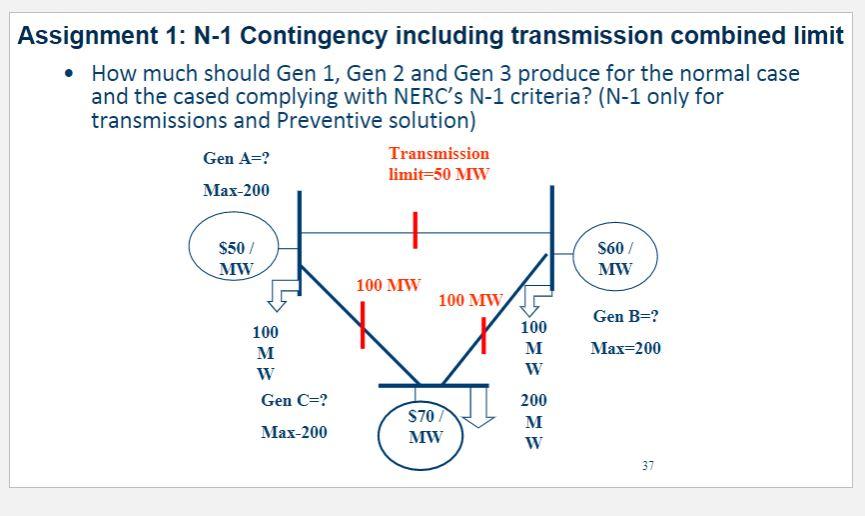
A crucial consequence of this is that grid assets are intentionally not used to their full capacity during normal operation. A line might only be run at 50% of its maximum rating to ensure it has enough "headroom" to accept the extra power flow during a contingency.
The image below shows a simplified planning problem. Engineers must decide how much power each generator should produce, not only for the normal case but also to ensure the system remains safe if any single transmission line were to fail.
2. Application in Grid Operation
N-1 security isn't just a one-time design check. The grid's state is constantly changing as demand fluctuates and generation patterns shift. Therefore, the ESO must continuously verify that the system is N-1 secure at its current operating point. This process is called contingency analysis.
Introduction to Contingency Analysis
The final part of the video explains how contingency analysis is used in real-time grid operations. It highlights the immense computational challenge this presents.
Watch the section from 19:09 to 32:50. The first part explains the scale of the problem: having to check thousands of potential failures every few minutes. The second part explains the goal of this analysis: to quickly assess if the system is secure and, if not, to take corrective action.
Here's a summary of the operational process:
- Continuous Monitoring: The ESO's control room constantly gets data about the state of the grid.
- Simulation: Sophisticated software runs thousands of simulations in the background. Each simulation asks: "What if line X fails right now? What if generator Y fails right now?"
- Assessment: The software checks if any of these simulated contingencies would cause a limit violation (a voltage breach or a line overload). The goal is a rapid "secure" or "insecure" assessment, not necessarily a perfectly precise calculation of the new power flows.
- Corrective Action: If the analysis shows that the loss of a particular component would lead to an insecure state, the grid operator must act pre-emptively. They might instruct a power station to reduce its output to lower the flow on a critical line, thereby making the system N-1 secure again.
Where does N-1 apply?
It is important to note that this level of security is primarily applied to the high-voltage transmission system—the "motorway" of the grid.
This last reading clarifies the scope of the N-1 criterion.
Read the short section 'Validity of the n-1 criterion'.
As you read, the local low-voltage distribution networks that deliver power to our homes are typically not N-1 secure. They are often 'radial' networks, like the branches of a tree. If the branch serving your street is damaged, the power goes out for everyone on that branch until it can be repaired. The cost of making every local street N-1 secure would be enormous.
Conclusion
In this lesson, we have demystified one of the most important principles underpinning the reliability of our electricity supply.
Key Takeaways:
- A contingency is the unexpected failure of a key grid component like a generator, transmission line, or transformer.
- The N-1 security criterion is a rule stating that the grid must be able to withstand the loss of any single component and continue to operate within all safety limits.
- It is applied in planning by building redundant infrastructure (like double-circuit lines) and in operation through continuous real-time contingency analysis.
- To maintain N-1 security, grid assets are often operated with significant headroom, meaning they are not run at their maximum capacity in normal conditions.
- If the system is found to be not N-1 secure, the grid operator must take corrective action to return it to a secure state.
We've discussed how the grid is planned to handle the complete loss of components. In our next lesson, we will look at a different but related security concept: explaining the concept of system strength and short-circuit level. This will help us understand the grid's inherent ability to maintain a stable voltage, a property that is becoming increasingly important in a world with more renewable energy.