Hello! Welcome to your next lesson on the inefficiencies and barriers within the UK's electricity system.
In our last lesson, we focused on "supply-side" flexibility by exploring energy storage. We learned how technologies like batteries are vital for balancing the grid but face significant market and regulatory barriers to their deployment.
Today, we're going to flip the coin and look at the other side: demand-side flexibility. Instead of just changing electricity supply to meet our needs, what if we could change our needs to match the available supply? This is the core idea behind Demand-Side Response (DSR).
This lesson will explain the challenges created by inflexible electricity demand and show how DSR technologies and schemes are designed to address them. Understanding this is crucial, as making our demand smarter is just as important as making our supply cleaner.
The Challenge of Inflexible Demand
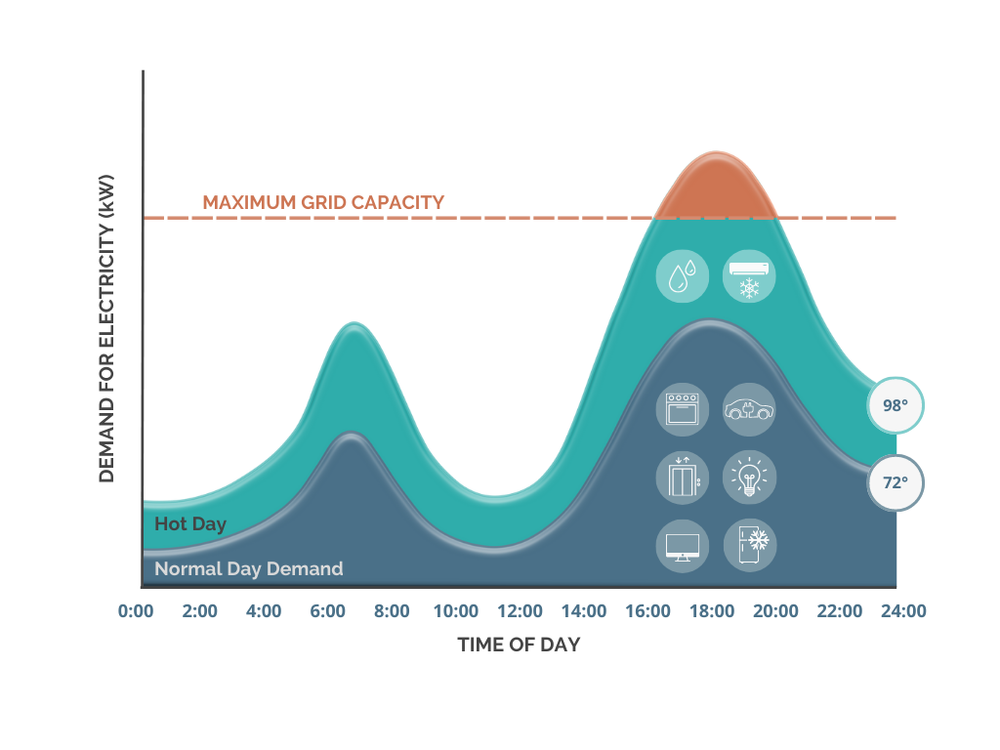
Historically, the power grid has operated on a simple principle: when you flip a switch, a power plant somewhere generates a little more electricity to meet your demand instantly. Our collective demand for electricity, however, is not constant. It follows predictable daily patterns, with significant peaks in the morning and, especially, in the evening.
This "inflexible" nature of demand, where we use power when we want it regardless of the state of the grid, creates several major challenges:
- Expensive Infrastructure: The entire grid, from power stations to transformers and cables, has to be built to handle the highest possible peak demand, even if that peak only lasts for a few hours each year. This is like building a 10-lane motorway for a traffic jam that only happens on bank holidays.
- Costly, Dirty "Peaker" Plants: To meet these short, sharp peaks in demand, the grid operator often has to fire up expensive and inefficient gas-fired power plants (known as "peaker plants"). These plants are a costly and carbon-intensive way to balance the system.
- Mismatch with Renewables: The rise of renewable energy adds another layer of complexity. Peak demand in the evening often occurs just as solar generation drops to zero. Conversely, it might be very windy and sunny in the middle of the day when demand is lower, leading to "wasted" clean energy.
The graph below illustrates how demand can spike, particularly on a hot day when air conditioning use increases, potentially exceeding the grid's maximum capacity.
The Solution: Demand-Side Response (DSR)
Demand-Side Response is the solution to this problem. Instead of only increasing supply, DSR aims to manage the demand itself.
A great way to think about this is the motorway analogy. Instead of building more lanes (power plants), DSR is like paying drivers to travel at quieter times. This smooths out the traffic (demand) and makes the existing road network (grid) operate more efficiently.
Let's read a short document from the UK Parliament that defines DSR and its purpose.
Demand side response: A tool for lowering household ...
This POSTnote from the UK Parliament provides a clear and concise overview of Demand-Side Response (DSR). It's an excellent primer on the topic.
Please read the 'Overview' on page 1, the 'Introduction' on page 2, and the section 'What is demand side response?' on page 3. Focus on: The definition of DSR. The two main reasons it's used (peak demand reduction and balancing with renewables). The difference between 'implicit' and 'explicit' demand response.
As you read, you'll have noted two key concepts:
- Implicit DSR: This involves using price signals to encourage behaviour change. Time-of-Use tariffs, where electricity is cheaper at off-peak times (like overnight), are a classic example.
- Explicit DSR: This involves paying consumers directly to reduce their demand during specific, pre-notified "events" when the grid is under stress. The National Grid ESO's Demand Flexibility Service (DFS) is a prime example of this.
It's also important to distinguish DSR from energy efficiency.
- Energy efficiency is about using less energy to do the same job (e.g., swapping an old lightbulb for an LED).
- Demand-Side Response is about changing when you use energy.
How Does DSR Work for a Household?
For large industrial users, DSR might mean temporarily pausing a furnace or adjusting a large refrigeration unit. But how does it work for ordinary homes?
To get a practical sense of this, let's watch a video that explains the UK's Demand Flexibility Service.
Demand Flexibility Schemes Explained
This video from the 'Gary Does Solar' channel gives a fantastic, easy-to-understand explanation of why demand flexibility schemes exist and how a typical household can participate.
Please watch from 01:01 to 06:02. The video covers: The Grid Problem (01:01 - 03:52): How different generation sources meet demand and why meeting the evening peak is a challenge. The DSR Solution (03:52 - 06:02): The practical steps of participating in a scheme, from getting a smart meter to shifting your appliance use during an 'event'.
As the video explains, the process relies heavily on technology. Smart meters are the foundation, as they measure electricity use in half-hourly intervals, allowing your energy supplier to see if you successfully reduced your demand during an event.
This response can be:
- Manual: You get a notification on your phone about a DFS event from 5-6 pm and consciously decide to run your dishwasher and washing machine later that evening.
- Automated: A smart electric vehicle (EV) charger or a modern heat pump can be programmed to automatically respond to price signals or DSR events, pausing a charge or pre-heating a room without you having to do anything.
Test your understanding!
A household decides to replace all its old, inefficient appliances with new A-rated energy-efficient models. They also sign up for a time-of-use tariff and start running their new washing machine overnight when electricity is cheapest, instead of in the evening.
Which action is an example of energy efficiency, and which is an example of Demand-Side Response?
Show answer
- Energy Efficiency: Replacing the old appliances with new, efficient models. This permanently reduces the total amount of energy they use.
- Demand-Side Response: Shifting the washing machine cycle from the evening peak to the cheap overnight period. This changes when they use energy to help balance the grid (and save them money).
The Challenges of Demand-Side Response
While DSR is a powerful tool, implementing it successfully is not straightforward. There are significant challenges to overcome.
Challenge 1: Insufficient Incentives
For people to change their behaviour, the reward must be worthwhile. If the payment for the inconvenience of not cooking dinner at the usual time is trivial, participation will be low. This has been a real-world issue with the UK's Demand Flexibility Service.
Demand Flexibility Schemes – Opportunity Lost?
Let's watch a follow-up video that explores this very problem. It highlights a critical challenge for DSR schemes: making them financially attractive enough for consumers to bother.
Please watch from 06:54 to 10:56. This segment discusses: The low payments households received in a real DFS event compared to gas power stations (06:54 - 08:26). The effect this had on consumer engagement and trust (09:19 - 10:56).
As the video shows, if DSR schemes don't offer meaningful rewards, they risk losing public trust and engagement, undermining the entire concept.
Challenge 2: Fairness and Equity
A successful DSR system must be fair to everyone, but this is difficult to achieve. The parliamentary POSTnote you read earlier highlighted several fairness issues.
Demand side response: A tool for lowering household ...
Let's revisit the POSTnote to focus specifically on the social challenges of DSR.
Please read the section 'Fairness of demand side response' on pages 9 and 10. Pay close attention to the points about: Access to devices. Ability to shift demand. Households with low electricity demand.
The key fairness challenges are:
- Access to Technology: DSR is most effective with flexible assets like EVs, batteries, and heat pumps. These are expensive, meaning wealthier households are better positioned to benefit, potentially widening the gap between the energy "haves" and "have-nots."
- Varying Flexibility: Some people simply cannot shift their demand. Families with young children, shift workers, or those reliant on powered medical equipment may need to use electricity during peak times, regardless of the cost.
- Penalizing the Frugal: Households in fuel poverty often use the bare minimum of electricity at all times. Their "baseline" usage is already very low, making it almost impossible for them to reduce it further to earn DSR rewards.
Challenge 3: Technical Hurdles
Finally, there are technical challenges in making DSR work reliably at a national scale. A major one is "baselining". To pay someone for reducing demand, you first need to accurately estimate what their demand would have been. This is notoriously difficult for households, whose energy use can be unpredictable. An inaccurate baseline can lead to people being over- or under-paid, or even "gaming" the system.
Conclusion
You've now seen how inflexible demand creates significant costs and carbon emissions for the grid, and how Demand-Side Response offers a smarter, cleaner, and more efficient alternative.
Key Takeaways:
- Inflexible Demand leads to an oversized, inefficient grid that relies on expensive, carbon-intensive "peaker" plants to meet daily peaks.
- Demand-Side Response (DSR) addresses this by encouraging consumers to change when they use electricity, either through price signals (implicit DSR) or direct payments (explicit DSR).
- Key Enablers for household DSR are smart meters and flexible technologies like EVs, heat pumps, and batteries, which can automate the response.
- Significant Challenges remain, including the need for sufficient financial incentives to drive participation, ensuring the system is fair and equitable for all, and solving technical problems like accurate baselining.
Preview of the next lesson:
The challenges facing both energy storage (from our last lesson) and demand-side response are part of a larger picture. In our next lesson, we will zoom out to describe the key market and regulatory barriers that stand in the way of building a fully decarbonized grid, tying together the themes of this module.