In the previous lesson, you estimated what a subsidy changed, rather than crediting it for every observed result. A public contract raises a different question: did the purchasing process give qualified suppliers a fair opportunity to compete? A tender can look competitive on paper while its requirements, deadlines, or scoring make one supplier unusually likely to win.
This lesson takes about 40 minutes, including the video and readings. You will learn to spot warning signs in tender specifications, bidding, and award decisions—and to separate a reason for scrutiny from evidence that favoritism occurred.
The buyer designs the competition
In an ordinary market, customers choose among offers. In public procurement, the buyer also writes the rules that determine which offers can be made and how they will be judged. A legitimate need might be reliable equipment, prompt delivery, or low operating costs. The concern is whether the rules pursue that need proportionately or give a particular business an unnecessary advantage.
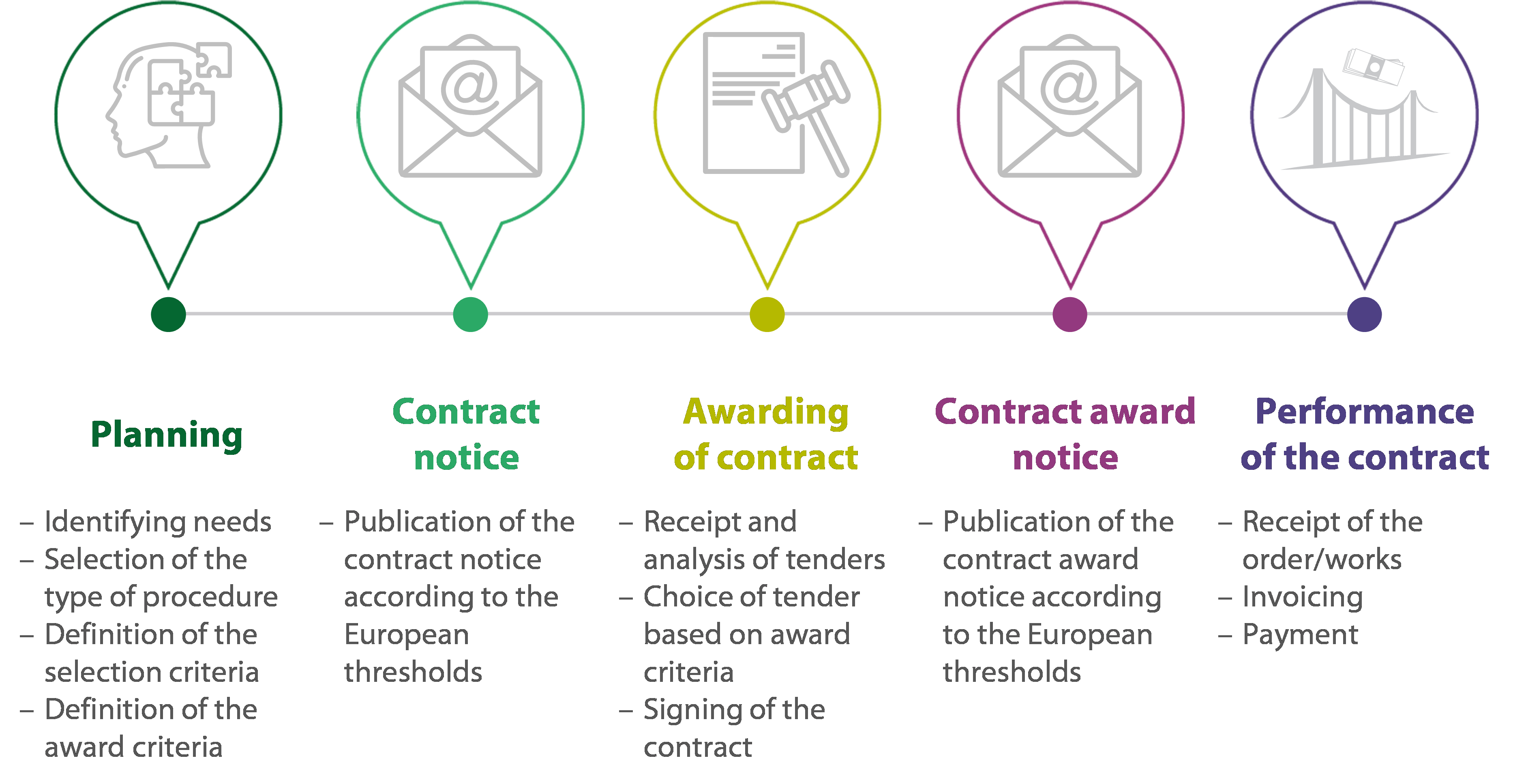
A specification describes what the buyer wants. Qualification requirements determine which suppliers are eligible or capable of performing. Award criteria determine how eligible offers are compared. These are distinct decisions: a supplier can be excluded before its price is considered, or can submit a compliant bid and lose on the announced scoring.
Watch the following account for a map of the process. It explains general tender practice; applicable public-procurement rules can differ by jurisdiction and take priority over a general guide.
Competitive Procurement: How to Run a Tender Process
Watch “Competitive Procurement: How to Run a Tender Process,” from Online PM Courses – Mike Clayton, to locate the decisions a public buyer makes before and after bids arrive.
Watch requirements and scoring for the progression from documenting needs to setting weights, a deadline, and publicity. Then watch shared answers for the importance of giving bidders the same clarifications. Finish with bid assessment, which distinguishes checking compliance from evaluating eligible offers.
The central point is that a published invitation alone does not guarantee an open contest. A tender may be advertised widely yet contain a condition that only one supplier can satisfy. Conversely, a tender with few bids is not automatically unfair: the relevant market may genuinely have few capable suppliers.
Specifications can narrow the field before bidding begins
Imagine an agency needs pumps that work with an existing control system. Requiring reliable compatibility serves a clear purpose. Requiring a particular brand, without considering demonstrably compatible alternatives, may narrow competition more than that purpose requires. The useful distinction is between specifying the result needed and specifying a supplier’s particular way of achieving it.
The OECD’s Tender Design Checklist gives practical guidance on researching the market and designing requirements. It is primarily advice for protecting competition, including against bid rigging by suppliers. Bid rigging is not the same thing as favoritism by public officials, but many design choices matter for both risks.
Read the OECD checklist to see how a buyer can test its assumptions about available suppliers, avoid unnecessary entry barriers, and choose meaningful award criteria.
In Section 2.1, “Be informed before designing the tender process,” begin with the caution that market research itself can be biased. Read market research through the bullet on keeping records of outside input. Note the check for consultants’ relationships with bidders. In Section 2.2, “Maximise the participation of genuinely competing bidders,” read participation requirements, then the bullet beginning “Allowing adequate time to prepare and submit a bid”: bid preparation time. Focus on whether requirements are relevant and proportionate, not simply whether they reduce bidder numbers. In Section 2.3, “Define requirements clearly and avoid predictability,” read specification design. Compare performance requirements with brand-specific descriptions. In Section 2.4, “Reduce communication among bidders and share information carefully,” read information sharing. In Section 2.5, “Carefully choose the criteria for evaluating and awarding the tender,” read award criteria.
Several warning signs follow from this distinction between need and unnecessary restriction. Specifications that closely match one firm’s product, unusually high revenue requirements for a modest contract, or a demand for experience with the buyer’s incumbent system can shut out otherwise capable suppliers. None is conclusive in isolation. A safety-critical purchase might justify demanding experience; integration with existing equipment might justify a tight compatibility standard. The buyer should be able to explain why the condition matters, why its threshold is proportionate, and whether an equivalent solution would work.
The same reasoning applies to contract size. Combining unrelated goods into one indivisible tender may leave only a large incumbent able to bid. Splitting a contract into sensible lots may permit specialist suppliers to compete. But splitting is not always better: a single integrated supplier may reduce coordination risk. The question is what the purchase requires and how the chosen structure affects plausible competitors.
The bidding process can distribute opportunity unequally
Suppliers need enough notice, time, and information to prepare serious offers. A very short deadline can favor a firm that already knows the buyer’s plans. An answer to a technical query shared privately with one bidder can have the same effect, even when the published specification looks neutral. Late changes to the requirements can disadvantage firms that prepared bids under the original terms.
The European Commission support portal’s Fraud in Public Procurement makes a useful distinction: a red flag identifies something requiring attention; it does not establish that fraud occurred. Its examples also help locate warning signs in notices, requirements, and deadlines. The document discusses rules and examples from its public-procurement setting; use the indicators as prompts for investigation, not as universal legal verdicts.
Fraud in Public Procurement [EN] - SFC Support Portal
Read this guide for its careful definition of a red flag and for concrete indicators in tender documents. Its lists describe risks, not findings about any particular buyer.
In the introductory discussion before “PRE-TENDERING PHASE” on p. 8, find the paragraph beginning “The aim of this year's working group”. Read the red-flag explanation, especially the distinction between a signal and proof. In “1.3 Content of the call and specifications,” go to “1.3.1 Insufficient information in the publication” on pp. 15–16. From its publicity warnings, read notice and clarification risks; the passage ends with changes not communicated on time. Continue through “1.3.2 Selection and award criteria,” “1.3.3 Definition of requirements,” “1.3.4 Deadlines and time frame,” and “1.3.5 Rigged specifications” on pp. 16–18. Read the concrete indicators. Focus on how each condition could limit competition, while keeping possible practical justifications in view.
Low participation is particularly easy to overread. One received bid is an outcome to explain, not proof that the buyer selected a supplier in advance—and not necessarily a direct award without a tender. Market research might show that only one firm could meet a necessary deadline. Alternatively, the documents might show that several capable firms declined because the deadline or qualification rules were avoidably restrictive. The distinction depends on evidence about the market and the process.
There is also a separate danger of coordination among bidders, such as firms submitting bids they do not intend to win. That could make a tender appear competitive without genuine rivalry. It should not automatically be attributed to a political connection or to misconduct by the buyer. Similar bid documents, repeated withdrawals, or a pattern of firms taking turns winning would call for a different investigation into bidder conduct.
Evaluate the award, not just the winning price
A higher-priced winner is another signal that requires context. Public buyers may reasonably value quality, delivery, maintenance, and operating costs alongside price. The stronger test is whether criteria were relevant, made known in advance where required, and applied consistently.
Consider this fictional tender. The published method awards up to 40 points for price and up to 60 for quality. Price points equal 40 times the lowest compliant bid price divided by the bid’s price; quality points equal 60 times a quality rating out of 100.
| Bid | Price | Quality rating | Price points | Quality points | Total |
|---|---|---|---|---|---|
| A | 100,000 | 70/100 | 40.0 | 42.0 | 82.0 |
| B | 108,000 | 90/100 | 37.0 | 54.0 | 91.0 |
B wins despite its higher price. If the quality ratings are supported by the bids and the published method was applied as stated, that outcome is not, by itself, evidence of favoritism. If evaluators quietly added a preference for B’s brand, changed the weights after submissions, or accepted a missing mandatory qualification from B while rejecting others for the same omission, the departure from the stated rules would be the concern.
A defensible assessment therefore examines both the design and the application of criteria. A quality criterion can be legitimate yet weighted to exploit one bidder’s known strength without a credible purchasing reason. Equally, an apparently surprising score may reflect a genuine difference in warranty, performance, or whole-life cost. An evaluation record should make the reasoning traceable.
Turning a warning sign into an evidence-based judgment
Suppose a buyer tenders for replacement pumps. The notice allows seven days to bid, specifies the incumbent supplier’s brand, and receives one offer—from that incumbent. Those facts warrant scrutiny because each could have reduced the field. They do not yet show why the rules were chosen, whether another supplier could have met the need, or whether anyone received advance notice.
A careful investigation would compare the tender with the buyer’s documented need and the available market. Technical assessments could establish whether other pumps would work safely with the control system. Planning records could show whether the short deadline followed an unexpected failure or a long-known replacement schedule. Notice dates and shared clarification records could establish whether suppliers had equal access to information. Prior comparable tenders and market research could reveal whether qualified alternatives existed.
Evidence of a political connection would add a possible explanation, not fill those gaps automatically. To support a favoritism claim, the connection would need to be linked to a consequential decision—such as an unjustified brand requirement, selective disclosure, or inconsistent scoring—and to the resulting advantage. Conversely, a documented urgent need, genuine incompatibility with alternatives, and consistent treatment of bidders could weaken that claim even when the winner is well connected.
The most reliable conclusion at the red-flag stage is often narrow: “These features may have restricted competition; the available facts do not yet establish that they were unnecessary or designed to favor the winner.” That is a substantive finding about what needs checking, not an evasion.
Conclusion
Tender warning signs cluster around three decisions: what suppliers must offer, whether they have an equal chance to bid, and how their bids are scored. Brand-like specifications, disproportionate qualifications, short deadlines, unequal information, and unexplained changes in evaluation each suggest a way competition could be distorted. Few bids or a higher-priced winner can reinforce concern, but neither proves favoritism without a credible comparison to the buyer’s needs, the available suppliers, and the stated rules.
The next lesson examines contracts awarded without a competitive tender. There, the central issue shifts from whether the contest was fair to whether bypassing one was justified by evidence about urgency, supplier availability, price, and safeguards.