Welcome to your sixth lesson. Over the past few lessons, we've explored the extensive list of fundamental rights guaranteed by the Constitution of Nepal, from personal freedoms to the socio-economic entitlements that ensure a life of dignity. But rights alone do not create a thriving state. They must exist within a framework of mutual responsibility and have a mechanism for enforcement when they are violated.
This lesson concludes our exploration of Part 3 of the Constitution by focusing on these two critical components. We will examine the fundamental duties of citizens and the powerful provision for constitutional remedies. By the end of our session, you will be able to explain the obligations every citizen has towards the nation and, crucially, understand how to enforce the rights we have discussed if they are ever infringed upon. This knowledge is not just theoretical; it is the practical foundation of a citizen's relationship with the state and a core concept for any aspiring public administrator.
The Two Sides of the Constitutional Coin: Rights and Duties
A constitution creates a social contract. While it grants citizens a comprehensive set of rights to protect them from state overreach and to ensure their well-being, it also expects citizens to uphold certain duties to maintain the integrity and harmony of the nation. These duties represent the citizen's contribution to the collective good.
The Constitution of Nepal outlines these obligations in Article 48. Let's examine them directly.
Part-3 Fundamental Rights and Duties | The Constitution of Nepal
This webpage provides a clear excerpt of the final articles in Part 3 of the Constitution, which deals with Fundamental Rights and Duties.
Please scroll to the bottom of the page to find item number 48. Read the four specific duties listed under the heading Duties of citizens.
As you have just read, every citizen has four fundamental duties:
- To safeguard the nationality, sovereignty and integrity of Nepal, while being loyal to the nation: This is the primary duty of patriotism and allegiance. It calls on every citizen to protect the country's independence and wholeness.
- To abide by the Constitution and law: This duty reinforces the principle of the rule of law. It means respecting the legal framework that governs the nation, starting with the Constitution itself.
- To render compulsory service as and when the State so requires: This provision allows the state to call upon citizens for service, for example, during national emergencies, natural disasters, or for national defense. It establishes a civic obligation to contribute in times of crisis.
- To protect and preserve public property: This duty fosters a sense of collective ownership and responsibility. Vandalism of public infrastructure, for instance, is not just a crime but a breach of this fundamental duty.
It's important to note that, unlike fundamental rights which are generally legally enforceable against the state, these duties are primarily moral and civic obligations. However, actions that directly contradict these duties (such as treason, breaking laws, or destroying public property) are made punishable by specific acts and statutes.
Making Rights Real: The Right to Constitutional Remedies
A right without a remedy is merely a suggestion. The framers of the Constitution understood this well. Therefore, they included a provision that has been called the "heart and soul" of the fundamental rights chapter: the Right to Constitutional Remedies. This is the right that gives all other fundamental rights their power.
Part-3 Fundamental Rights and Duties | The Constitution of Nepal
Staying with the same resource, let's look at the provision that makes all other rights enforceable.
On the same page, please find item 46 and read the crucial text under the Right to constitutional remedies.
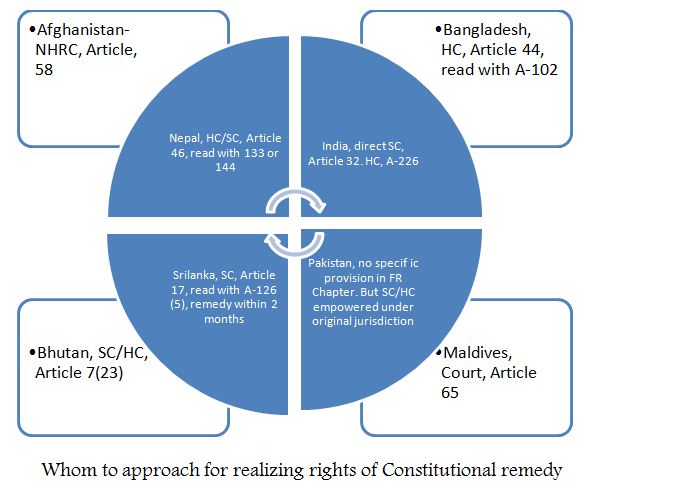
Article 46 guarantees the right to a remedy but points to two other articles for the procedure: Article 133 and Article 144.
- Article 133 grants this power to the Supreme Court.
- Article 144 grants this power to the High Courts.
This means that if any of your fundamental rights (from Article 16 to Article 46) are violated by the state or any public body, you don't have to start at the lowest court. You have the right to go directly to a High Court or even the Supreme Court to seek justice. This is known as the extraordinary jurisdiction of these courts.
The Tools of Justice: Writs
To enforce these rights, the Supreme Court and High Courts can issue powerful judicial orders known as writs. These are commands that compel or prohibit certain actions. For your Loksewa exams, it is essential to know the five types of writs:
- Habeas Corpus (बन्दी प्रत्यक्षीकरण): Literally "to have the body." This writ is issued to protect against illegal detention. If a person is detained, the court can order the detaining authority to bring the person before the court and justify the detention. If the justification is not lawful, the court will order the person's immediate release.
- Mandamus (परमादेश): Literally "we command." This writ is issued to compel a public official, public body, or lower court to perform a legal duty that they have failed or refused to do. For example, if a government office refuses to issue a certificate that you are legally entitled to, you could seek a writ of Mandamus.
- Certiorari (उत्प्रेषण): Literally "to be certified." This writ is used by a higher court to quash (cancel) a decision already made by a lower court, tribunal, or quasi-judicial authority. It is issued when the lower body has acted without jurisdiction, in excess of its jurisdiction, or in violation of the principles of natural justice.
- Prohibition (प्रतिषेध): Literally "to forbid." This writ is issued to prevent a lower court, tribunal, or authority from proceeding with a case that is outside its jurisdiction. It stops an illegal action before it happens, whereas Certiorari cancels it after it has happened.
- Quo Warranto (अधिकारपृच्छा): Literally "by what authority?" This writ is issued to inquire into the legality of a person's claim to a public office. If someone is holding a public office they are not entitled to, the court can use this writ to remove them.
These writs are the essential tools that transform the judiciary into the ultimate guardian of the Constitution and the fundamental rights of the people.
Conclusion
In this lesson, we have completed our survey of Part 3 of the Constitution. We've seen that the constitutional framework is a balanced system: it bestows rights, expects duties, and provides powerful remedies to ensure the system's integrity. As a future public servant, understanding this balance is paramount.
Here are the key takeaways from today's lesson:
- Fundamental Duties (Article 48): Citizens have four key duties: safeguarding the nation, abiding by the law, rendering compulsory service when required, and protecting public property.
- Right to Constitutional Remedies (Article 46): This is the core right that makes all other fundamental rights enforceable.
- Extraordinary Jurisdiction: Citizens can directly petition the Supreme Court (Article 133) or High Courts (Article 144) if their fundamental rights are violated.
- Writs: The courts use five types of powerful orders—Habeas Corpus, Mandamus, Certiorari, Prohibition, and Quo Warranto—to protect rights and ensure public bodies act lawfully.
In our next lesson, we will move to Part 4 of the Constitution to discuss the Directive Principles, Policies, and Obligations of the State. While fundamental rights are legally enforceable claims, directive principles are the long-term goals and guiding philosophy for the state. We will explore how they shape laws and policies, and how they differ from the rights we have just studied.