Hej! Välkommen till din fjärde lektion.
In our previous lessons, we've built the essential foundation of a Swedish main clause: we've identified the subject pronouns (the "who"), learned to conjugate present tense verbs (the "what"), and placed them correctly using the V2 word order rule. You can now form positive statements like Jag talar svenska (I speak Swedish) or Vi bor i Sverige (We live in Sweden).
Today, we'll add a crucial layer of expression by learning how to negate these statements. Our learning outcome is to construct negative main clauses by placing 'inte' correctly after the finite verb.
For you, as a language tutor and analyst, this isn't just about learning the word for "not." It's about understanding a fundamental, immovable slot in the Swedish sentence structure—the position for sentence adverbials. Mastering this now will make it much easier to handle more complex sentences and different adverbs in the future.
The Sentence Schema: Finding a Home for 'inte'
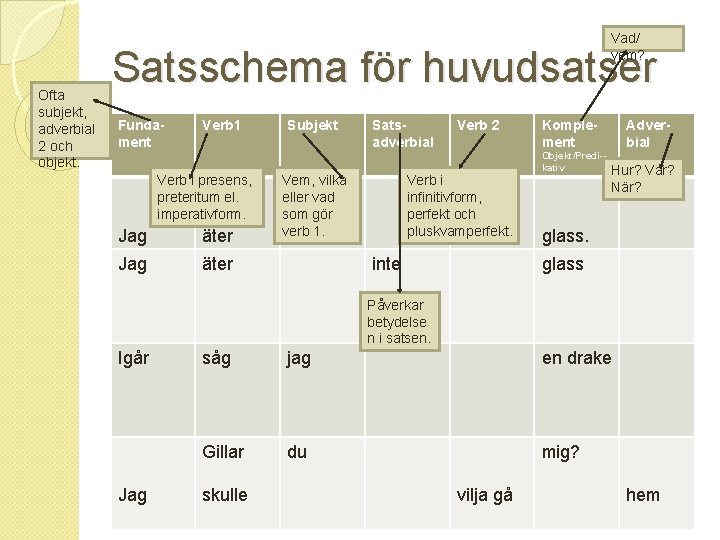
Swedish word order is highly structured. You can visualize a main clause (huvudsats) as a schema with fixed slots for different sentence parts. The most common word for negation, inte (not), belongs to a category called sentence adverbials (satsadverbial). These are adverbs that modify the entire clause, and they have a specific, non-negotiable position.
To understand this structure, let's look at the "formula" for a Swedish main clause.
The resource 'Word Order' from swedishgrammar.com provides a brilliant, formulaic breakdown of the main clause. This will give you the complete, un-simplified rule you prefer.
Please read the section titled 'Main Clause Formula'. Focus on the formula itself: X + V1 + (S) + SA + V2 + O + Adv. Pay special attention to the description of the 'SA' (SatsAdverbial) position and its role.
As you can see from the formula, the SA slot comes directly after the subject (S) and, most importantly, the first verb V1. This gives us our core rule:
In a Swedish main clause, inte is placed directly after the finite verb.
The "finite verb" is the main action verb of the sentence, the one that is conjugated for tense (what the resource calls V1).
Let's look at a visual representation of this schema. This diagram uses the Swedish grammatical terms, which will be useful for you. Satsadverbial is the slot we're interested in.
Putting the Rule into Practice
Let's apply this to the sentences we can already build.
-
Positive:
Jag studerar svenska.(I study Swedish.)- Subject:
Jag - Finite Verb (V1):
studerar
- Subject:
-
Negative:
Jag studerar inte svenska.(I don't study Swedish.)integoes right afterstuderar.
-
Positive:
De förstår.(They understand.)- Subject:
De - Finite Verb (V1):
förstår
- Subject:
-
Negative:
De förstår inte.(They don't understand.)
This core concept is explained very clearly in the following video. The presenter uses the idea of a "subject-verb unit," which is a helpful mental shortcut for identifying where inte should go.
The video 'Swedish Word Order: Basics' from Academia Cervena effectively demonstrates the placement of 'inte'.
Watch from 01:13 to 02:25. The key takeaway is how 'inte' is placed immediately after the subject-verb unit, regardless of their order.
Expanding the Rule: Sentences with Two Verbs
What happens when a sentence contains more than one verb, for example, a modal verb (kan - can, vill - want) followed by an infinitive?
- Positive:
Jag kan tala svenska.(I can speak Swedish.)- Finite Verb (V1):
kan - Infinitive Verb (V2):
tala
- Finite Verb (V1):
The rule remains exactly the same: inte follows the finite verb (V1). This means inte will be placed between the two verbs.
- Negative:
Jag kan inte tala svenska.
This is perfectly predicted by the sentence formula: X + V1 + (S) + SA + V2...Jag (X) kan (V1) (-) inte (SA) tala (V2) svenska (O).
The same logic applies to all constructions with an auxiliary (helping) verb and a main verb.
Let's return to the 'Swedish Word Order: Basics' video to see this principle applied to sentences with two verbs.
Now, watch from 04:12 to 04:58. Notice how 'inte' separates the finite verb from the infinitive verb.
Test your understanding!
Turn the following positive statements into negative statements.
Jag arbetar idag.(I work today.)Hon vill resa till Sverige.(She wants to travel to Sweden.)Vi läser boken.(We are reading the book.)Du kan sjunga.(You can sing.)
Show answer
Jag arbetar inte idag.Hon vill inte resa till Sverige.Vi läser inte boken.Du kan inte sjunga.
Negation with V2 Inversion
In the first lesson, we learned that if a sentence starts with something other than the subject (like a time or place adverbial), the verb still takes the second position, and the subject moves after the verb. This is the V2 rule.
Idag arbetar jag.(Today I work.)- X-position:
Idag - Finite Verb (V1):
arbetar - Subject (S):
jag
- X-position:
How do we negate this? The rule doesn't change. inte still comes directly after the finite verb.
- Negative:
Idag arbetar jag inte.
This structure holds true for any main clause. The Satsadverbial slot is fixed after V1.
Swedish Word Order: V2 Rule and Why the Verb Always ...
To reinforce this, let's look at another clear textual explanation that covers all these cases.
Read the section under the heading 'Negation Navigation: Where “Inte” Lives'. It provides concise examples for simple sentences, compound tenses, and modal verbs, reinforcing everything we've covered.
Final Practice
The website swedishgrammar.com has interactive exercises to test your understanding. Please complete the following two fill-in-the-blank questions on their site.
It's time to apply what you've learned. The 'Word Order' resource has some quick exercises.
Scroll down to the 'Exercises - Main Clause Word Order' section. Complete questions 2 and 3, which focus specifically on placing 'inte' correctly.
Conclusion
You have now integrated a critical piece of the Swedish grammatical puzzle. By understanding the satsadverbial slot, you can reliably construct both positive and negative statements in main clauses.
Key Takeaways:
- Swedish negation in main clauses is primarily done with
inte. Inteis a sentence adverbial (satsadverbial) and has a fixed position in the sentence schema.- The unbreakable rule is:
inteis placed directly after the first (finite) verb. - This rule applies to all main clauses, including those with one verb, multiple verbs (modal/auxiliary + main verb), and those with V2 inversion.
In our next lesson, we will move from making statements to asking them. We will start with yes/no questions, which involves another predictable manipulation of the V2 word order you are now familiar with. Vi ses! (See you!)